
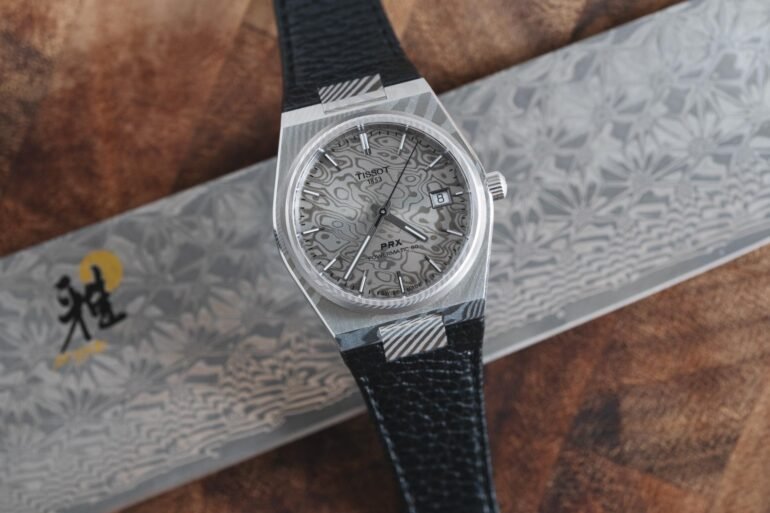
Traditional Damascus is created by taking sheets of steel in differing alloys, layering them, forging and folding them repeatedly to reach the desired number of layers, which can range from a few to thousands, and then manipulating them to create unique patterns, shaping, hardening, etc. The time, let alone skill, this takes makes mass production untenable. So, they use a modern method that fuses layers of powdered steel of different alloys using intense heat and pressure to create Damascus billets.
While Tissot doesn’t go into great detail as to what follows that step, such as if it needs any additional folding, forging, or hardening, or how the patterns are created, this initial method clearly goes a long way toward mass production. Whether a metallurgical purist would still call it Damascus or just “sparkling-layered-steel” (sorry, I knew I wanted to make that joke before starting this article) is tbd. Still, the end product, visually at least, has the same qualities. There are clearly different tones of steel interweaving throughout the case, dial, and, impressively, the buckle, creating dynamic, gorgeous, and random textures.

Zach Weiss
2025-12-11 20:00:00