
Despite the devastating effects of the Great Depression, Benrus held on as the world plunged into another devastating global conflict. Due to their movement manufacturing capabilities being located outside of the United States, Benrus was not required to refit and alter production like many other American watchmakers. This meant that the brothers were able to continue exporting their Swiss movements while manufacturing timing devices from the US plants, allowing Benrus to undergo enormous growth during the war years.
By the 1950s, Benrus had grown into the third-largest American watchmaker behind Bulova and Elgin. Following a proposal in 1952 that would place a tariff on Swiss watch movements, Benrus began eyeing the Hamilton Watch Company as a solution — Hamilton possessed domestic movement manufacturing capabilities that would bypass the tariff problem. Benrus began rapidly buying Hamilton stock, owning nearly a quarter of their competitor by 1953.
Hamilton filed an antitrust suit, and Benrus was summarily served an injunction that same year. The hostile takeover of Hamilton marked a high-water mark for the brand; as the century crossed its halfway point, Benrus’ influence gradually fell as American watchmaking faced a serious reckoning. The sixties marked a pivotal decade for more than just the brand’s future, it marked a turning point for American watchmaking as a whole. The influx of inexpensive wristwatches from Japan began to reduce Benrus’ market share even as they began to obtain lucrative US Government contracts for military watches.

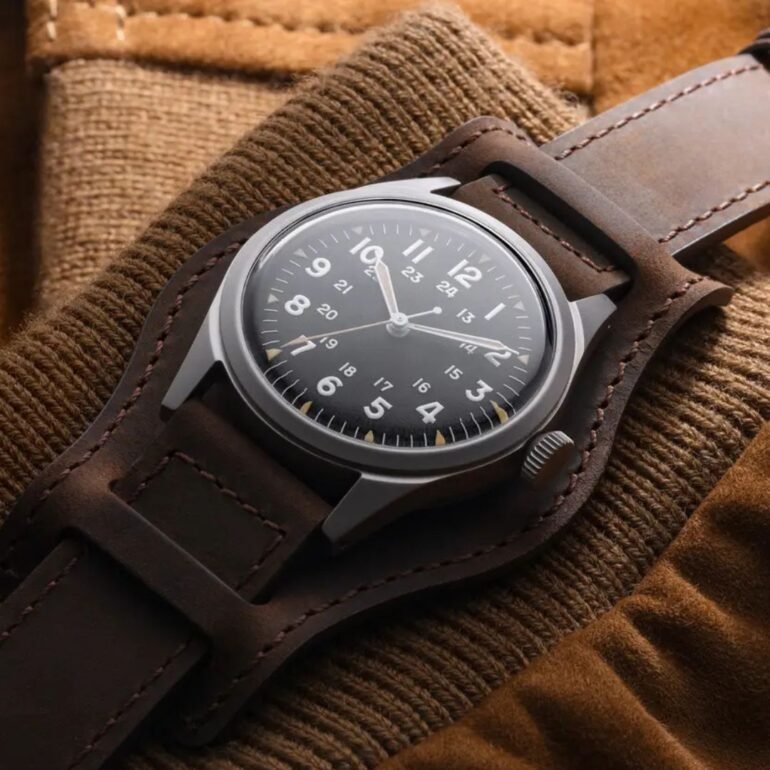
Enter the DTU-2A/P. Introduced in 1964 in response to the MIL-W-3138B specification of 1962, it became one of the primary field watches issued to the American military at a time when it would soon find itself rapidly expanding to meet conflict. A basic 34mm field watch, it would appear on the wrists of thousands of servicemen in Southeast Asia as the war in Vietnam ramped up. The DTU-2A/P is a cornerstone of the brand’s modern collection as well, including a take on the civilian variant worn by Steve McQueen in 1968’s Bullitt.
The war in Vietnam would prove to be Benrus’ lifeline during the 1960s and 1970s, providing lucrative contracts that would help keep the brand in the black. With the exit of its founders in the late 1950s, however, Benrus found itself lacking direction. By 1968, it was sold to businessman Victor Kiam, an entrepreneur best known for his later ventures with Remington Products and as an owner of the New England Patriots.
The Quartz Crisis took a sharp toll on Benrus’ fortunes. As with nearly every other American brand, the 1970s saw a steep decline in American watchmaking, closing a storied chapter in history. Kaim sold his majority stake in 1977. Benrus, having faltered for several years, declared bankruptcy in the early 1980s, and ownership of the name bounced around over the following decades.
Windup Watch Shop
2025-10-10 16:00:00