
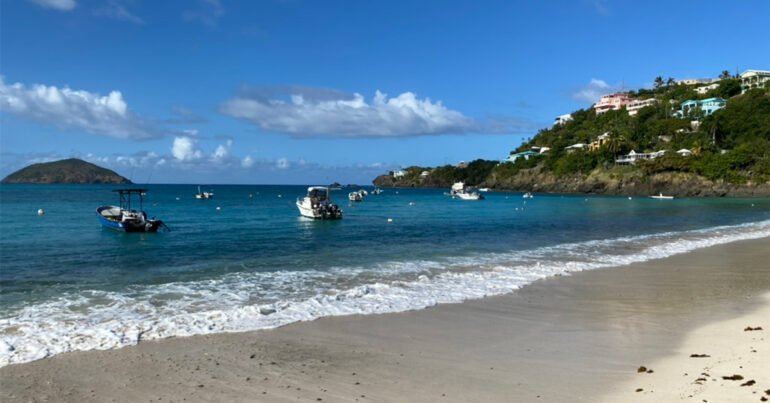
It’s quiet here. Not the quiet of an empty place, but the quiet of a neighborhood. You hear the waves first, a steady break against rock, deeper and more constant than the softer shoreline further south. There’s no line of music, no hum of beach bars competing for attention. Just water, wind, and the occasional call between people who know each other.
Hull Bay sits on the north side of St. Thomas, facing the open Atlantic. The drive alone signals the shift. The road narrows, bends tighter, and the views come in fragments through thick green hills before the bay opens all at once.
It’s not the beach you may be used to. But that’s why I like it. Even on an island with myriad magnificent beaches this one just has a cool, unique quality.
A Different Kind of Beach Day
You don’t come to Hull Bay for rows of loungers or a long list of water sports. The beach is compact, edged with rock, with sand that runs darker underfoot. Boats rest just offshore, tied close, moving with the current. People stand at the waterline watching the sets come in, reading the rhythm before stepping in.
This is one of the few places on St. Thomas where surfing is part of daily life. When the swell is right, you’ll see boards in the water from early light through late afternoon. The takeoff happens close to shore. There’s no performance, no crowd gathering to watch. It’s a local rhythm, steady and familiar.
Even when the surf is down, the water carries energy. You feel it when you step in, a pull that keeps you aware of where you are. Swimming here is possible on calmer days, but it’s never passive. The Atlantic defines the experience.
The People Who Keep It Moving
Hull Bay doesn’t cycle through visitors the way other beaches do. Many of the faces repeat. Fishermen move between boats and shore, unloading coolers or preparing lines. Surfers lean boards against trucks, checking conditions, talking through the last set. Conversations carry easily because there’s no competing noise.
You’re not stepping into a curated scene. You’re stepping into a place people use every day. That shows in the way everything is positioned. Boats are practical, not decorative. Coolers sit in the back of pickups. There’s a pace to how people move that reflects familiarity with the water.
Spend enough time here and you start to recognize the patterns. When the swell picks up, more boards appear. When it drops, the focus shifts back to fishing, to small groups gathering in the shade, to quiet stretches where the only movement is the tide.
Eating and Drinking, Hull Bay Style
There’s one place that anchors the social side of the bay: The Shack at Hull Bay. It’s close to the water, open-air, with a setup that matches everything around it—direct, unfussy, built for people who come here often.
You order at the counter, find a seat, and settle in. The menu leans into what works: fish sandwiches, burgers, simple plates that arrive quickly. Drinks are cold, poured without ceremony. There’s no rush to turn tables. People stay, talk, watch the water.
From your seat, you can see the entire bay. Boards moving in and out. Boats shifting slightly with the current. The line where the water darkens further out. The Shack doesn’t try to redefine the place. It follows it.
My suggestion? Try the Captain Rick, a very cool cocktail that includes Bush Tea.
Why It Feels So Different
Most of St. Thomas is oriented toward the Caribbean side. The water is calmer, the beaches wider, the infrastructure more built out. Hull Bay faces the Atlantic, and that single detail changes everything.
The wind is stronger here. The waves carry more force. The shoreline is tighter, shaped by rock and movement rather than long stretches of white sand. There’s less development, fewer structures between the hills and the water. What you see is closer to how the island functions beyond its busiest corridors.
You notice it in how people use the beach. There’s no transition from parking lot to resort setup. You step out, you’re already part of it. The environment sets the terms.
How to Spend Your Time Here
You don’t plan a full-day itinerary at Hull Bay in the traditional sense. You come, you stay as long as it holds your attention, and you leave when it doesn’t.
Start by walking the edge of the shoreline. The texture shifts underfoot from sand to small rock, then back again. Watch the sets come in and see how the surfers position themselves. Even if you don’t go in the water, the movement is constant enough to hold your focus.
Take a seat at The Shack and let the view do the work. Order something simple, watch how the light changes on the water. Conversations around you move in and out without pressure to join.
If the conditions are calm enough, step into the water briefly. You’ll feel the difference immediately. It’s not the kind of place where you float without thinking. You stay aware, you stay present, and that’s part of the draw.
When to Go
Hull Bay shifts with the conditions more than most beaches on the island. On days with stronger swell, the surf becomes the main event. More locals arrive, boards in hand, and the water fills with movement.
On calmer days, the bay feels even quieter. Fewer people, less activity in the water, more time to take in the setting without interruption.
Midweek visits tend to feel more local, with fewer visitors making the drive. Weekends bring a slightly fuller scene, but it never reaches the density of the island’s more well-known beaches.
Getting There
From Charlotte Amalie, the drive to Hull Bay takes about 15 minutes, but it feels longer in the best way. You leave behind the busier roads and move into tighter curves, climbing and descending through hills that frame quick views of the ocean.
The final stretch drops you directly to the bay. Parking is informal, usually along the roadside near the beach. There’s no grand entrance, no signage directing you through a planned arrival. You know you’re there when the water opens up in front of you.
Where to Stay Nearby
You won’t find large resorts at Hull Bay itself. Staying here means choosing something smaller, more residential, and letting the bay be part of your daily routine rather than a one-time stop.
In the nearby hills, villas and small guesthouses offer views that stretch across the north side of the island. You wake up to the same sound you heard on the beach—waves carrying across open water.
Closer to Magens Bay, about 10 minutes away, you’ll find more structured accommodations, including The Mafolie Hotel, where hillside rooms look out over Charlotte Amalie and the harbor. It gives you access to both sides of the island: the calm Caribbean waters and the more active Atlantic edge.
If you prefer a more traditional resort base, properties near Charlotte Amalie keep you within easy reach of Hull Bay while offering full-service amenities. The drive becomes part of the daily shift between environments.
Why You Come Back
Hull Bay doesn’t deliver a checklist of experiences. It just feels different. You remember how you feel.
You come back for the sound. For the way the water moves with more force. For the absence of layers between you and the shoreline. You come back because it shows a side of St. Thomas that isn’t arranged or adjusted.
Hull Bay stays in your memory because it feels almost like a neighborhood beach. It remains steady in its own way, shaped by the Atlantic and the people who return to it every day.
Guy Britton
2026-03-24 21:44:00