
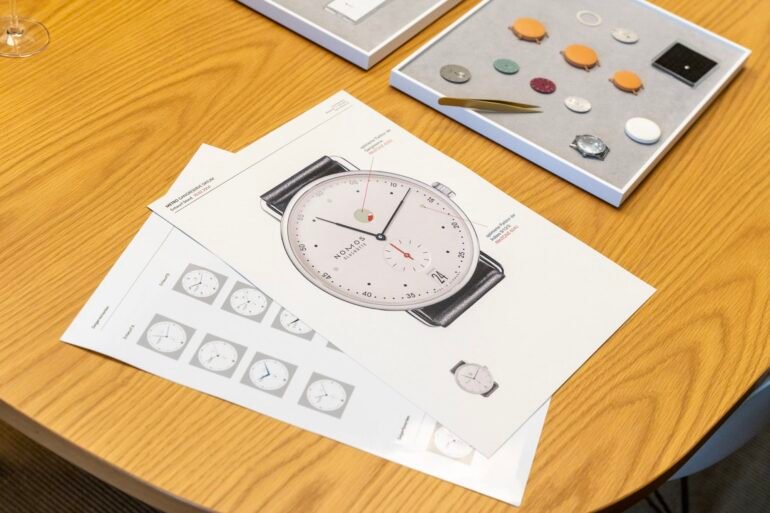
We live in a (watch) world where brand names reign supreme and terms like “in-house” carry a lot of weight. However, I find it much more interesting when a watchmaker is willing to peel back the curtain and highlight the great minds and hands that go into crafting the watches we love. Recently, Nomos gave us one of those unique opportunities to sit down with the man behind the design of one of its core collections: the Metro.
The Metro first came into the Nomos catalog back in 2014. At the time, it made waves thanks to its debut of the brand’s proprietary swing escapement system, which was developed over seven years with the Fraunhofer Institute and TU Dresden. The structure notably features a tempered blue balance spring and offers superior precision, efficiency, and compactness with a thickness of approximately 3.2mm, which perfectly lends itself to Nomos’ sleek and effortless timepieces.

While perhaps considered secondary at its initial introduction, the form of the new collection was given just as much attention as the function. In typical Nomos fashion, the caliber was housed in a modern and minimalist design echoing the tenets of German watchmaking but with a twist. This creation was the brainchild of industrial designer Mark Braun.
The project marks Braun’s first and only foray into the watch space. The artist has worked in nearly every medium under the sun from furniture to kitchenware and birdhouses to shaving kits, light fixtures, jewelry, calligraphy pens – the list goes on. “No matter what project I’m working on, the best concept comes from trust and teamwork,” clarifies Braun.

Trust was a part of the equation from the start, given Braun’s breakout role as a designer in the world of watches. The collaboration sparked when a member of the Nomos team was captivated by a glass carafe designed by Braun that was simple and clean yet with beautiful attention to detail and subtle visual interest. His work with glass in prior projects would come to play a big role in his input on the crystal design of the Metro, but more on that later.
Despite Braun being a novice at watch design, the brand trusted him so much they gave him “carte blanche,” he recalls. The designer’s ideas ran wild, and Nomos did have to bring them back down to earth. “I was really interested in exploring asymmetry on the dial,” Braun explains, “but some of my concepts just wouldn’t be possible to execute given the constraints of the movement.”

Still, both Nomos and Braun felt it was crucial to balance his “own DNA and mindset” with the “target market,” he emphasizes. The work started with the former. Part of Braun’s creative process on every project he executes is the creation of a mood board. “I’m a bit of a treasure hunter,” he confesses. “I have a passion for observing my surroundings and for collecting. When I get a new brief from a client, I go to my treasure box, which for me is a big shelf with all the things I have collected,” Braun explains. While he stressed his lack of skill in the kitchen, giving credit to his wife for her culinary abilities, he likened his artistic process to that of a chef playing with ingredients.
In balancing the design language defined by Nomos with his own, Braun explored the interplay between a clean, legible, white dial and the use of color. “I’m from Hanover,” he shares, “and the stereotype is, people from Hanover have no humor. But I love color,” Braun emphasizes, “and to me, adding in these subtle elements of color is a bit playful or perhaps humorous. You’ll notice red is a prominent accent color,” he continues, “and this came from the mood board. In my collection, I have one of those old wax stamps – the way this bit of color is used to seal a white envelope, this inspired me.”

The original Metro from 2014 featured a perfectly sized 37mm stainless steel case with wire lugs and a galvanized and silver-plated dial with a soft white color punctuated by black, red, and mint green markings. Most notable is the subtle push and pull with symmetry in the dial arrangement. The periphery of the dial contains a lot of structure, with the unique delineation of the minutes in five-increment Arabic numerals as opposed to traditional indices. Instead, the hours are defined by small circles – mint green for 12, 3, and 9 and black for the other hours along with a date window anchored at 6 o’clock. A small seconds register and the central hour and minute hands line up vertically above the date aperture. Then, the asymmetry comes in with the Nomos logo offset between 9 and 10 o’clock and a power reserve indicator floating around 1 o’clock.
The Metro has gone on to take many other forms – some ditching the asymmetry by removing the power reserve indicator and shifting the Nomos logo to 12 o’clock and others ditching the white dial for full color alongside versions in rose gold as well as special editions for select markets. However, a few characteristics remain consistent in each iteration. “It’s easy to get excited when you’re developing new versions of a design,” Braun affirms, “but it’s also crucial that there are some rules you must adhere to. “The design of the crystal is very important to me,” he stresses. “This is one element I was very particular about executing perfectly, I would not budge until we got it just right. The crystal is the lens through which we view the dial. To me, this is one of the most important parts of the design – it defines the visual experience of reading the watch.”

I have to interject – Braun really blew my mind with this passion and dare I say obsession with the crystal. I could have listened to him wax poetic about the intricacies of shaping sapphire for hours, and it completely opened my eyes to an aspect of watchmaking I had almost entirely overlooked. Once you notice the nuances, you can’t unsee them, and the sapphire of the Metro is legitimately mesmerizing. Here, the crystal is not a uniform dome. It uses a double-domed or step-down curvature where the crystal gently arcs up from the bezel before flattening out across the center, giving it a liquid-like appearance, particularly when viewed from an angle.
“For the most part, the dial itself is the playground,” Braun continues. “The only element here I would say is very particular to the Metro is the display of the hours and minutes, with the dots for the hours and numbers for the minutes. We negotiated this in one of the newer models,” he explains. “The Metro with the ring date added another layer to the periphery of the dial, so we had to consider if we would keep the hours and minute display the same. We had to be very careful not to compromise legibility and make things too cluttered, taking away from the design.”

In typical fashion, we closed our conversation teasing out what’s next. “I would love to work on a limited edition in German silver,” shares Braun. “I know this material has become polarizing in watchmaking, and there are a lot of practical constraints to consider, but I think the patina would be beautiful – I enjoy the aging process of silver. And there are still other tricks up my sleeve,” he suggests. “I have ideas for other models as well, whenever the time is right.”
For more information on the Metro, head directly over to Nomos.
Cait Bazemore
2026-03-24 20:00:00