
Something interesting is happening in the Caribbean travel market, and it’s being driven by the traveler who, until recently, was often overlooked in destination marketing: the one traveling alone.
According to the new 2026 Caribbean Travel Trends Report, released by the Caribbean Hotel and Tourism Association in partnership with Amadeus, solo travelers now represent roughly 26 percent of all tourist arrivals to the Caribbean — more than one in four visitors. And among the destinations capturing a growing share of that demand, one stands out for reasons that might surprise even seasoned regional watchers.
It’s Guyana.
The South American nation — and proud member of the Caribbean Community — saw solo travel arrivals climb 7 percent year over year compared to the previous reporting period, according to the CHTA-Amadeus data. That’s a notable figure in a year when the broader Caribbean saw overseas demand grow by just 1 percent, well below the double-digit gains of the prior two years.
In other words, Guyana isn’t just keeping pace. It’s outperforming the region in one of the fastest-growing traveler segments in the world.
And anyone who has spent time in Georgetown, paddled the Burro Burro, or stood on the edge of Kaieteur Falls will understand exactly why.
A Destination Built for the Solo Mindset
The modern solo traveler, as the CHTA-Amadeus report describes them, isn’t running from anything. They’re building something. They’re choosing trips that prioritize meaning over convention, experience over itinerary, and connection over consumption. They want destinations that feel personal, off-script, and a little bit rare.
Guyana checks every one of those boxes.
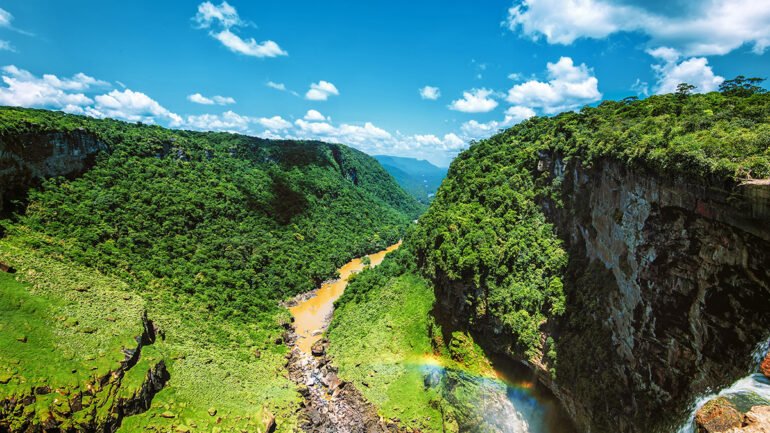
This is, after all, the least-visited country in South America. The nation welcomes only around 300,000 visitors annually — a number that wouldn’t fill a single weekend in Punta Cana — which means solo travelers who venture here often find themselves with rainforests, waterfalls, and rivers all to themselves. There’s no crowd to elbow through at Kaieteur Falls, the world’s largest single-drop waterfall. There’s no Instagram queue at Iwokrama. There’s just you, the jungle, and the kind of quiet that makes you remember why you wanted to travel in the first place.
For solo travelers, that kind of breathing room is the whole point.
Why Solo Travelers Are Choosing Guyana
The appeal goes deeper than crowds — or the lack of them.
Guyana is the only English-speaking country in South America, which immediately lowers the friction for solo visitors from North America, the U.K., and the wider Anglophone Caribbean. Georgetown, the capital, feels far more Caribbean than South American: a colorful, slightly weathered colonial city of wooden architecture, West Indian markets, rum shops, mosques, churches, and Hindu temples sitting comfortably side by side. It’s a city that rewards wandering, which is exactly what solo travelers tend to do best.
Beyond Georgetown, the country’s tourism product is almost tailor-made for the solo experience economy. Guyana’s signature offerings — small-group rainforest expeditions, indigenous-led community lodges, birding circuits, river journeys, and overnight stays in places like Surama and the Rupununi — are inherently structured for travelers who prefer arriving alone and leaving with friends.
Many of the country’s most beloved properties, including the community-owned Surama Eco-Lodge and the iconic Cara Lodge in Georgetown, are intimate, social, and built around the kind of shared meals and shared excursions that make solo travel feel like anything but lonely.
It’s the formula that’s working everywhere from Iceland to Vietnam — small destinations, big experiences, and a built-in sense of community for travelers without a built-in companion.
A Caribbean Story, Told Differently
The Guyana surge also says something important about where Caribbean tourism is going more broadly.
The 2026 CHTA-Amadeus report makes clear that the region is moving past its post-pandemic recovery phase and into something more measured, more strategic, and far more interested in higher-value, niche-driven travel. CHTA President Sanovnik Destang has called it a new chapter — one where data, diversification, and destination positioning will determine which Caribbean nations capture the next wave of growth.
Solo travel sits squarely inside that thesis. Solo travelers tend to stay longer. They tend to spend more on experiences. They tend to book direct, engage deeply with local operators, and return again, often bringing others with them the second time around. They are, in other words, exactly the kind of traveler the modern Caribbean wants more of.
And Guyana — long viewed as the region’s wild card — is suddenly looking like a leading indicator.
Caitlin Sullivan
2026-05-25 18:43:00