
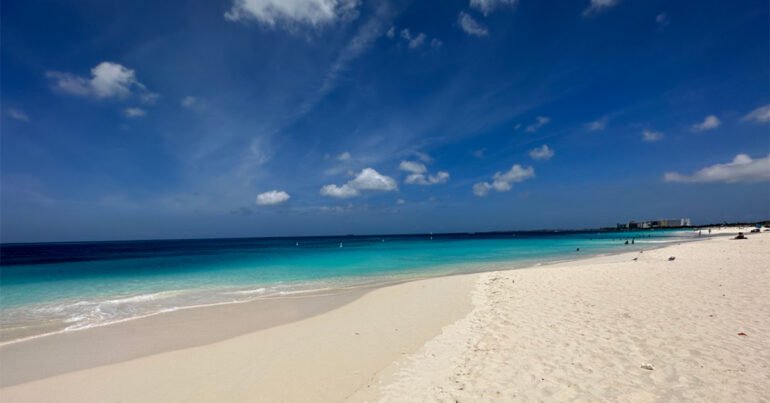
You land at Queen Beatrix International Airport, clear arrivals quickly and head northwest toward Palm Beach, where the high-rise hotels line the water from one end of the beach to the other. Ten minutes later, catamarans are pulling away from the sand, beach bars are open and the resort pools are already active before noon.
More travelers are making that trip to Aruba right now.
A new report from Amadeus and the Caribbean Hotel and Tourism Association says Aruba recorded a 10 percent increase in tourist arrivals between April 2025 and April 2026.
The figures come from Amadeus’ proprietary Arrivals and Stays platform, which tracks travel demand and visitor activity across international markets.
The newest data adds another strong year to Aruba’s tourism performance as the island continues expanding airlift, adding new hotel inventory and seeing growing demand for longer Caribbean stays.
Aruba Keeps Adding Visitors
The report measured visitor arrivals over the 12-month period ending in April 2026, with Aruba posting one of the stronger growth rates in the wider Caribbean market.
Tourism demand on the island has remained strong across several categories over the last year, including hotel occupancy, airline seat capacity and extended-stay travel.
Aruba has also continued benefiting from one of the Caribbean’s largest nonstop flight networks.
Travelers can fly directly to Aruba from major cities including New York, Boston, Miami, Atlanta, Charlotte, Chicago, Dallas, Toronto and Montreal.
That route network has helped Aruba maintain steady tourism demand throughout much of the year instead of depending almost entirely on winter traffic.
Several airlines have also added frequencies to Queen Beatrix International Airport during peak travel periods, particularly from the United States and Canada.
Palm Beach Continues Driving Aruba’s Tourism Economy
Much of Aruba’s tourism infrastructure remains concentrated along Palm Beach, where the island’s largest beachfront resorts continue attracting visitors from North America and Europe.
The corridor includes major Caribbean resort brands including The Ritz-Carlton, Aruba, The Hyatt Regency Aruba Resort Spa and Casino, The Hilton Aruba Caribbean Resort and Casino and The Marriott Aruba Resort and Stellaris Casino.
The area has remained one of the Caribbean’s busiest hotel corridors over the last several years, with continued investment in luxury resorts, restaurants, beach clubs and residential accommodations.
The opening of The St. Regis Aruba Resort added another luxury property directly on Palm Beach, bringing new suites, branded residences, oceanfront restaurants and additional spa inventory to Aruba’s tourism market.
That’s along with the recent debut of the newest addition to the Hilton called The Westerly.
Aruba’s Restaurant Scene Keeps Expanding
Aruba’s dining sector has become a larger part of the island’s tourism economy over the last several years, particularly as visitors increasingly book trips centered around restaurants as much as beaches and resorts.
In Savaneta, Zeerovers continues pulling crowds daily for fried shrimp, snapper and dockside tables directly on the water. Visitors line up before lunch for baskets of seafood served beside the fishing boats bringing in the day’s catch.
In Palm Beach, restaurants around the high-rise corridor have expanded rapidly alongside Aruba’s resort growth.
At Gianni’s Ristorante Italiano, tables fill nightly for house-made pastas and parmesan-wheel preparations served in the center of the dining room. Nearby, L.G. Smith’s Steak and Chop House inside The Renaissance Wind Creek Aruba Resort remains one of Aruba’s busiest upscale dining rooms, particularly for waterfront tables overlooking the marina.
Papiamento Restaurant, set inside a historic Aruban cunucu house, continues drawing visitors for Caribbean seafood, grilled meats and courtyard dining around the property’s central pool.
At Flying Fishbone in Savaneta, tables directly in the sand remain one of Aruba’s most requested dinner reservations, particularly at sunset when the water reaches the edge of the restaurant during high tide.
The chef’s-table segment has also become increasingly popular across Aruba’s tourism market.
At 2 Fools and a Bull, guests sit around a single communal table for a multicourse tasting menu prepared directly in front of them. Reservations often book well ahead during peak travel periods.
That’s along with spots we love like Ever in the heart of the marina.
Luxury resorts across Aruba have also continued expanding tasting-menu experiences, wine pairings and private dining concepts aimed at travelers increasingly building evenings around destination restaurants instead of traditional resort entertainment.
Eagle Beach Continues Expanding Its Appeal
South of Palm Beach, Eagle Beach remains one of Aruba’s strongest-performing resort areas.
The beach continues attracting visitors looking for lower-density accommodations, wider stretches of sand and smaller resort properties compared to the Palm Beach high-rise corridor.
Hotels including the Bucuti and Tara Beach Resort, Manchebo Beach Resort and Spa and Amsterdam Manor Beach Resort have continued benefiting from strong occupancy trends, particularly among couples and extended-stay guests.
Condominium-style accommodations have also become a larger part of Aruba’s tourism market over the last several years.
Many visitors now book longer winter stays centered around apartment hotels, beachfront condos and residential-style suites with kitchens and larger living areas.
That segment has become increasingly important across Aruba’s tourism economy, particularly during January through April.
The biggest addition? The new Embassy Suites by Hilton, our top pick for families heading to the island.
Aruba’s Airlift Advantage
The tourism growth reflected in the Amadeus data also aligns with continued airline expansion into Aruba.
Major carriers serving the island have increased frequencies from several North American gateways over the last year, particularly from Florida, the Northeast United States and Canada.
Aruba continues benefiting from a route network that stretches across both legacy airlines and low-cost carriers, giving travelers more pricing flexibility across multiple departure cities.
The island’s airport infrastructure has also remained a major advantage.
Queen Beatrix International Airport operates one of the Caribbean’s most efficient passenger processing systems, including full U.S. preclearance facilities that allow travelers to complete customs procedures before departing Aruba.
That process remains especially attractive for U.S.-bound passengers during busy winter travel periods.
Many of Aruba’s major hotel areas are within a quick drive of the airport, particularly compared to Caribbean destinations requiring longer ground transportation between airports and resort zones.
This summer, JetBlue is actually expanding its new Fort Lauderdale-Aruba service to daily, as we previously reported.
Longer Stays Continue Driving Demand
Aruba has increasingly become a destination for longer Caribbean trips.
The island’s combination of broad resort inventory, condominium accommodations, restaurant density and reliable airlift has helped support extended-stay demand, particularly among travelers from the Northeast United States and Canada.
Many visitors now spend multiple weeks on the island during winter travel periods.
That demand has helped expand Aruba’s residential accommodation market, particularly around Palm Beach, Eagle Beach and nearby condominium developments.
Remote-work travel has also remained part of the equation.
Apartment hotels, residential resorts and villa rentals with strong Wi-Fi infrastructure and full kitchens continue attracting visitors mixing work schedules with longer Caribbean stays.
Aruba’s Weather Continues Helping Tourism Growth
Aruba’s climate remains one of the island’s strongest tourism advantages.
The island receives significantly less rainfall than many Caribbean destinations and remains outside the primary Atlantic hurricane belt, helping maintain tourism demand during summer and fall months.
That weather consistency has helped Aruba sustain stronger year-round occupancy and airlift compared to destinations with more seasonal demand swings.
Several airlines now operate routes deeper into spring and summer schedules because of that steadier traffic pattern.
The result is broader year-round connectivity across more North American cities.
Hotel Investment Across Aruba Continues
Hotel development and renovation activity has also remained active across the island.
Several major resorts have completed upgrades to guestrooms, pool areas, restaurants and wellness facilities over the last two years.
Luxury-branded residential development has also accelerated, particularly in the Palm Beach corridor.
That investment continues reshaping Aruba’s tourism product beyond traditional hotel stays.
The island now has a broader mix of luxury resorts, all-inclusive options, boutique properties, villa rentals, condominium resorts and extended-stay accommodations than at almost any point in its tourism history.
What the New Tourism Numbers Mean
The report arrives during another strong period for Caribbean tourism overall, although growth rates continue varying widely between destinations.
Aruba’s 10 percent increase stands out because it follows several already strong years for the island’s tourism sector.
Many Caribbean destinations experienced major post-pandemic rebounds followed by stabilization periods. Aruba has continued generating growth while operating from already elevated visitor totals.
That continued expansion has translated into additional airline seats, expanded hotel inventory and ongoing tourism investment across multiple parts of the island.
The newest data suggests that momentum is continuing into another year.
At the same time Aruba is posting stronger tourism numbers, the island is also trying to avoid overtourism problems.
That effort has increasingly centered around the Aruba Promise, a sustainability initiative designed to push visitors toward lower-impact travel behavior while protecting the island’s beaches, reefs and desert ecosystems.
The program encourages visitors to think of themselves as guests of the island rather than simply tourists, with guidelines focused on reef-safe sunscreen, reduced water and electricity consumption, respect for wildlife areas and support for locally owned businesses beyond the resort corridors.
Aruba has also implemented broader environmental policies in recent years, including restrictions on single-use plastics and protections for sea turtle nesting areas.
The tourism strategy goes beyond environmental messaging.
Officials in Aruba have increasingly focused on balancing tourism growth with infrastructure, local quality of life and long-term sustainability instead of focusing exclusively on visitor volume. Aruba’s tourism sector has increasingly emphasized regenerative tourism and overtourism mitigation as part of its long-term planning strategy.
That includes efforts to encourage longer stays over pure volume expansion and spread tourism spending across more parts of the island instead of concentrating activity only inside the major resort corridors around Palm Beach.
The island has also increasingly emphasized eco-conscious travel, culinary tourism, wellness-focused resorts and smaller-scale experiences tied to local businesses and neighborhoods.
The conversation has become more important as Aruba continues adding visitors.
The newest tourism numbers show the island’s growth continuing. The Aruba Promise campaign reflects Aruba’s effort to keep that growth from creating the same overcrowding and infrastructure pressure now affecting several major global tourism destinations.
Karen Udler
2026-05-18 02:02:00