
Puerto Rico is heading into the summer travel season with some of the strongest tourism numbers in its history.
That’s according to a new performance update from Discover Puerto Rico, the island’s destination marketing organization, which reported a sweep of record-setting results out of the first quarter — and forward booking data that points to a robust summer ahead.
Forward booking data shows 9 to 16 percent more hotel room nights already reserved through July compared to the same window last year, with short-term rentals also maintaining healthy pace. The trends point to one of the strongest summers on record for Puerto Rico, driven by travelers seeking authentic experiences, expanding air access and the island’s growing cultural and culinary profile.
“The strength of our first-quarter results confirms that Puerto Rico continues to build extraordinary and well-diversified tourism momentum heading into summer,” said Jorge L. Pérez, chief executive officer of Discover Puerto Rico. “We are seeing how a consistent strategy centered on marketing, air connectivity, and international promotion is translating into more visitors, longer stays, and greater economic impact for communities and businesses across the island.”
The Numbers
Total lodging demand on the island increased 8 percent year-over-year in the first quarter of 2026.
Puerto Rico also closed 2025 with 7.9 million room nights sold — a 109 percent increase compared to 2019 — and lodging revenue reached $1.99 billion, the highest figure ever recorded in the destination’s history.
Tourism’s broader economic impact has tracked alongside the lodging gains. The leisure and hospitality sector reached a record 102,500 jobs in December 2025, while room tax collections surpassed $153 million, more than double 2019 levels.
It’s a meaningful set of numbers for an island that has spent much of the last decade rebuilding its tourism industry following a series of disruptive events — and the data suggests Puerto Rico has now decisively moved beyond recovery and into expansion.
International Markets Driving Growth
One of the more notable storylines out of the first-quarter results is the strength of Puerto Rico’s international markets.
Arrivals from Europe increased 17 percent year-over-year, while arrivals from South America grew 28 percent — reflecting what Discover Puerto Rico described as the success of a multi-year effort to diversify the island’s source markets beyond its traditional United States mainland base.
New international air routes have continued to strengthen connectivity with both Latin America and Europe, building out the airlift picture at Luis Muñoz Marín International Airport in San Juan, which has long been one of the most-connected airports in the Caribbean.
The Spirit Airlines Question
The international growth has come at an important moment, given the bigger air-service story shaping the Puerto Rico travel market this year.
Spirit Airlines, the second-largest carrier serving the island before its shutdown earlier this year, has exited the market — leaving what could charitably be described as a meaningful gap in domestic airlift to Puerto Rico, particularly out of Fort Lauderdale, which had been Spirit’s primary Puerto Rico gateway. The carrier had operated a steady pipeline of low-cost nonstop flights to San Juan, Aguadilla and Ponce, much of it tied to South Florida’s large Puerto Rican community and the steady flow of long-weekend and visiting-family travel between the mainland and the island.
The departure has left an open question: who fills the void?
So far, several carriers have moved aggressively to absorb the demand. JetBlue has emerged as the biggest replacement, expanding service from Fort Lauderdale to both San Juan and Aguadilla, and launching a new daily nonstop between Fort Lauderdale and Ponce on July 9 — the route Spirit had previously operated.
Frontier Airlines and Southwest Airlines have also stepped in on the Fort Lauderdale-San Juan corridor, with Frontier in particular positioned as a natural successor on the low-cost side of the market. Frontier has expanded significantly across the Caribbean in recent years, with Puerto Rico as one of its primary growth markets.
For travelers, the upshot is that all three Puerto Rico destinations formerly served by Spirit out of Fort Lauderdale now either have replacement service operating or are launching this summer — and the overall airlift picture into Puerto Rico remains strong, even as the carrier mix shifts.
Still, the loss of one of the lowest-cost players in the market has been felt, particularly in the early summer fare data, and the longer-term competitive picture out of Fort Lauderdale and other former Spirit gateways remains one of the more closely-watched storylines in Puerto Rico travel.
A New Campaign for the Summer
To capitalize on the broader tourism momentum, Discover Puerto Rico has launched a new marketing and advertising campaign — “Awaken Your Senses” — designed to spotlight the island’s multisensory appeal through its gastronomy, music, nature, culture and identity.
The campaign is targeting key source markets with the goal of increasing Puerto Rico’s consideration set among new travelers, driving travel intent and converting global interest into visits.
It’s a positioning that lines up with broader trends across the Caribbean travel market, where destinations leaning into authenticity, distinctive cultural offerings and immersive experiences have continued to outperform their more generic counterparts.
And Then There Are the Outer Islands
One of Puerto Rico’s quietest competitive advantages — and one that has gotten more accessible heading into summer — is the island’s two smaller offshore neighbors: Vieques and Culebra.
Both sit a few miles off the eastern coast of the main island, and both have spent the last few years quietly emerging as some of the most beautiful and least-developed beach destinations in the entire Caribbean.
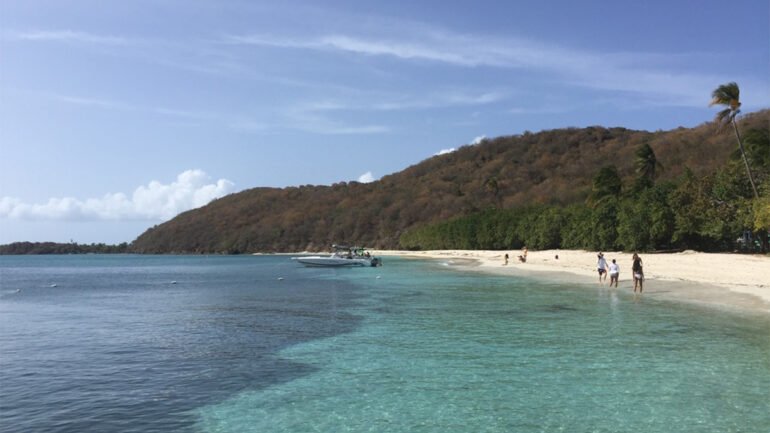
Culebra is the smaller of the two, anchored by Flamenco Beach, regularly ranked one of the best beaches in the world — a perfect crescent of powdery white sand and turquoise water that remains, against all odds, largely undeveloped. Zoni Beach on the eastern end is the local favorite, even quieter and often empty. Tamarindo Beach is the snorkeling spot, with sea turtles practically guaranteed.
Vieques is the larger, more layered of the two. The island is home to one of the brightest bioluminescent bays in the world — Mosquito Bay — where the water lights up neon blue with every paddle stroke at night. It’s also home to the Vieques National Wildlife Refuge, which protects nearly half the island and includes some of the most stunning, undeveloped beaches in the Caribbean — Playa Caracas, Playa La Chiva and Playa Pata Prieta among them. Wild horses roam freely across the island. The W Retreat & Spa Vieques site (currently being redeveloped) and the boutique Hix Island House are among the standout places to stay.
The reason both islands matter more right now is airlift. Cape Air operates the lifeline service between Luis Muñoz Marín International Airport in San Juan, Vieques and Culebra, with multiple daily nonstop flights on small turboprop aircraft. The flights run roughly 30 minutes and connect directly to most major mainland arrivals at San Juan, making it possible for travelers to land in Puerto Rico and be on a beach in Vieques or Culebra within a few hours of arrival.
Cape Air also operates service from Ceiba on the main island’s east coast — a shorter, often cheaper option — and ferries continue to run from Ceiba as well, though the Cape Air flights remain the most reliable way to reach the outer islands on a same-day connection.
For travelers heading to Puerto Rico this summer who want to pair a couple of nights in San Juan with a few days on a more remote stretch of beach, Vieques and Culebra offer some of the most rewarding side trips in the Caribbean — and the Cape Air airlift continues to make them easier to reach than most other comparable Caribbean outer islands.
Hotels We Like Right Now
The hotel side of the Puerto Rico equation has gotten stronger and more diversified in recent years, with a deepening lineup across categories. Two properties stand out heading into the summer.
OLV Fifty Five is the call for couples. The 55-room adults-only boutique hotel sits on the western edge of Condado, a few steps from the beach in one of the most-walkable neighborhoods in San Juan. The property leans intimate and design-forward, with a clean, modern aesthetic and a rooftop pool that has quietly become one of the more sought-after sunset spots in the city. It’s the kind of property that pairs well with the broader Condado restaurant scene — and one of the strongest small-format hotels in Puerto Rico for a romantic getaway.
Caribe Hilton is the move for families. The historic resort — famous as the birthplace of the piña colada — sits on a private peninsula at the entrance to Old San Juan, with multiple pools (including a kids’ pool with a waterslide), a private beach, an oceanfront water sports center and a deep roster of on-property restaurants. It’s also one of the most family-friendly hotels in the Caribbean Hilton portfolio, with a kids’ club, family-sized suites and easy walking access to both Condado and Old San Juan. For travelers traveling with kids who want a full-service resort experience without leaving the San Juan metro area, it’s one of the best choices on the island.
Beyond those two, the broader Puerto Rico hotel lineup runs deep, with The St. Regis Bahia Beach Resort, The Ritz-Carlton, San Juan, Dorado Beach, a Ritz-Carlton Reserve, Condado Vanderbilt, El San Juan Hotel and Hotel El Convento all giving travelers serious range across price points and styles.
The Broader Picture
Puerto Rico has quietly emerged as one of the strongest-performing destinations in the wider Caribbean over the last several years, with record visitor numbers, expanding airlift and a hotel pipeline that has continued to grow. From the boutique hotels of Old San Juan to the beachfront resorts of Dorado and the eco-lodges of Vieques and Rincón, the destination has been building a more diversified hospitality product, and the booking data suggests travelers are responding.
The island’s culinary scene has also continued to gain national recognition, with a wave of acclaimed restaurants in San Juan, Santurce and beyond — alongside a small but growing collection of restaurants outside the capital that have helped reposition Puerto Rico as one of the more compelling food destinations in the Caribbean.
“We remain cautiously optimistic,” Pérez said. “We recognize that external factors, including geopolitical developments and global economic conditions, can influence the industry. Nevertheless, Puerto Rico has a strong foundation on which to continue building tourism growth, supported by increased global visibility and a truly unique cultural offering.”
Discover Puerto Rico has also emphasized the importance of continuing to elevate the visitor experience so that every traveler becomes an ambassador for the destination through recommendations and repeat visits — a priority that has become increasingly central to how the destination is approaching its long-term tourism strategy.
What’s Next
The summer ahead will be a key test for Puerto Rico.
The forward-booking data is strong. The international growth markets are tracking ahead of expectations. The hotel pipeline continues to deepen. And the destination has weathered the Spirit Airlines departure with a relatively quick capacity backfill from multiple carriers, even if the longer-term low-cost competitive picture is still settling.
If the trend lines hold through the summer, Puerto Rico could be looking at one of the strongest full-year tourism performances in its history — and a meaningful confirmation that the multi-year strategy around marketing, airlift and international diversification is working.
For now, the picture heading into June is straightforward: historic results, healthy demand and one of the most-booked summers in the destination’s recent history.
Fares to Puerto Rico
Getting to Puerto Rico is still a far more affordable proposition than many competing destinations — to be fair, the island has built its tourism back on cheap airfare. And that’s really still the case. For example, a roundtrip from Miami to San Juan will run you about $247 on Frontier Airlines, based on what we found on Google Flights. That’s far less than just about anywhere else.
Karen Udler
2026-05-26 02:02:00