
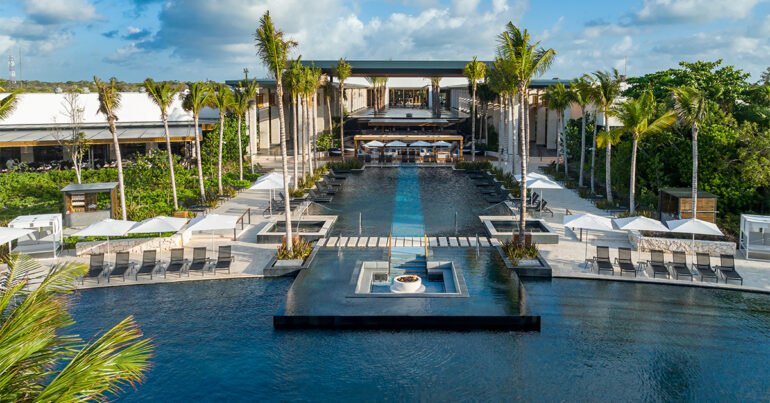
You reach Conrad Tulum Riviera Maya through dense jungle. Stone walls, palms, long stretches of vegetation. The Caribbean doesn’t arrive all at once. You hear it first. Then catch flashes of blue between buildings. Then the full sea opens beyond the pools and pale stone terraces.
The architecture earns the slow reveal. Buildings stay low against the coastline. Pathways cut through tropical landscaping. Water reflects off smooth surfaces, and open-air corridors frame the ocean at different angles as you move between restaurants, guest rooms, and the central gathering spaces.
That has been the visual identity of the resort since it opened south of Cancun along the Riviera Maya: modern luxury rooted in texture, natural materials, and long indoor-outdoor transitions that keep the Caribbean visible from nearly every part of the property.
Now the resort is making a significant change, one targeted at the biggest trend in travel right now: all-inclusive resorts.
Conrad Tulum Riviera Maya has officially introduced a new all-inclusive package, bringing a different version of the model to one of the most design-conscious luxury resorts in Mexico.
The timing matters. Across Caribbean and Mexican luxury hospitality, travelers want the simplicity of an all-inclusive stay while still expecting elevated dining, strong design, premium beverages, wellness programming, and individualized service.
At Conrad Tulum, the approach looks nothing like the all-inclusive resorts most travelers picture. No sprawling buffet halls. No oversized activity schedule. No high-volume entertainment pacing the day.
What you get instead: restaurant-driven dining, architectural calm, curated experiences, and the kind of environment you’d expect at a luxury a la carte property — with the convenience of an all-inclusive built quietly underneath.
A different read on the Riviera Maya
Tulum has changed dramatically over the last decade.
What was once a smaller beach destination defined by boutique hotels and yoga retreats has become one of the most recognizable luxury travel markets in the Caribbean basin. International hotel brands arrived alongside independent properties. Wellness tourism took off. Design became central to the destination’s identity.
Architecture here functions almost like branding. Concrete walls, warm woods, limestone textures, filtered light, reflecting pools, and open-air circulation define many of the area’s best-known hotels. Travelers come expecting a strong visual point of view as much as beaches or nightlife.
Conrad Tulum Riviera Maya was built directly into that environment.
The resort stretches across a large beachfront footprint where jungle vegetation remains deeply integrated into the design. Walkways curve through landscaping rather than cutting straight across the property. Water appears constantly — ornamental pools, beachfront swimming areas, long reflecting surfaces beside restaurants and gathering spaces.
The architecture keeps hard lines restrained. Stone, wood, woven textures, and neutral palettes carry the visual weight. You rarely lose sight of nature while moving through the resort, and even the larger public areas feel separated because of how the buildings sit between trees, water, and open-air corridors.
That atmosphere matters now that the property is moving into the all-inclusive category.
The biggest challenge facing luxury all-inclusive resorts today is preserving calm and individuality while delivering unlimited food, beverages, activities, and service. Conrad Tulum is trying to solve that through design, spacing, and programming rather than volume.
The restaurants are doing the heavy lifting
The dining program sits at the center of the new package, which immediately separates Conrad Tulum from traditional all-inclusive resorts where restaurants tend to function as secondary amenities surrounding the beach and pool.
Here, the restaurants are a primary reason travelers book in the first place.
Autor, the property’s Michelin Guide-recognized concept, runs a tasting-menu format built around regional ingredients and contemporary presentation. The dining room keeps the same restrained aesthetic as the rest of the resort — soft lighting, natural textures, a deliberate quiet across the evening. Courses arrive individually over a slow dinner built around cocktails and conversation. The cocktails lean into fresh herbs, tropical fruit, mezcal, and regional spirits. The room feels closer to an independent destination restaurant than a hotel outlet.
At Maratea, Mediterranean influences drive the menu — seafood, house-made pasta, olive oil-forward dishes, open views toward the water. Lunch turns into dinner here without a hard break. By late afternoon, tables fill with travelers returning from the beach, and cocktails start appearing beside seafood towers, grilled octopus, crudo, and chilled wine. The open design keeps the Caribbean in the frame throughout the meal.
At Ukai, Japanese techniques shape the menu — sushi, robata grilling, smaller-format dishes served in a darker, more intimate room.
Kengai adds another layer, combining Japanese influences with broader Asian flavors in a space built around shadow, texture, and lower lighting.
The important detail: these restaurants weren’t built for an all-inclusive operation. They already existed as destination dining concepts within the resort. The new package simply folds them into a more comprehensive stay structure.
That changes how the trip feels. Instead of deciding whether a high-end dinner is “worth” an additional spend each night, you move freely between restaurants across the week.
A luxury resort that happens to be all-inclusive
That distinction may define where the luxury all-inclusive category heads next.
For a long time, travelers separated luxury resorts and all-inclusive resorts into different types of vacations entirely. One implied flexibility, independent dining, and individualized experiences. The other implied convenience, simplicity, and operational efficiency.
Those categories have started overlapping. Travelers who once dismissed all-inclusive resorts began reconsidering the model as luxury brands improved restaurant quality, beverage programs, room design, and wellness offerings. Rising travel costs pushed more guests toward pricing structures that eliminate constant decision-making during a trip.
Conrad Tulum’s new package fits into that shift.
The property still functions visually and operationally like a luxury Conrad resort. The lobby stays quiet and open. Guest rooms still prioritize natural materials and oversized terraces. Restaurants still operate with individual identities rather than interchangeable menus.
The difference is that you can now experience the entire property through a single package — restaurants, wellness programming, bars, beach, and activities running as one continuous stay rather than separate decisions across the trip.
That includes unlimited dining and beverages across participating restaurants and bars, 24-hour in-room dining, a stocked minibar, wellness programming, watersports, family activities, and live entertainment.
The resort isn’t asking you to compromise the environment for convenience. It’s trying to merge the two.
Rooms designed around light
The guest rooms follow the same architectural language as the rest of the property. Large wood doors, textured stone, soft neutral palettes, open transitions between indoor and outdoor space.
Floor-to-ceiling glass is the constant. Natural light moves through the rooms all day, especially in ocean-facing categories where terraces open directly toward the Caribbean. Furniture stays low and restrained — woven textures, warm woods, pale fabrics, large bathrooms finished in stone with oversized soaking tubs. Many rooms include plunge pools or outdoor soaking areas built into private terraces.
Higher-category suites expand that continuity. Separate living areas, larger terraces, wider ocean views. The rhythm gets more residential while the visual restraint stays the same. Nothing is overloaded with decorative detail. Proportion, texture, and light do the work.
Pools that change character through the day
Water shapes nearly every movement through the property. Pools appear in different forms and scales rather than centering everything on one main feature.
Some areas stay active through the afternoon — music, cocktails, groups gathered beside the water. Others stay quieter, positioned deeper inside the property where the sound of the ocean carries louder than conversation. You move between environments depending on the hour rather than orbiting one social hub.
Early in the morning, the pool areas sit nearly silent except for the sound of palms shifting in the breeze and staff setting up loungers. Midday picks up around cocktails, lunch, and beach service. The energy softens again toward sunset as guests start moving toward dinner.
Wellness over entertainment
Another major piece of the new all-inclusive package is wellness programming, which reflects where luxury travel in Tulum and the Riviera Maya has been heading for years.
At Conrad Tulum, wellness shows up across the property rather than living inside a single spa building. Programming includes yoga, meditation, fitness classes, wellness experiences, and outdoor activities built around the surrounding environment.
The spa follows the resort’s larger architectural approach — soft lighting, natural materials, water features throughout the treatment areas, quiet open corridors. The experience leans into calm transitions rather than visual excess.
Even the fitness facilities hold the same design line. Large windows bring in natural light. Equipment spacing is generous. Outdoor vegetation stays visible from nearly every angle.
That matters more inside an all-inclusive framework. Luxury travelers want wellness integrated into the environment, not packaged as a separate upsell. Conrad Tulum’s program is built around that expectation.
The beach remains the anchor
For all the emphasis on architecture and dining, the beach is still the property’s anchor. The Caribbean carries the bright turquoise tones travelers associate with this stretch of Mexico, shifting between lighter and deeper blues across the day.
The shoreline stretches wide in front of the resort. Loungers and shaded areas are integrated into the landscape rather than packed tightly together. Palms break up the seating visually.
You move easily between sand, pools, restaurants, and rooms because of how the pathways connect. Nothing feels isolated. You leave breakfast and reach the beach within minutes. You come up from the water and walk straight into shaded lounges or pool terraces. Dinner reservations don’t require a hike across the property. At night, the sound of the water carries into the outdoor spaces.
Why luxury brands are reconsidering all-inclusive
Conrad Tulum Riviera Maya is far from the only luxury property rethinking the all-inclusive model. Across the Caribbean, Mexico, and Central America, major hotel brands have started recognizing that traveler expectations around value and convenience have shifted.
Luxury travelers still want exceptional restaurants, premium cocktails, wellness programming, and well-designed accommodations. They just don’t want constant transactional decisions shaping the trip.
The traditional all-inclusive category solved part of that equation years ago. What luxury travelers resisted was the operational feel that often came with it — repetitive dining, crowded buffets, weaker beverage programs, entertainment-heavy atmospheres. Brands are now trying to separate the convenience from those older associations.
Conrad Tulum’s rollout is one of the clearest examples yet. The property already had strong luxury credentials before introducing the package. The architecture, restaurant program, and position within the Tulum market were already established. The all-inclusive structure broadens how guests can experience the resort without rebuilding what it is.
The family equation has shifted too
The new package also changes how the property reads for families.
Luxury family travel has gotten simpler in what it wants. Parents want high-quality food, strong service, children’s programming, and flexible scheduling without constant logistical coordination across the trip.
Conrad Tulum addresses much of that directly. Family-friendly programming now runs alongside the higher-end dining and wellness offerings, which means multi-generational groups can use the property differently at the same time. One part of the family heads to the beach for the afternoon while others move between spa treatments, cocktails, restaurants, or fitness sessions.
The resort’s footprint lets those experiences happen simultaneously without forcing everyone into the same environment.
A stronger competitive position in Tulum
Tulum remains one of the most competitive luxury hotel markets in the Caribbean basin. Boutique properties, wellness resorts, beach clubs, and global hotel brands keep opening across the region. Differentiation comes down to clarity — a strong visual identity, recognizable food and beverage programming, and a distinct atmosphere travelers immediately understand.
Conrad Tulum already had most of that. The architecture, beach position, restaurant lineup, and connection to Hilton’s luxury portfolio gave the property visibility from the start.
The all-inclusive package adds another layer. The resort can now compete across multiple luxury travel categories at once: design hotel, beach resort, wellness destination, luxury family resort, and luxury all-inclusive.
That flexibility matters as booking patterns keep evolving. Some guests still prefer a traditional room-only structure. Others want a fully integrated vacation where dining, beverages, wellness, and activities are already built in. Conrad Tulum now accommodates both.
Getting to Tulum is easier than it used to be
The travel equation into Tulum keeps improving. Most travelers still reach the region through Cancun International Airport, the primary gateway for much of the Riviera Maya. The opening of Tulum International Airport added another entry point closer to the destination, cutting transfer times for travelers arriving from the United States and Canada.
That connectivity has pushed luxury development deeper into the region. What once felt relatively isolated now functions as one of the Caribbean basin’s major international tourism corridors.
Conrad Tulum benefits directly. The resort delivers the visual atmosphere and beachfront environment travelers associate with Tulum while sitting inside the infrastructure and service expectations of a major luxury brand.
With the new all-inclusive package, the property is also moving into one of the fastest-growing segments in luxury travel. The category itself is changing — and at Conrad Tulum Riviera Maya, the transition is happening through architecture, restaurants, wellness, and atmosphere first, with the all-inclusive structure built quietly underneath rather than dominating the experience.
Karen Udler
2026-05-23 02:02:00