
Along beaches in destinations like the Mexican Caribbean, the scene has become increasingly familiar: thick bands of brown seaweed piled along the shoreline, the air carrying a sharp, sulfur scent, tractors moving early to clear what arrived overnight. The blooms stretch for miles in some places, disrupting beach days, affecting marine ecosystems, and forcing governments and hotels into costly, constant cleanup.
This is sargassum, and across the Caribbean, it has become one of the region’s most persistent environmental and tourism challenges.
Now, researchers are asking a different question: what if this problem could become part of the solution?
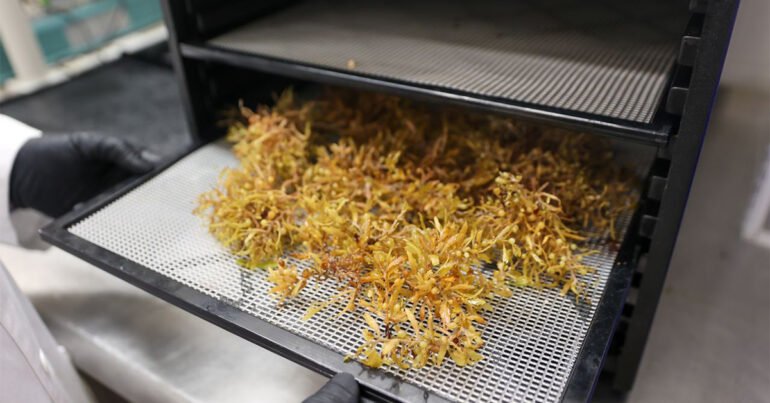
A new study involving scientists at Florida International University, working alongside teams from Florida State University and Florida Atlantic University, is exploring how sargassum could be transformed into a valuable ingredient used in everyday food products. The findings, published in Food Hydrocolloids, point to a future where the seaweed washing up across Caribbean shores could move from waste to resource.
The Caribbean’s Growing Sargassum Challenge
Sargassum is a naturally occurring brown algae that forms large floating mats in the Atlantic Ocean. In recent years, those blooms have grown in size and frequency, driven by a mix of warming ocean temperatures and nutrient changes. The result has been record-breaking influxes across the Caribbean basin.
On the ground, the impact is immediate. Hotels deploy crews before sunrise to clear beaches. Local governments invest millions in removal. In destinations heavily dependent on tourism, even a few days of heavy sargassum can affect visitor experience.
Beyond tourism, the buildup can harm marine life, block sunlight in coastal waters, and release gases as it decomposes.
The default response has been straightforward: remove it as quickly as possible.
Researchers at FIU are proposing a different approach.
Turning Seaweed Into Something You Eat
Instead of treating sargassum strictly as waste, the research team has been studying what’s inside it — and what could be extracted.
One of the key findings centers on alginate, a natural compound found in seaweed that is already widely used in the global food industry. Alginate acts as a stabilizer and thickener, helping give products like ice cream, sauces, and dairy alternatives their texture and consistency.
The study found that sargassum contains significant amounts of alginate, with extraction yields of around 45 percent — a level that positions it as a viable alternative to traditionally harvested seaweed sources.
That matters because alginate is already a critical ingredient in food manufacturing worldwide. Finding a new, abundant source — especially one currently treated as waste — could reshape part of the supply chain.
From Beach Nuisance to Supply Chain Input
The idea is simple in concept: take a material that is already arriving in massive quantities across Caribbean coastlines and convert it into something usable.
But turning sargassum into a food ingredient requires solving several challenges.
The seaweed is not currently classified as a food source, and it can carry contaminants, including bacteria and heavy metals. That means processing is essential before it can be used safely.
Researchers are now studying methods to address that.
One of the techniques being tested is high-pressure processing, a method already used in the food industry. Instead of using heat, which can alter or damage compounds, the process applies extremely high pressure to eliminate harmful microorganisms while preserving the useful elements like alginate.
It’s an early-stage effort, but one that aligns with existing food production technologies.
What This Could Mean for the Caribbean
For the Caribbean, the implications go beyond food science.
Sargassum has become a recurring cost center for many islands, with millions spent annually on removal, transport, and disposal. In some cases, it has also affected bookings, particularly in peak travel seasons.
If even a portion of that seaweed could be redirected into a usable product, it could begin to offset those costs.
There’s also the potential for new local industries. Processing facilities, collection systems, and export pipelines could emerge in regions that are already dealing with the highest volumes of sargassum.
The research is still in its early stages, and consumer-ready products are not yet on the market. Further testing, refinement, and regulatory approvals will all be required before sargassum-derived ingredients appear on store shelves.
But the foundation is being built.
A Different Way of Looking at the Problem
The shift here is less about a single product and more about perspective.
For years, the conversation around sargassum in the Caribbean has focused on removal — how fast it can be cleared, how much it costs, and how to manage its impact on tourism.
This research reframes that conversation.
Instead of asking how to get rid of it, scientists are exploring how to use it.
And in a region where sargassum arrivals are no longer occasional but expected, that shift could become increasingly important.
If the work continues to progress, the same seaweed lining Caribbean beaches today could eventually be part of global food production — from the texture of your ice cream to the consistency of your sauces.
What arrives as a coastal disruption could end up as a new kind of resource.
Caribbean Journal Staff
2026-05-05 18:31:00