
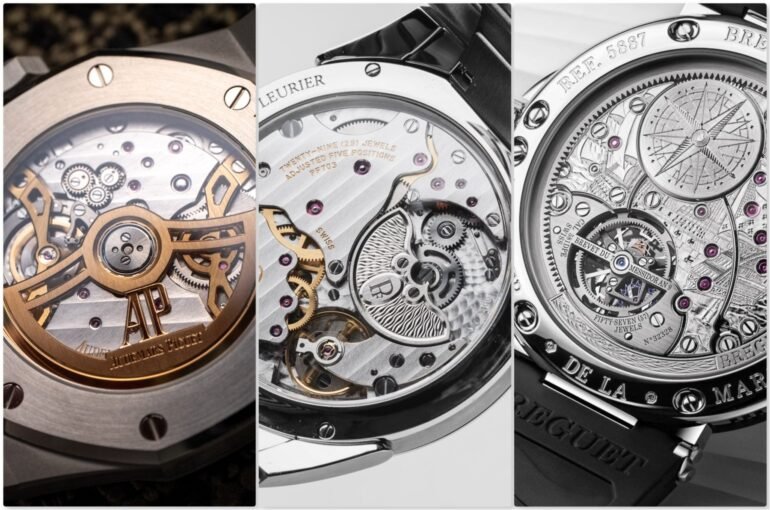
Is there such a thing as a best rotor? A pragmatic watchmaker might say a heavy central one that winds the mainspring the most efficiently is the best. A collector of traditional watches with similar movements might say that nothing beats a solid micro-rotor. And I know people with a deep fondness for technical watchmaking who lust after peripheral rotors. Now tell me, how do you like your rotor — central, micro, or peripheral? If you do, I will tell you which system I prefer. It might be a system I haven’t mentioned yet.
Before looking at different rotor types, let’s first quickly explain how the automatic movement came about and how it became the most common mechanical watch movement out there. In case you want to go back to the basics and fully understand how automatic watches work, please check out Brandon’s in-depth article on the matter first.
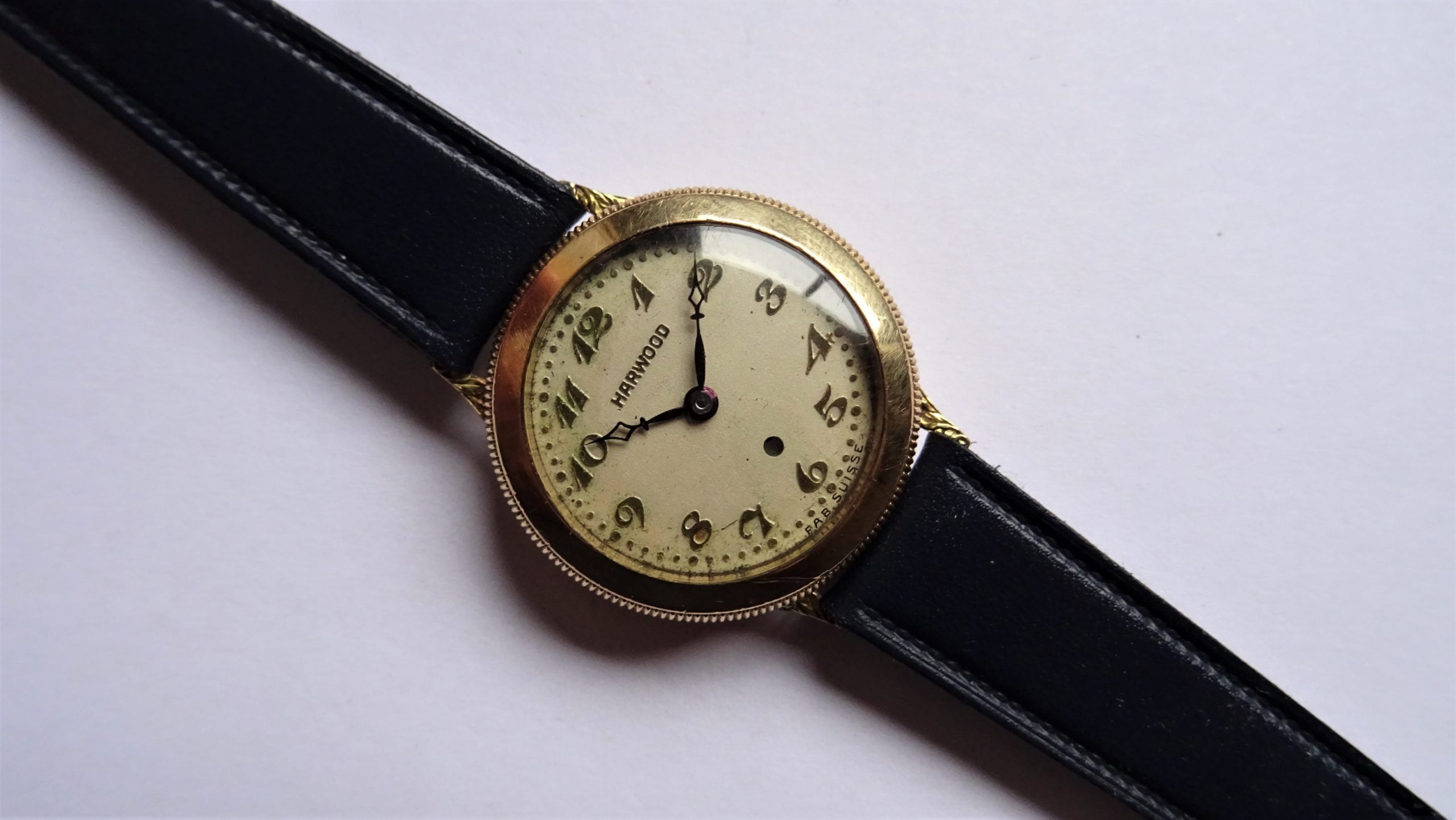
18K gold Harwood watch from the 1920s with an automatic bumper movement — Image: VFL Watches
How do you like your rotor? John Harwood liked it “bumper” style
As you are (now) very well aware, automatic watch movements use a system that winds the mainspring as the wearer’s wrist moves. While the exact origin is difficult to pinpoint, the concept dates back to the 18th century, with watchmakers such as Abraham-Louis Perrelet and Joseph Gallmayr having contributed to its early development. Mind you, that was the time of the pocket watch; the wristwatch was still nowhere to be seen. And it is in an almost-always-moving wristwatch that an automatic winding system really shines.
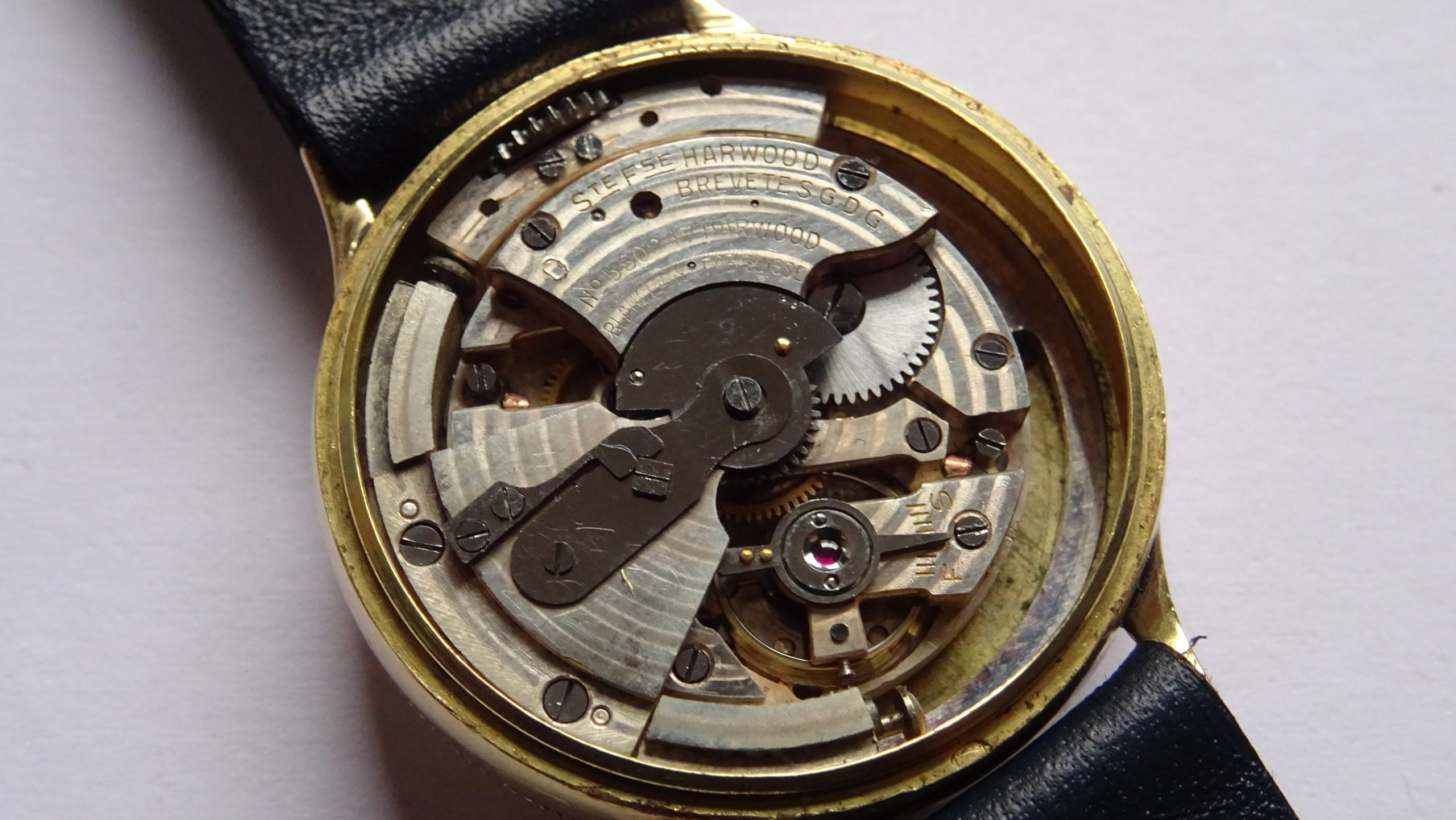
Bumper movement inside a 1920s Harwood watch — Image: VFL Watches
The first automatic wristwatch movement is credited to John Harwood in 1923–1924. His design used a “bumper” system, in which the rotor swung only 180º and was halted by springs on either side. Though less efficient than the 360º rotors you see nowadays, it marked a breakthrough. Harwood’s innovation also eliminated the need for a traditional crown, and in 1926, Swiss watchmaker Fortis introduced a crownless winding system.
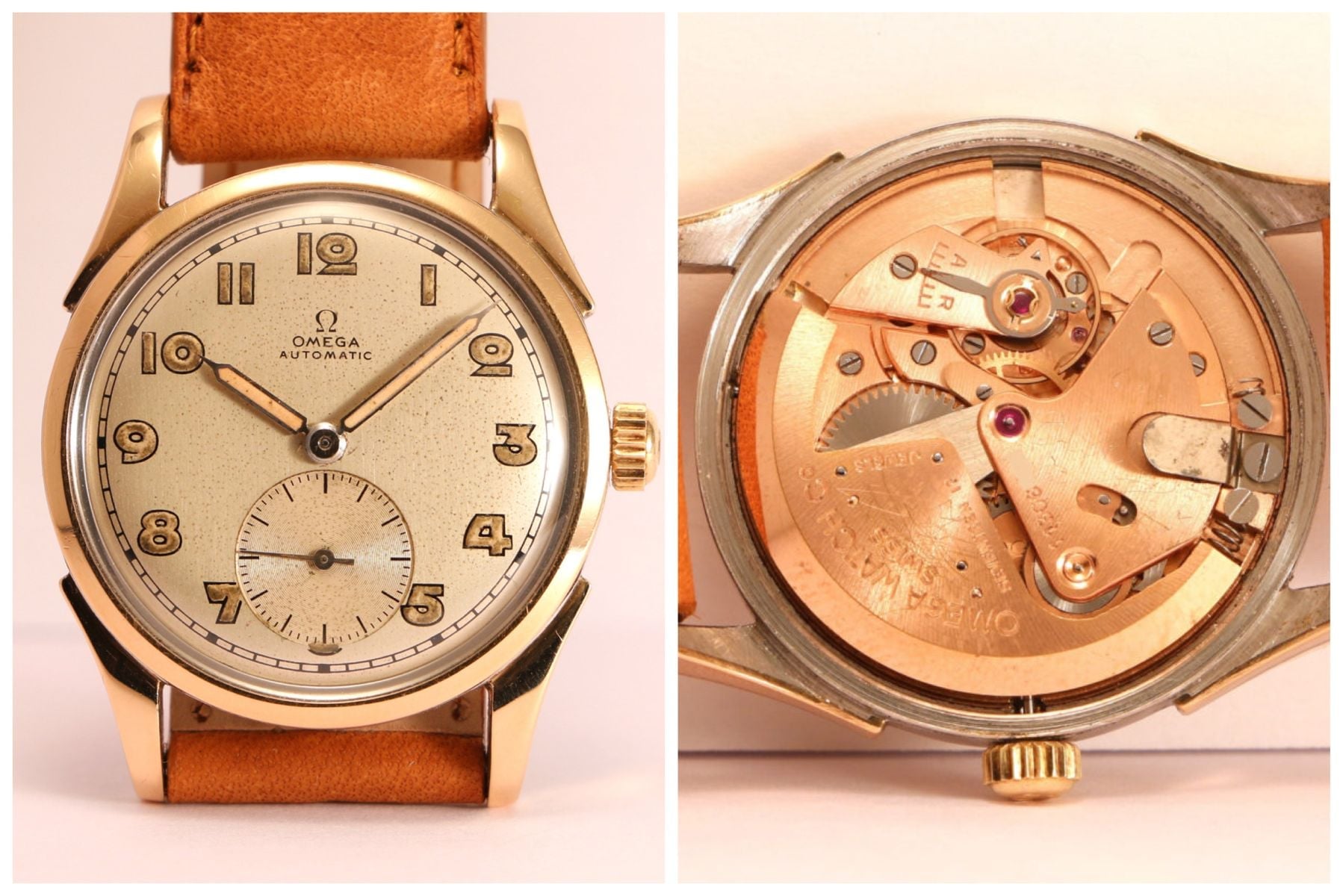
Omega 2478 bumper movement — Image: Brussels Vintage Watches
The watch industry recognized the potential in Harwood’s design, and several brands started producing bumper automatics. Perhaps the most famous of these brands is Omega. From the late 1930s through the 1950s, the company produced a variety of bumper calibers, like the 2478 movement. They were hugely successful and remain beloved by vintage collectors to this day.

Alpina Startimer Pilot Heritage Manufacture

Caliber AL-709 is a modern bumper movement
Modern bumpers
Alpina also has a history with bumper movements, and in 2021, the brand launched the Startimer Pilot Heritage Manufacture. The watch came with a modern AL-709 bumper caliber. It was an improved movement because, while the weights in vintage ones often run through a 120° arc, the AL-709’s weight swings 330º, leading to more efficient winding action. Also, the springs at either end of the arc were ditched in favor of a sprung and pivoted stop. It still produced a distinct ticking sound that fans of the bumper system appreciate so much. Alpina produced 188 pieces of this 42mm cushion-shaped watch in regular 316L steel, and there were also 188 gold-plated models available. Both versions cost just under €3k.
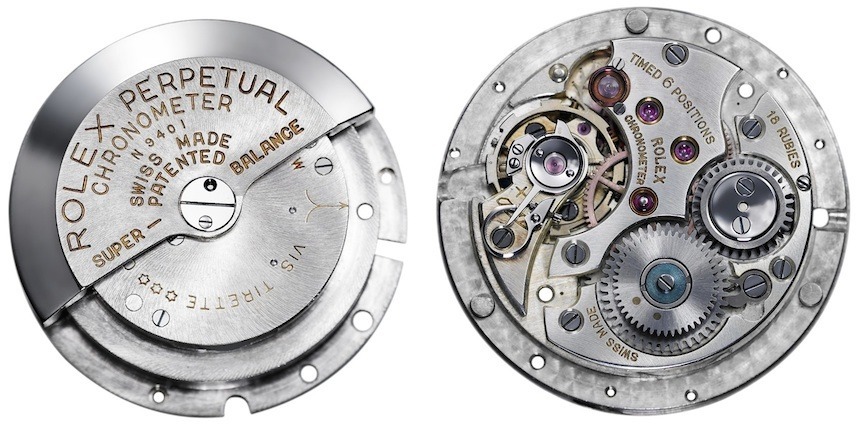
Rolex Perpetual movement from 1931
Rolex swings in
In 1931, Rolex refined the automatic movement with its Perpetual rotor, a full 360º winding system that set the standard for modern designs. Paired with the water- and dust-resistant Rolex Oyster case introduced in 1926, the Oyster Perpetual marked the beginning of modern automatic wristwatches. A centrally mounted 360º rotor is the most efficient and cost-effective mechanism to wind a mainspring, and that’s why it has become the foundation of most automatic watches.

Rolex 1908

The automatic caliber 7140 inside the Rolex 1908
You will see these movements of this type from ETA, Sellita, Miyota, Seiko, and La Joux-Perret in a majority of mechanical watches. A movement with a central rotor has become the industry’s standard, from entry-level brands to high-end manufacturers.

Audemars Piguet Royal Oak Perpetual Calendar

Caliber 7138 inside the Audemars Piguet Royal Oak Perpetual Calendar
Unfortunately, traditional rotors typically cover about half the movement. If your watch has a transparent case back and you’re interested in the inner workings of the movement, that rotating mass gets in the way. Decorating the rotor doesn’t change a thing; only skeletonizing it does somewhat. If you can’t live with just a peek at the movement and want to see it all, you have two options — a watch with a micro-rotor or a peripheral winding weight. Let’s look at the micro-rotor first.
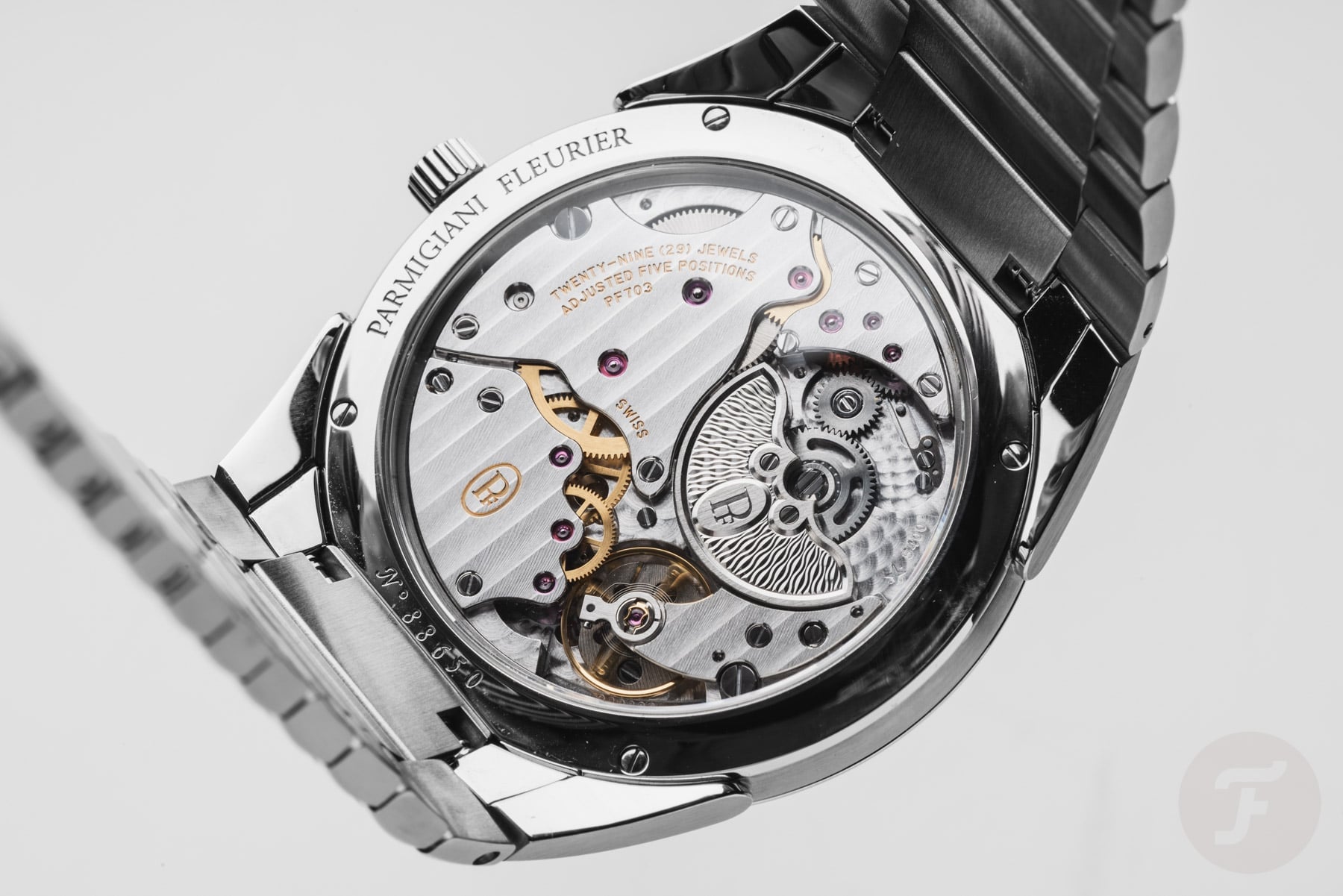
The Parmigiani Fleurier Tonda PF Micro-Rotor No Date showing its caliber PF703
Small and heavy
Micro-rotor movements show it all. Instead of having an oscillating mass swinging above the movement, a small rotor is embedded inside it. As you might expect, creating a micro-rotor movement is more expensive than its conventional counterparts, as they are significantly more complex to design and manufacture. The biggest challenge is achieving a winding efficiency comparable to that of a full-sized rotor. A much smaller, off-center mass is not as efficient as a large, central swinging rotor. Due to the reduced mass and distance from the pivot point, they struggle to create enough force to overcome the mainspring’s torque, even at partial capacity.

Parmigiani Fleurier Tonda PF Micro-Rotor No Date

Caliber PF703
Micro-rotors are also more delicate, and their construction is far more complex. Still, during the 1950s, both Universal Genève and Büren Watch Company independently developed micro-rotor technology. Why? Because they could, I guess, and because a micro-rotor allows for a slimmer movement, although the first iterations were not thinner than their central-rotor counterparts.
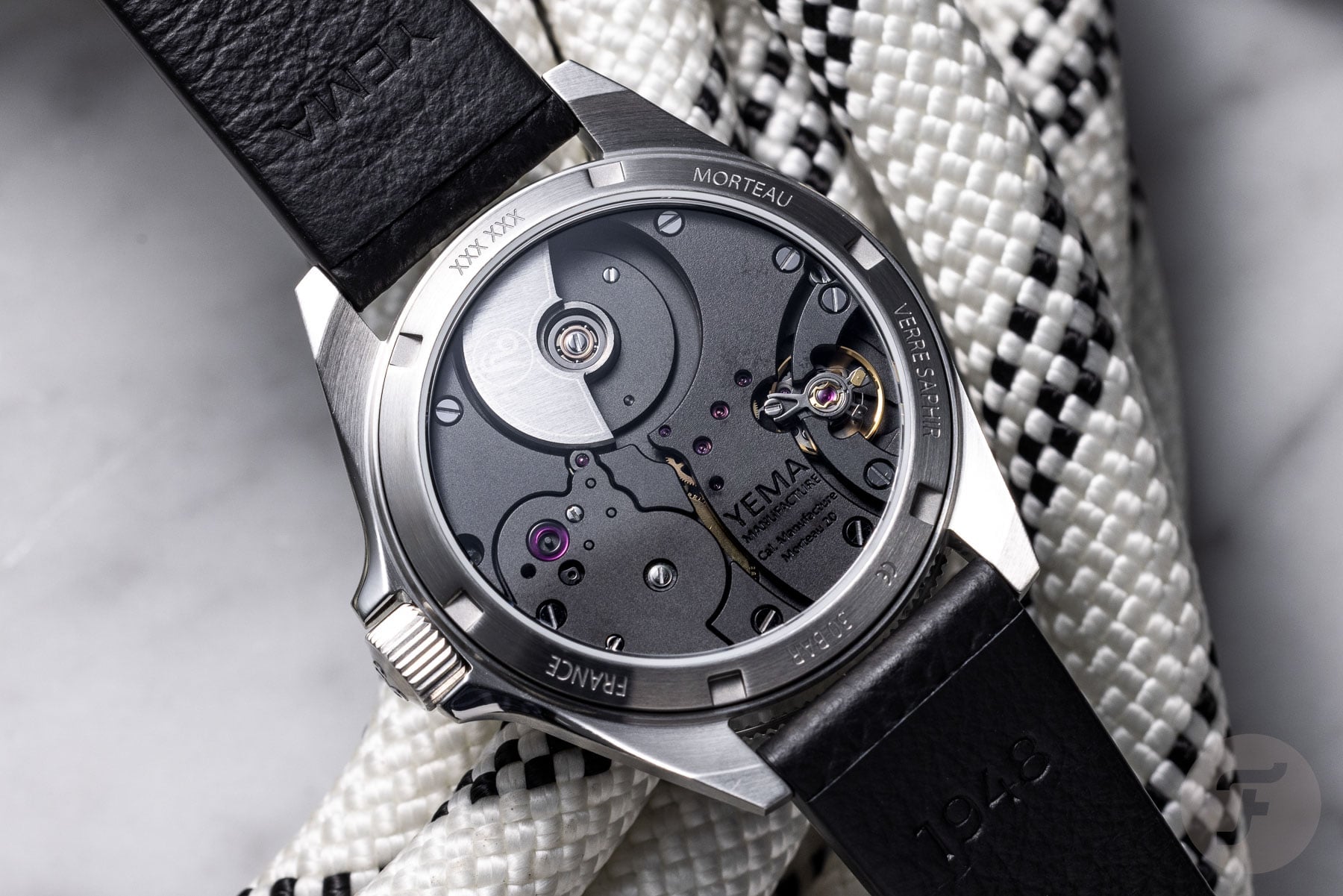
Yema Navygraf Slim CMM.20 Limited Edition
Cost-friendly, evolved micro-rotors
Micro-rotor movements started evolving in 1959 when Piaget introduced its caliber 12P. The movement was only 2.3mm thick, which made it the thinnest automatic movement in the world by nearly 0.2mm. Nowadays, micro-rotors are appearing in Haute Horlogerie movements, and most of the time, they are made of dense platinum because they need to be as heavy as possible.

Yema Navygraf Slim CMM.20 Limited Edition

CMM.20 micro-rotor movement
Interestingly, Yema introduced the sub-€2k Navygraf Slim CMM.20 Limited Edition two years ago, featuring the in-house Calibre Manufacture Morteau 20. The movement features a tungsten micro-rotor instead of a platinum one and achieves a 70-hour power reserve. Tungsten is slightly less dense and therefore lighter than platinum, but it’s also around 90% percent cheaper. The Yema caliber might not be a high-horology creation. Rather than being elaborately decorated with engravings and anglage, it looks modern with a black satin finish and a contrasting tungsten micro-rotor spinning on ball bearings. Still, it is an affordable way to enjoy a micro-rotor movement.
Dominique Renaud — yes, half of Renaud & Papi — knows micro-rotors are not the most efficient. That’s why he set out to find a solution. He did so with Julien Tixier, and the result is the Renaud Tixier Monday, a watch featuring a new micro-rotor winding system. For CHF 79,000 (ex. taxes), you get a watch with a micro-rotor that uses a technical solution best described as a propeller powered by a specially designed spring. This construction inside the rotor acts as an “engine,” providing the micro-rotor with a boost of energy (via a spring and flywheel). It also includes a shock absorber, further protecting this otherwise delicate construction from harsh shocks.
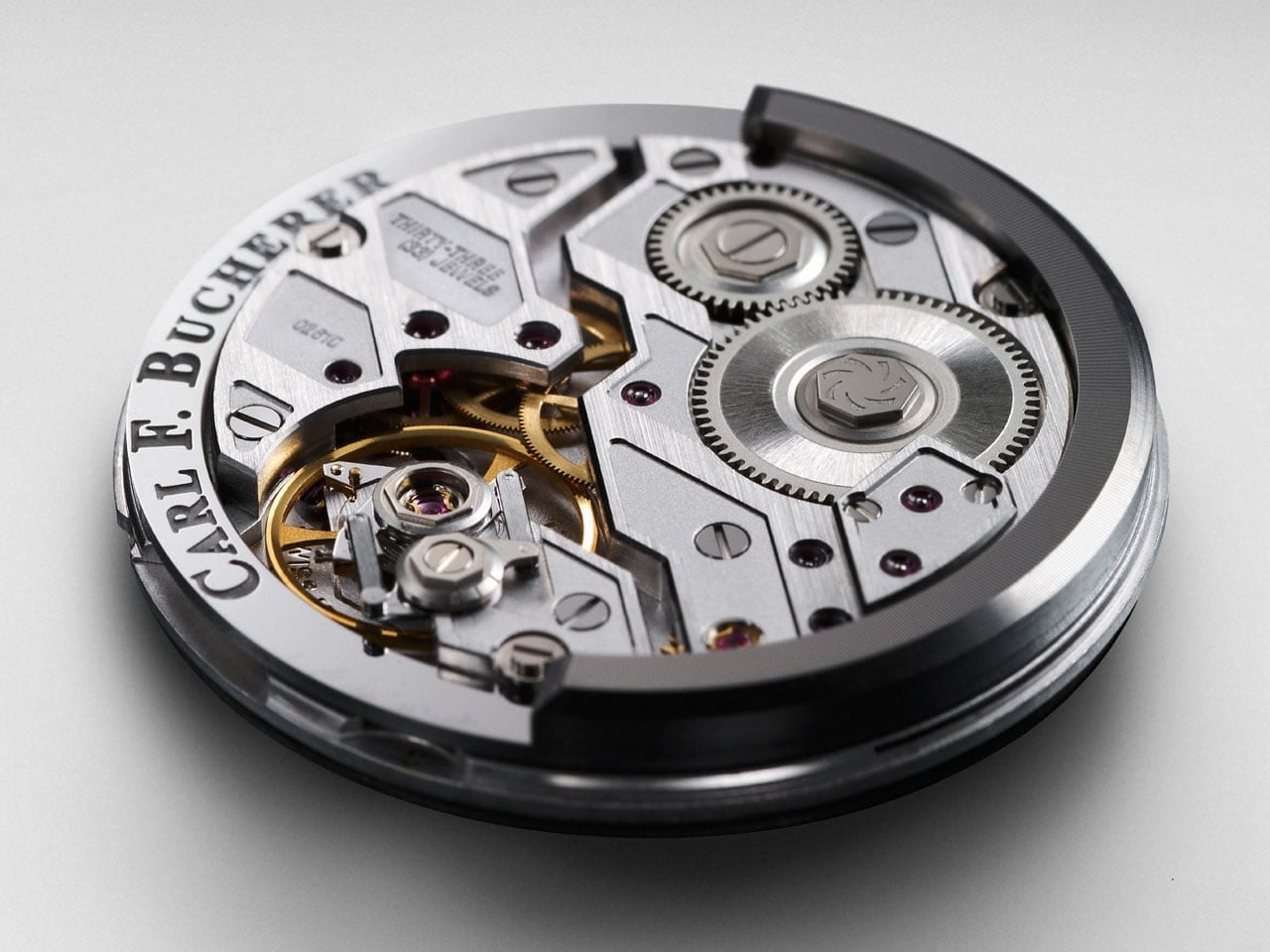
Carl F. Bucherer caliber A1000
‘Round the outside
What if you could combine the strength of a central rotor with the benefit of being as nonintrusive as possible? That would result in the peripheral rotor, a weight spinning on the outside of the movement, keeping it thin and allowing you to admire it. The system looks complicated and costly, and it is. Watchmakers have experimented with the concept since the 1950s, but peripheral-rotor automatics remain relatively expensive, largely because they are technically challenging to manufacture at scale. As a result, most examples come from high-end brands, such as Vacheron Constantin, Audemars Piguet, Jaeger-Coultre, and Breguet, though there are a few notable exceptions.

Perrelet Lab Peripheral

Perrelet caliber P-411
The peripheral rotor gained broader attention in 2009 with the release of the Carl F. Bucherer caliber A1000. The movement featured DLC-coated rollers and ceramic ball bearings, enabling bidirectional rotation of the tungsten rotor along the periphery and improving stability and reliability. Another interesting example is the Perrelet Lab Peripheral 3 Hands A1100/1 outfitted with the in-house caliber P-411 with a peripheral rotor. It costs €4,080, making it more affordable than most micro-rotor watches. Abraham-Louis Perrelet would be proud.
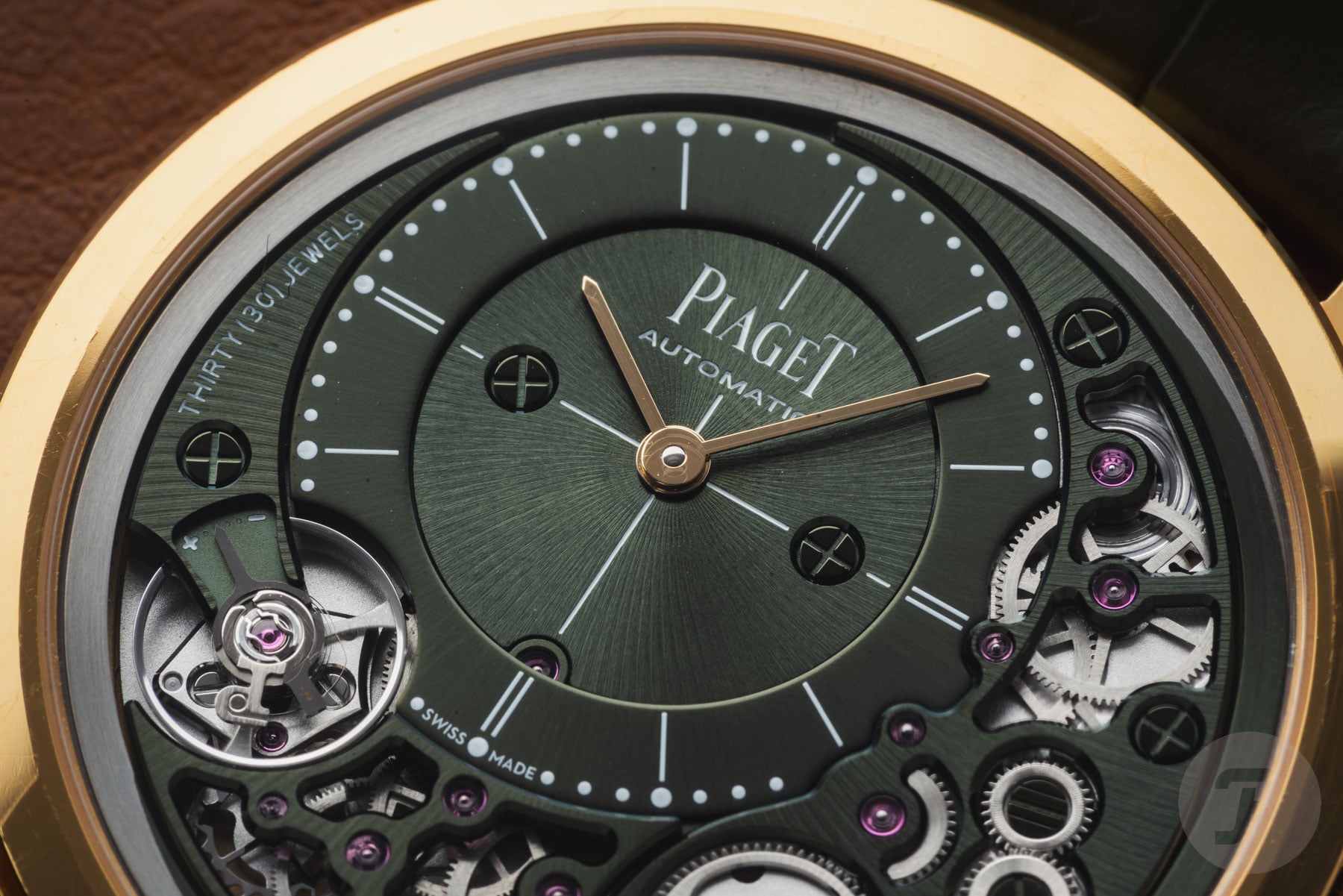
Piaget Altiplano Ultimate Automatic 910P
Setting records
A more exclusive example is the Piaget Altiplano Ultimate Automatic. When it debuted in 2017, it was the world’s thinnest automatic watch, proving once again Piaget’s expertise in ultra-thin watchmaking. Thanks to its caliber 910P, the watch measures just 4.3mm in total thickness. It takes a peripheral rotor to set records. And Bvlgari proved that by creating the Octo Finissimo Tourbillon Automatic, the world’s thinnest automatic tourbillon watch. Its case is 3.95mm thick, with a movement measuring just 1.95mm.

Jaeger-LeCoultre Hybris Mechanica Calibre 362

The peripheral rotor shows through openings in the dial
Not record-breaking but fascinating because of its looks is the 41 × 7.8mm Jaeger-LeCoultre Hybris Mechanica Calibre 362. This watch contains a 566-part automatic movement with a tourbillon, a minute repeater, and a peripheral rotor with eight separate patents.

Breguet Marine Tourbillon Equation Marchante 5887

Just as visually arresting is the Breguet Marine Tourbillon Equation Marchante 5887, a platinum watch featuring civil time (hours, minutes), equation of time (solar minutes, month of the equation), a perpetual calendar (day, date, month, leap-year cycle), and a tourbillon. The caliber 581DPE’s peripheral rotor shows a subtle wave pattern.
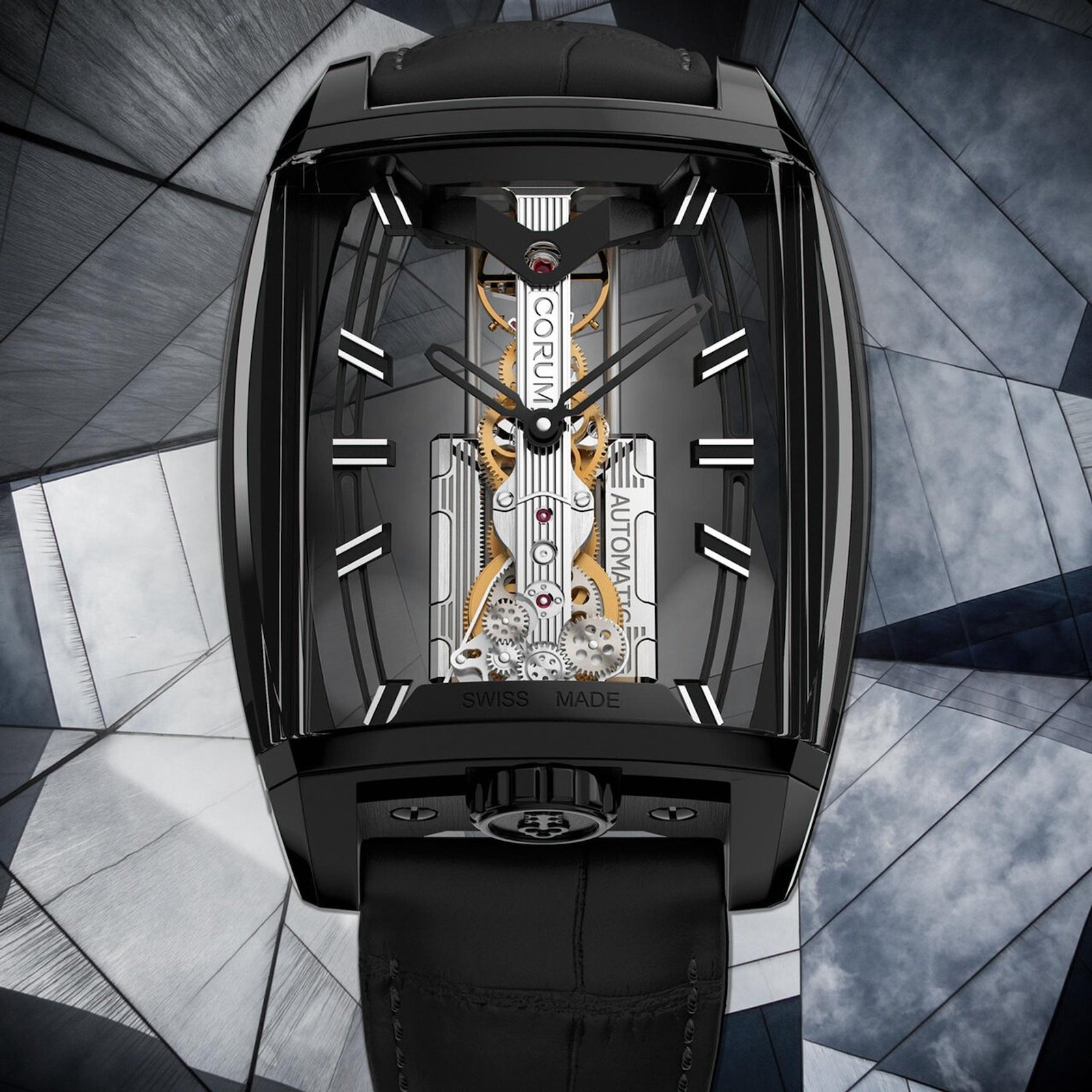
Corum does it up and down
You can also have a weight sliding up and down to wind the mainspring. The hammer winding system is a linear one, and as far as we at Fratello know, only Corum offers it in modern watches, such as the Golden Bridge Avant-Garde Titanium. The challenges for a linear system like this are overcoming winding capacity, the weight’s mass, and friction. Corum uses cupro-beryllium and steel, with a nickel-polytetrafluoroethylene coating comparable to Teflon, to ensure the 4g platinum linear winding weight moves smoothly and performs its winding duties effectively.
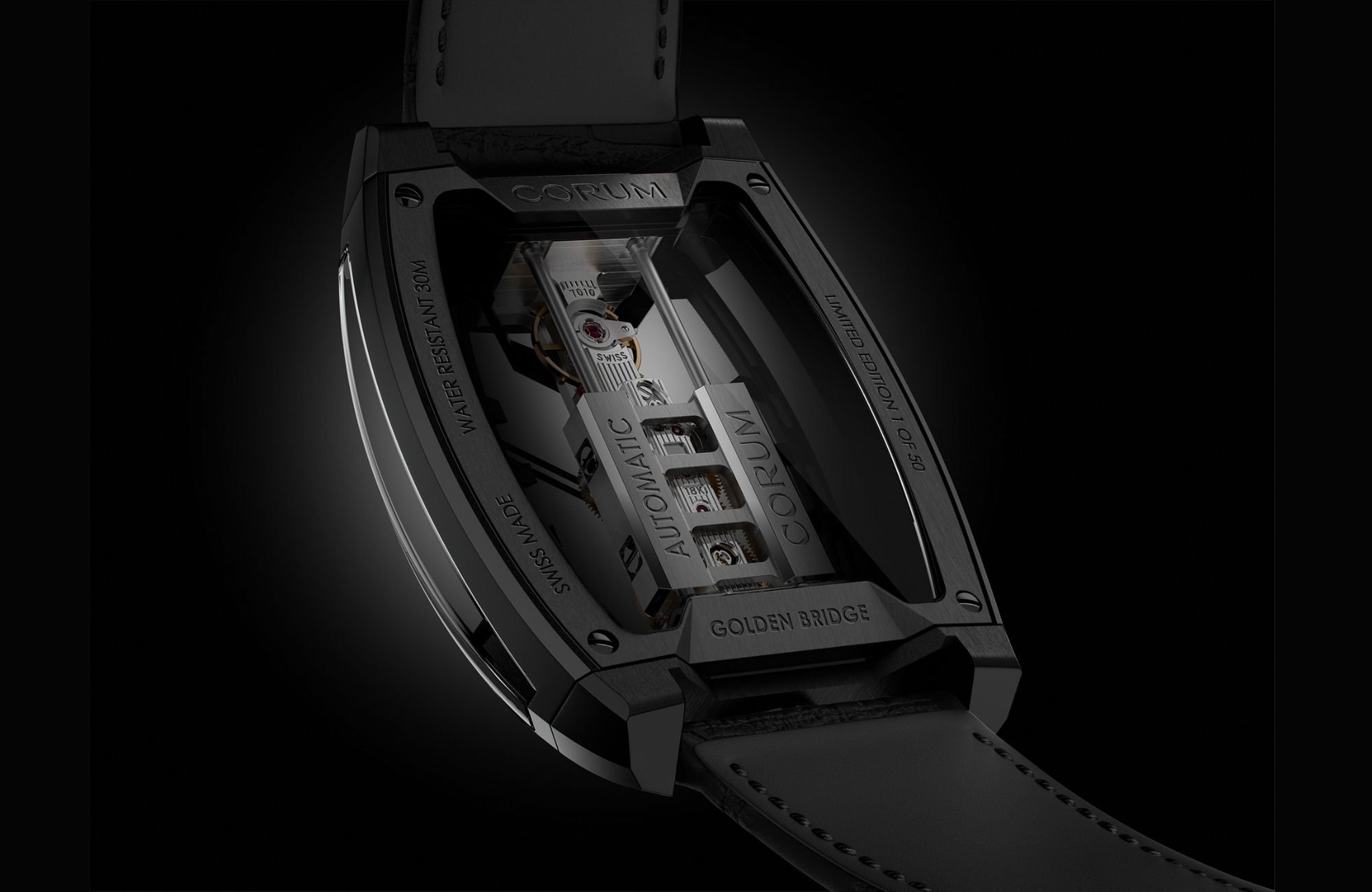
The Corum Golden Bridge Avant-Garde Titanium is outfitted with the CO 313, a movement with a linear winding system
Caliber CO 313 was developed in conjunction with La Joux-Perret, and its highlight is the winding weight that moves along its steel rails for one centimeter before its motion is slowed by a system of gaskets that sends it back in the other direction. Outfitted with ceramic ball bearings, the hammer winding system requires no lubrication.
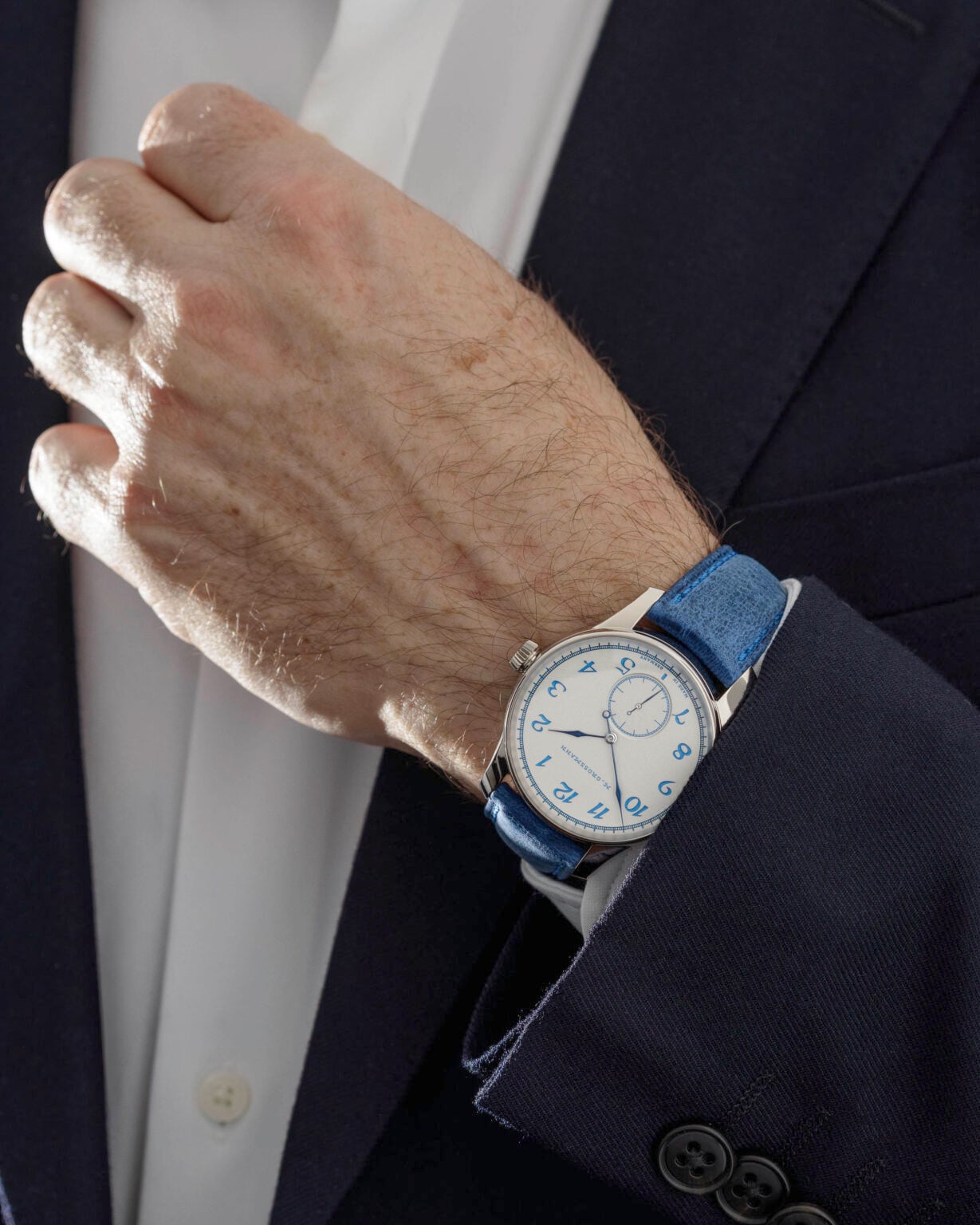
The latest version of the Moritz Grossmann Hamatic
A hammer, but not as we know it
Moritz Grossmann, from the German watchmaking town of Glashütte, has the Hamatic in its collection, and it’s something special. Like the Corum Golden Bridge Avant-Garde Titanium, the watch’s caliber 106.0 uses a hammer winding system. But it differs a lot from Corum’s linear construction. The Hamatic’s movement features a pendulum-like weight to wind the mainspring.
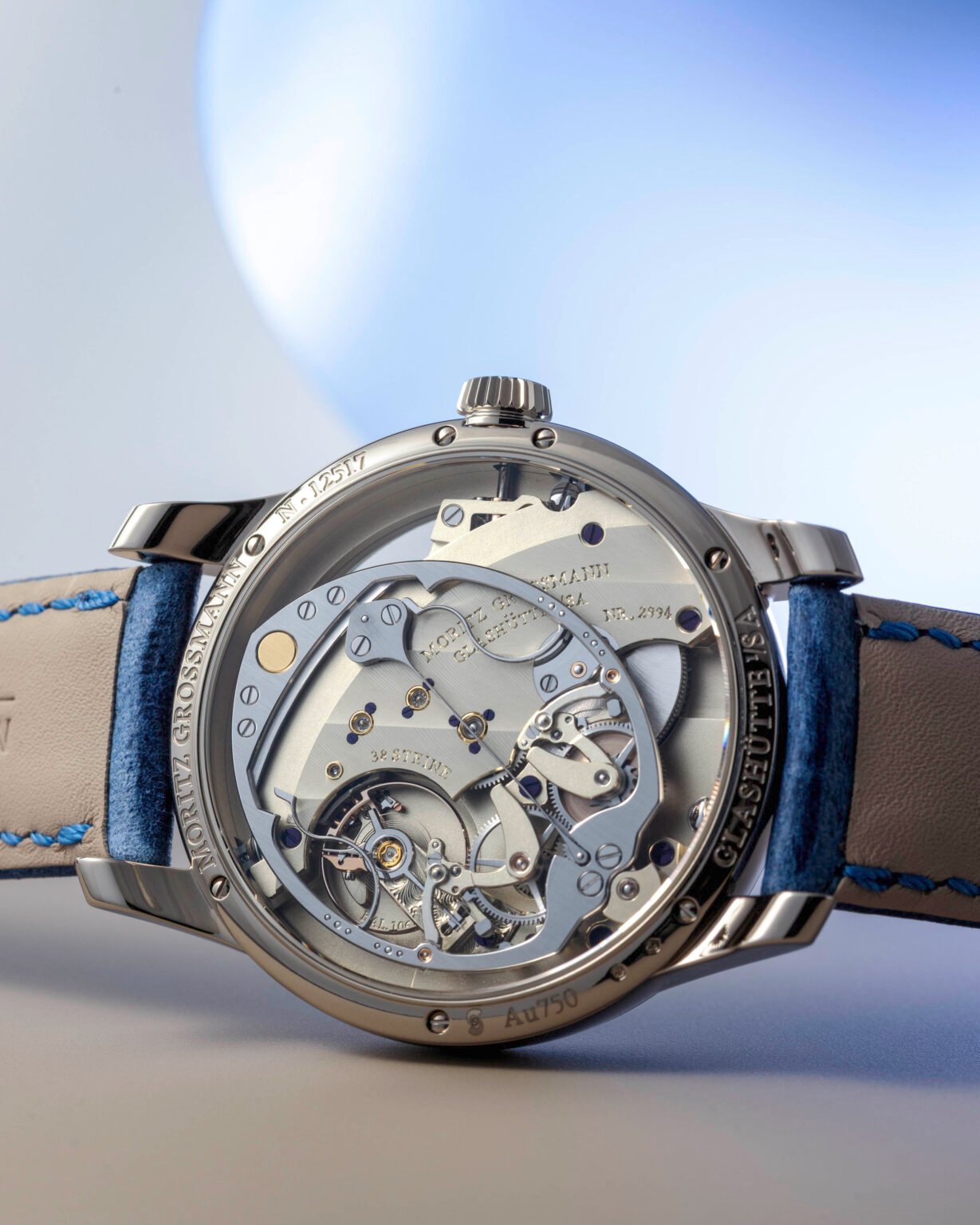
Caliber 106.0 uses a hammer winding system
This concept dates back to early pocket watches developed by Breguet, building on earlier ideas from Abraham-Louis Perrelet. The Hamatic’s “hammer” is a large, open, oval-shaped pendulum with a small gold weight at its tip, designed to improve winding efficiency. It swings through a relatively narrow arc and is cushioned at each end of its motion by two curved, shock-absorbing springs. These springs alternately contact a bumper connected to a long, thin blade spring positioned at the center of the mechanism. Indeed, this is a highly unusual, rare, and fascinating construction.
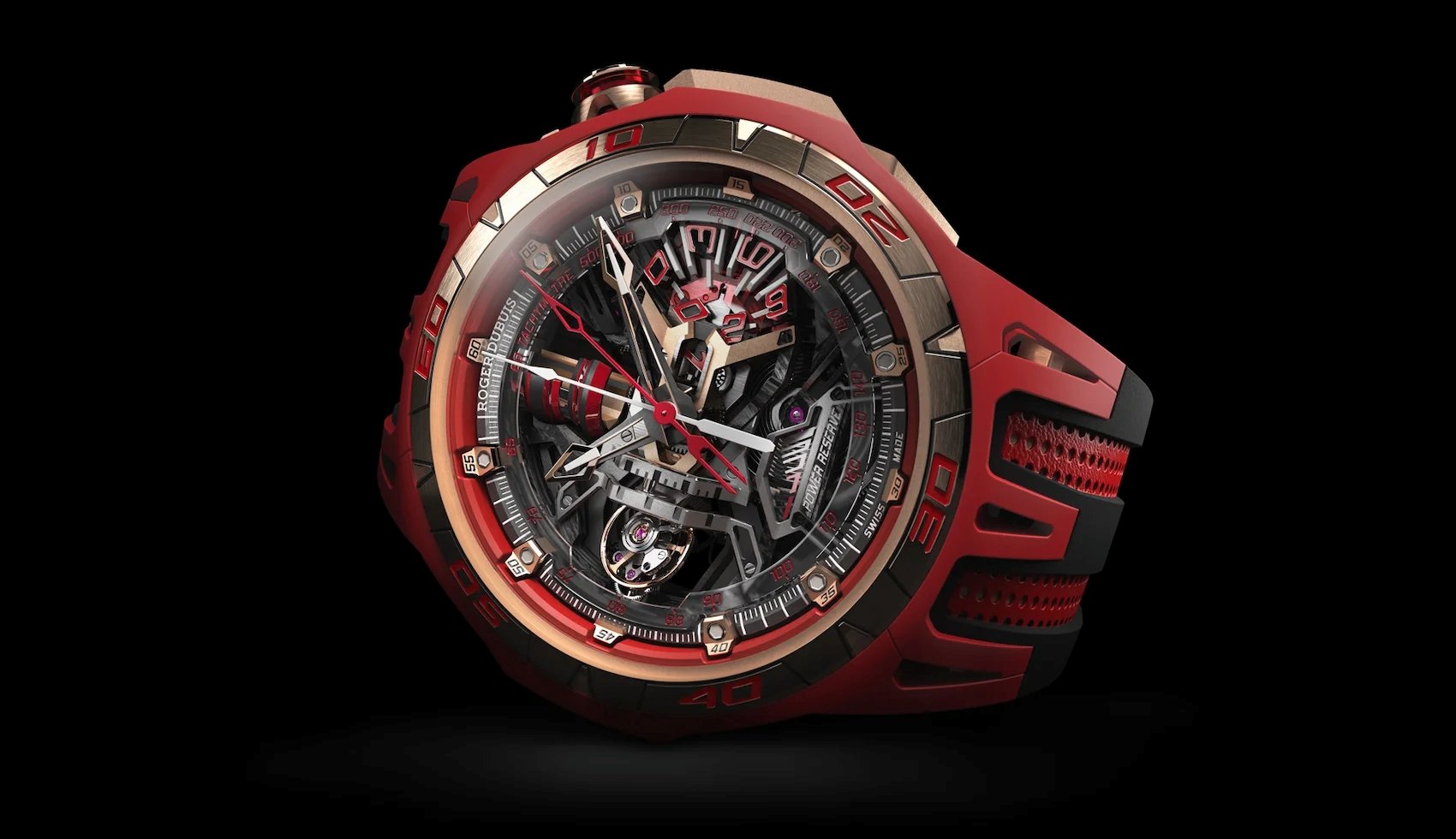
The Roger Dubuis Monovortex Split Seconds Chronograph with its Turborotor Cylindrical Oscillating Weight at 12 o’clock
The one-of-a-kind vertical Turborotor
The Monovortex Split Seconds Chronograph, a concept watch that Roger Dubuis presented at Watches and Wonders 2023 in a 47mm red composite fiber case, was more than just big and loud. This complicated chronograph featured a tourbillon, but that’s not what this article is about; we’re talking about rotors here. Well, the rotor inside this watch never saw production, but it’s still worth mentioning. At 12 o’clock, you will notice something unusual because the watch lacks a dial. It’s the Turborotor Cylindrical Oscillating Weight. The new self-winding system, which includes a vertically oriented spinning cylinder to wind the mainspring, took eight months of research and development. Here’s to hoping that Roger Dubuis will eventually put it into production.
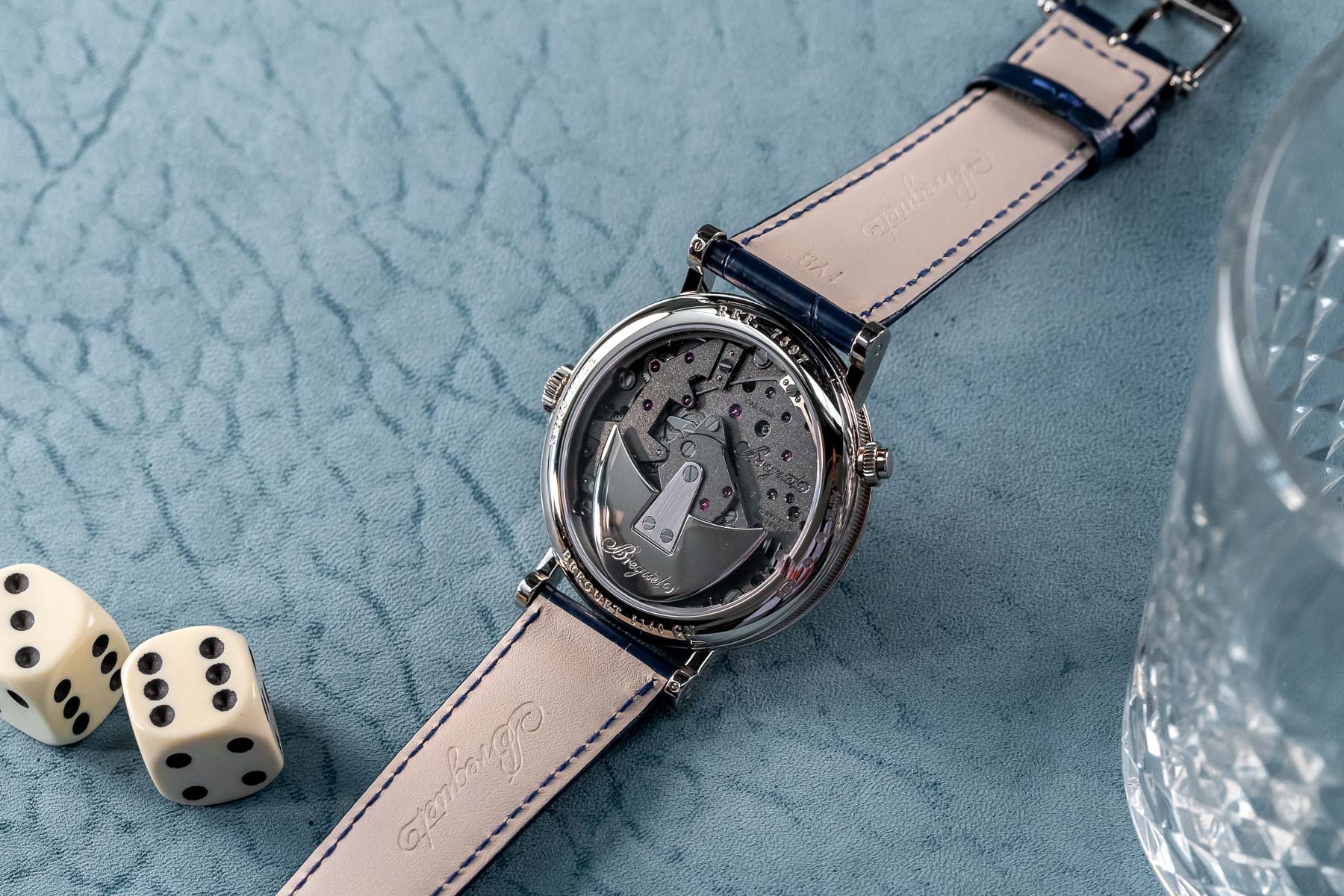
The central rotor inside the Breguet Tradition 7597 mimics the look of the automatic movement inside the perpétuelle repeating watch no. 1/8/82, completed in 1782
Time to pick the “best” rotor
Now tell me, what is your favorite rotor? And don’t say, “I prefer a hand-wound movement,” because we’ll deal with that topic another time. My favorite automatic system is the micro-rotor because it allows for a thin watch and offers a dynamic spectacle on the movement side. The central rotor blocks too much of the view, and the peripheral rotor, however ingenious and fascinating, does its job (staying out of sight) too well. Therefore, a nicely decorated platinum micro-rotor is the “best” in my book.
Lex Stolk
2026-03-29 09:00:00