
Like a little bonbon of horological sweetness at the end of another week, your Bring a Loupe for the 27th of March is here. We’re getting dangerously close to the end of March, meaning you’ve made it not only through another month but the entire first quarter of 2026. As Tom Haveford would advise: Treat Yo Self.
Scorcarding last week’s watches, the Omega Deville 146.017 sold for €3,650, the Rolex 16523 ‘Invert 6’ Daytona for £8,800, the Goodwill Cartier Tortue for an eye-watering $25,002, and Arnie’s Arnie hammered at $47,250. Of note from the strays, the Heuer Orange Boy went for $6,175.
Strays
Credit SPANGARO & CO.

Credit Karl Benz Auctions.
Credit Estate Collection NY via eBay.
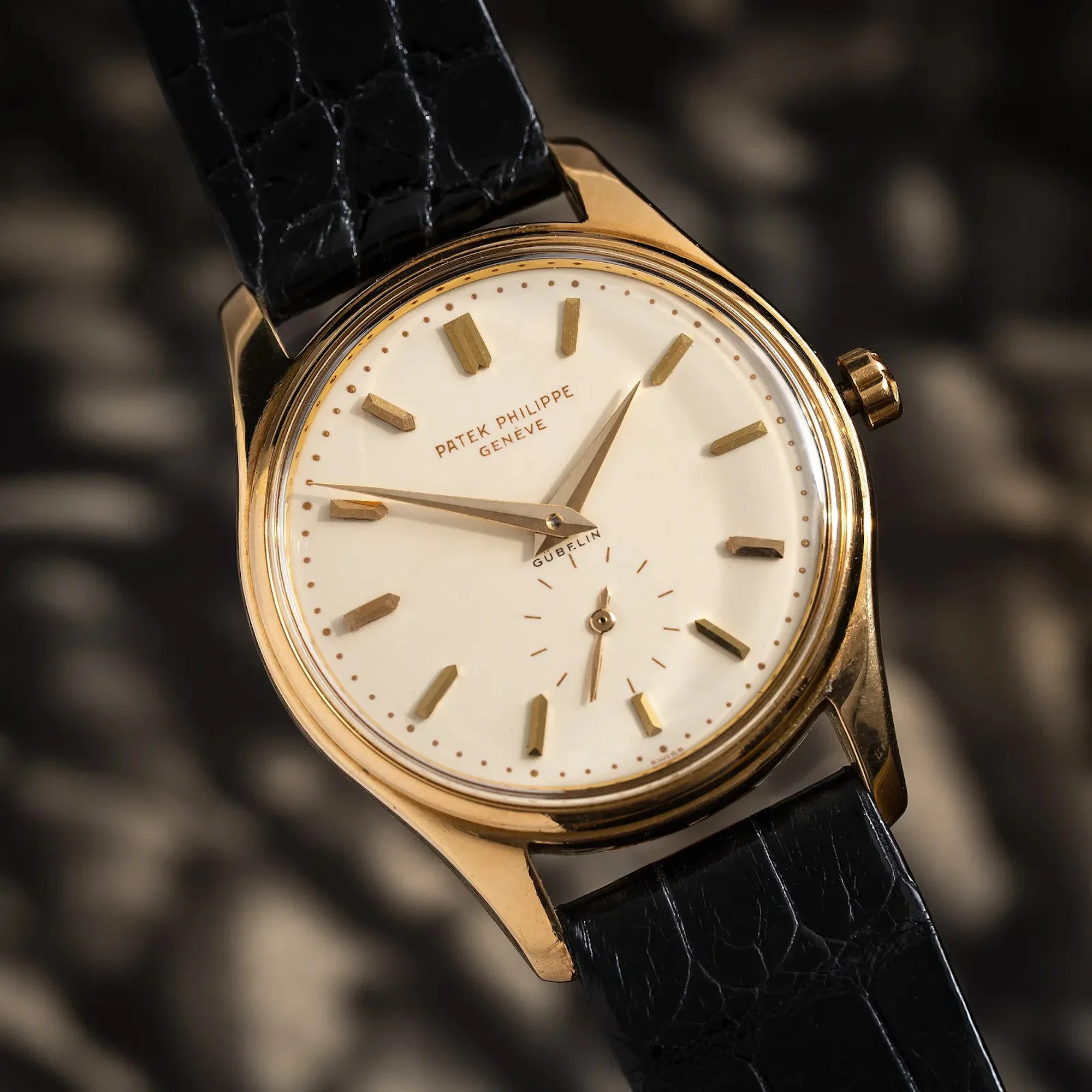
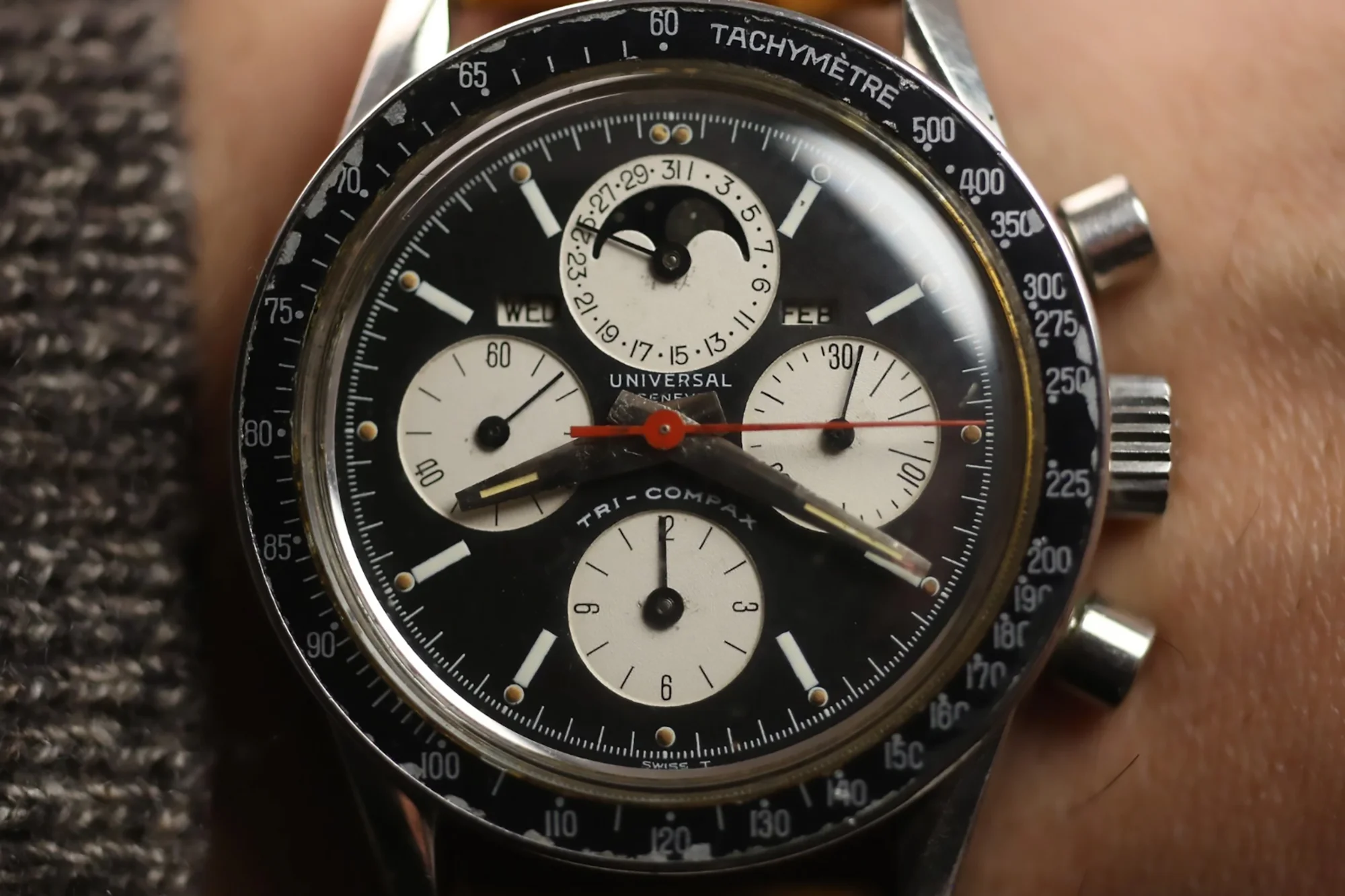
If you’re a Swatch Guy, Karl Benz in France has your number this week, offering, as my dad would say, “More Swatches than you could shake a stick at,” (in this case, 1600); the auction starts April 2nd. At almost the diametrically opposed end of the spectrum, here’s a Gubelin-signed Patek 2526 that looks to be in excellent shape, also at auction on April 2nd. I have not been able to figure out if this Waltham Bathyscaphe has been relumed or if it’s original (curious to hear what people think), but if it checks out, it sure seems to be a lovely example. For those whose New Year’s resolution was No More Mr Nice Guy, this Evil Clapton is the obvious and appropriate accessory, and if that’s a bit too dark, here’s another vintage moon-phase chronograph, a Movado Astronic, which seems great other than the fact that the hands have been replaced (though worth noting that the hands are correct and were replaced during a service).
Ball Official Railroad
Full disclosure requires me to admit that I’m hopelessly fond of this style of Ball Official Railroad watch, and have spent years enjoying them, tracking to see if they’d ever gain the audience and adoration I believe they deserve. While that hasn’t happened, please don’t read any of the following as any attempt to build hype or anything—this is just a simple love letter to one of the best vintage values you can get.

Ball Watch Company was founded after a train crash in Ohio in 1891, caused by a conductor’s watch losing 4 minutes, so on a single track, the conductor didn’t realize it was time to give another train the right of way. In the aftermath of the accident, railroad officials asked Webb C. Ball to be their Chief Time Inspector, in which role he (presumably quickly) noted the need for reliable watches. The timekeeping requirements Ball introduced—RR (railroad) Standard—are literally the roots of COSC standards.
These particular Ball Railroad models—introduced in 1959—came in a variety of shapes and styles (steel or gold plated, tonneau and two types of circular cases, one with thin lugs and one with lyre lugs), and were all powered by a fairly pedestrian A. Schild 1604B manual-wind movement, which was simply a standard Schild 1604 with a hacking feature. At 34mm, it is, yes, on the smaller side, though it’s about what you’d expect for the time.
But if you enjoy this watch, you’ll likely end up falling for it because of its dial and hands. All watches are transmitting gobs of data simultaneously (about status, taste, style, etc.), but the data point I often find myself most drawn to when considering a watch is realizing that each individual watch represents some person’s/company’s idea of how best to tell time. Best is doing lots of work in that previous sentence: best can mean elegant or tough, flashily stylized or stoically basic, cryptic or simple, et cetera. In this case, the Ball Official Railroad’s roots make clear precisely what best means: it’s trying to be eminently, totally clear, as unfussily direct and simple to read as possible. If you’re someone who appreciates the mechanics of a box of Kleenex, and how pulling one tissue (usually) leads to another popping up to take its place, this seems like your kind of watch.
The bidding is up to $100 at the time of writing, and it’s unlikely to pass $500. You can find examples of the Official Railroad (or the seemingly later Official Standard Trainmaster, which, as far as I can tell, was the new label given to the model once it had been approved for railroad use) for under $1000 on eBay all day long. While the example here needs its crystal polished, it looks otherwise in excellent shape, and, truly, these watches offer as much bang for your buck as any vintage model I can think of.
Omega Grand Luxe ref. 3953
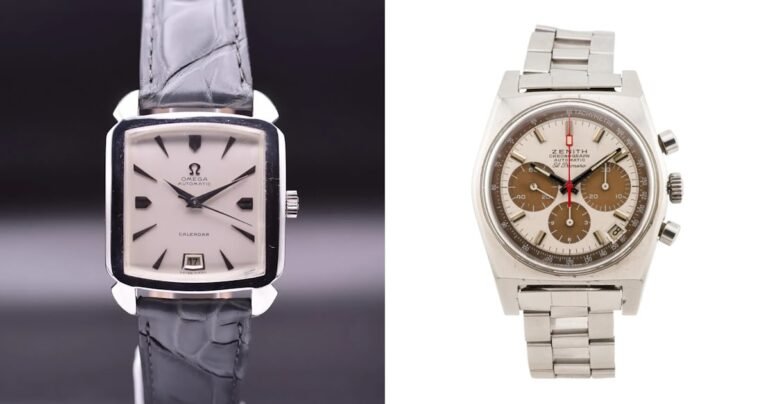
This solid 18k white-gold 1952 Omega Calendar “Grand Luxe” (I don’t know why there are quotes, either; that’s how Omega lists the reference) is a thing of absolute beauty. Those lugs! That dial! The thing is 74 years old and has no right to look that good.

Credit Blenheim Auctions
The Omega ref. 3953 is a fairly uncommon model, and in all instances came in solid gold (the majority of which seem to have been yellow gold vs this example’s white). Everything you need to know about the watch is clear just from looking at it: the caseback is press-fit, but even if it weren’t, it’s obviously a purely dress watch, with next to nothing by way of water resistance. Note, too, the lack of lume: this thing’s good for dressing up and dressing up only. You won’t even be able to track the time in a darkened theater.

Credit Blenheim Auctions
Looking at this watch, I sort of can’t help but wonder what would’ve become of Omega had the Speedmaster not been chosen by NASA. This isn’t to say Omega didn’t or doesn’t still make dress watches, but it’s not as well-known for making fine dress watches as for its chronograph and Bond-worn divers (though they did just relaunch the famous Omega Connie yesterday). And obviously, Omega is, more than anything, a company, meaning they’re in the business of selling watches, and presumably the lovely ref. 3953 was so briefly made and in such small numbers because it simply didn’t sell all that much.


Which is a shame, as I hope the pictures make abundantly clear. At 32mm wide and 40mm lug-to-lug, this watch seems phenomenal, and had I meant it, I’d’ve gone to see it in person simply due to the unlikelihood of seeing one again (I can not only find no other examples for sale, but not even that many examples that’ve sold anytime recently). Bidding starts at £2,750, and the watch will be auctioned on the 29th.
A Tropical Zenith El Primero A384
Is there any watch movement more romanticized than the Zenith 3019PHC? Doomed to the dustbin of history by unaware owners but saved by one engineer, the first automatic, integrated, high-frequency mechanical chronograph movement has, for me, always exerted a strong pull, no different from the Valjoux 72 or the Omega 321. It is, in fact, one of the few remaining watches I keep telling myself to finally settle down and buy a decent example of, but somehow I always talk myself out of it. It’s one of my last horological crushes, I suppose, and the fantasy of owning and wearing one, for now, remains enough.

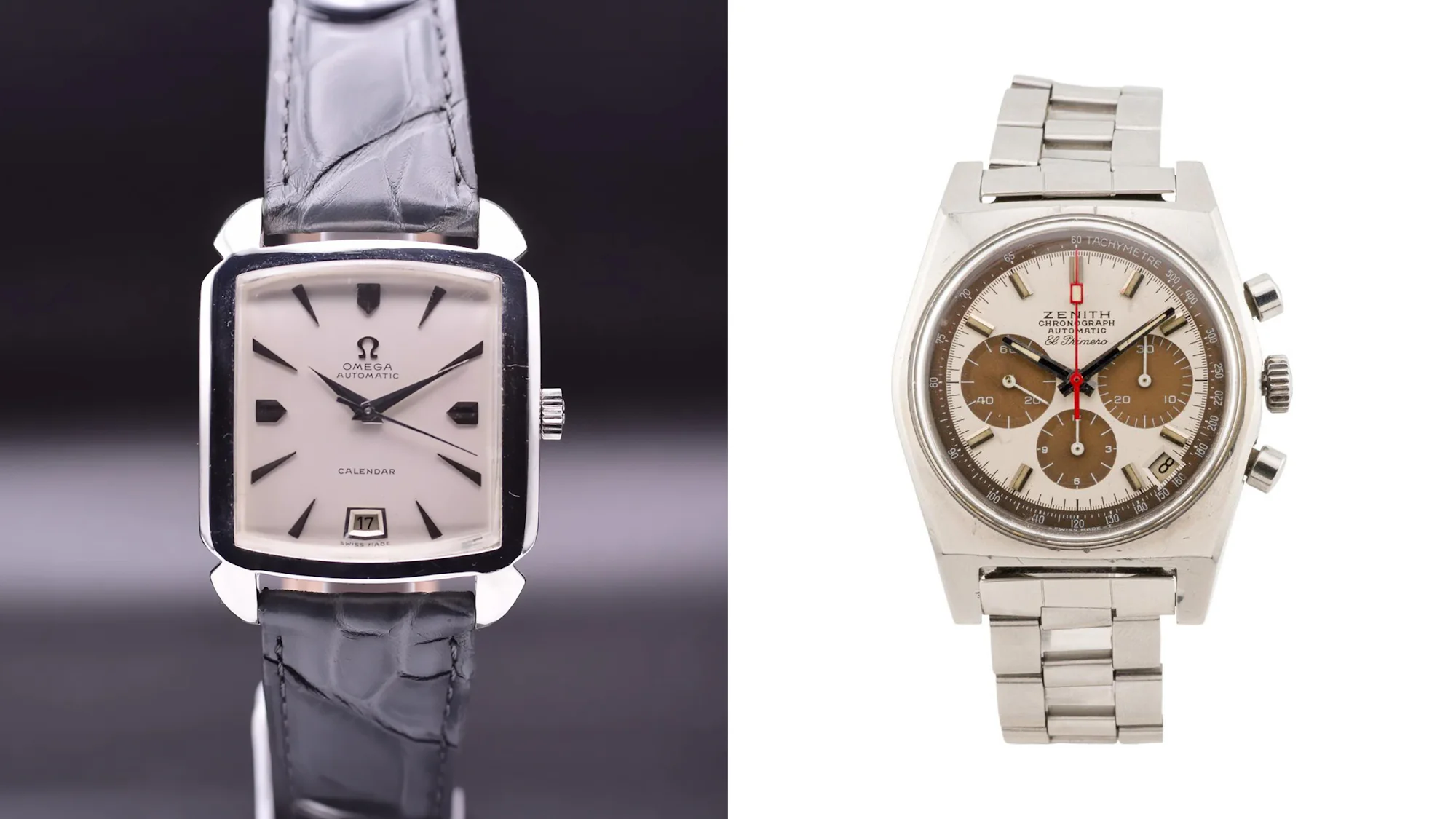
This Zenith El Primero—reference A384, introduced the same year as the A386—is, of course, powered by the 3019PHC, but as you can see from the pictures, the movement’s exceptional legacy is not even half the story. While I fully submit that one man’s ‘patina’ is another man’s ‘damage,’ I find it tough to imagine anyone who’d look at this watch and not go a little weak-kneed.
I’m not personally crazy about tonneau-shaped watches, but even the most fervently anti-tonneau among us would have to make an exception for this, right? True: the case (from the one picture the auction house has offered) looks to have a bit of wear, but, again, what you’re buying with this watch is that extraordinary dial. Even the original Gay Freres bracelet becomes a distant consideration. And certainly, given the fairly serious number of A384s that’ve tropicalized in ridiculously attractive ways, some enterprising researcher is digging into what’s made that possible, right? I’m fascinated by whatever original ingredients and pigments have allowed for so many of this specific model to age so beautifully.
With a starting bid of €8,000, this watch goes up for auction on the 31st.
A 14k Vintage Tissot Chronograph Lemania 2310/CH 27
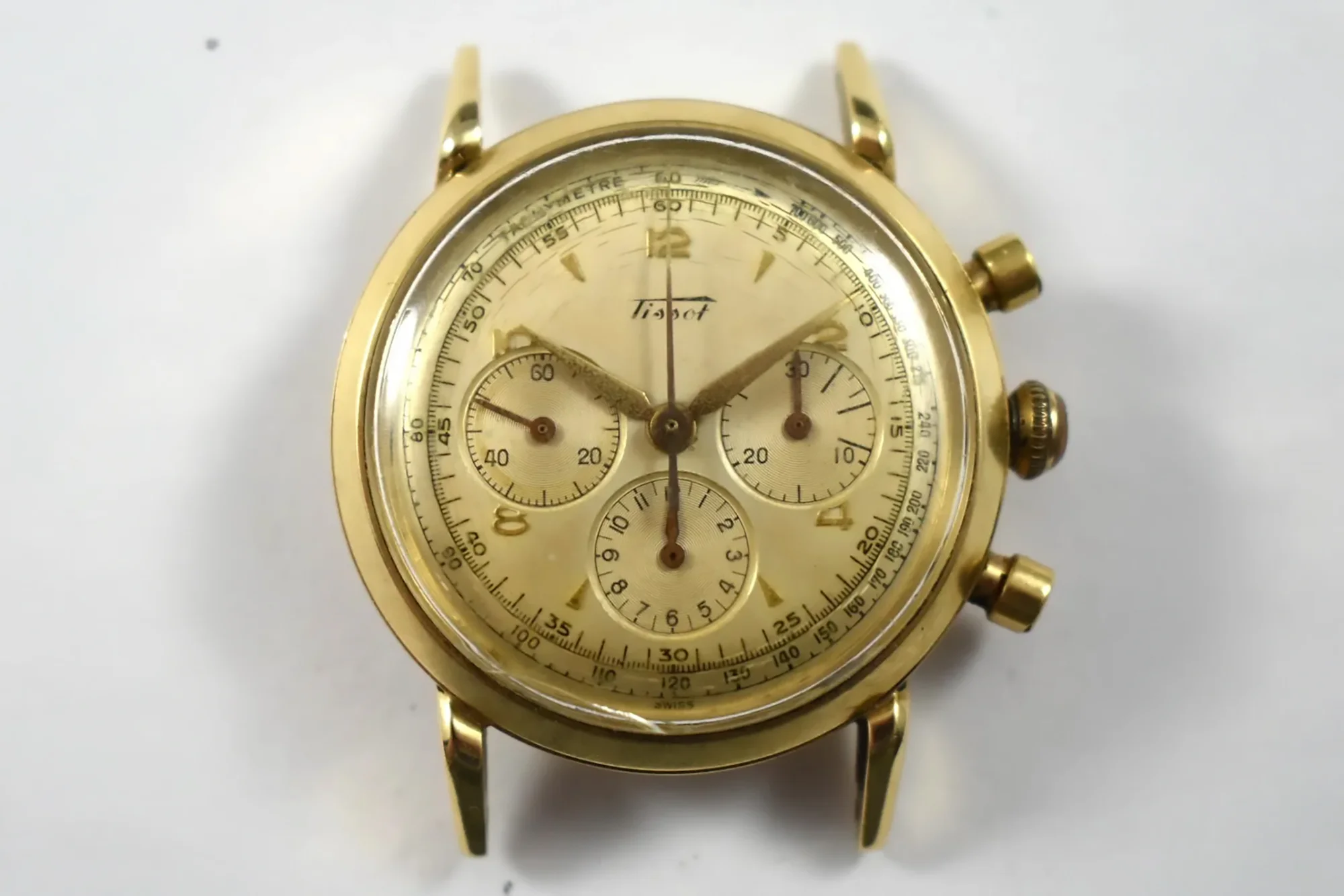
Speaking of romanticized movements. Launched in 1942, the Lemania 2310 has been the engine powering legendary watches from Patek Philippe, Vacheron Constantin, Breguet, Roger Dubuis, and, obviously, Omega. No less an eminence than 2026 GPHG Jury President Wei Koh argues the movement is, in fact, “the greatest chronograph movement of all time,” and who am I to argue? Having a Lemania 2310 in your collection feels a bit like having a pair of Levi 501s in your closet—less a requirement and more like an almost universally smart starting point.

If you don’t already have that Lemania box checked, this Tissot—dating to 1954 based on the caseback serial number—would be compelling even were it not powered by the CH 27, but mercifully, we don’t face that particular choice. The watch will not, in its current state, win any awards, if only because the crystal needs to be replaced, but beneath that crazed and cracked acrylic awaits what appears to be a lovely and original gold dial and hands set. The case, too, seems in remarkably good shape. I’m no Tissot scholar, meaning I’ve no idea if this is some specific and known reference, but the case appears unpolished, given that the spider-like lugs clearly show a bevel. I don’t know that this particular detail will matter much, but the fact that the watch is 14k (rather than 18k) charms principally due to the squirrel hallmark inside the caseback, which was the Swiss mark used to denote 14k gold.
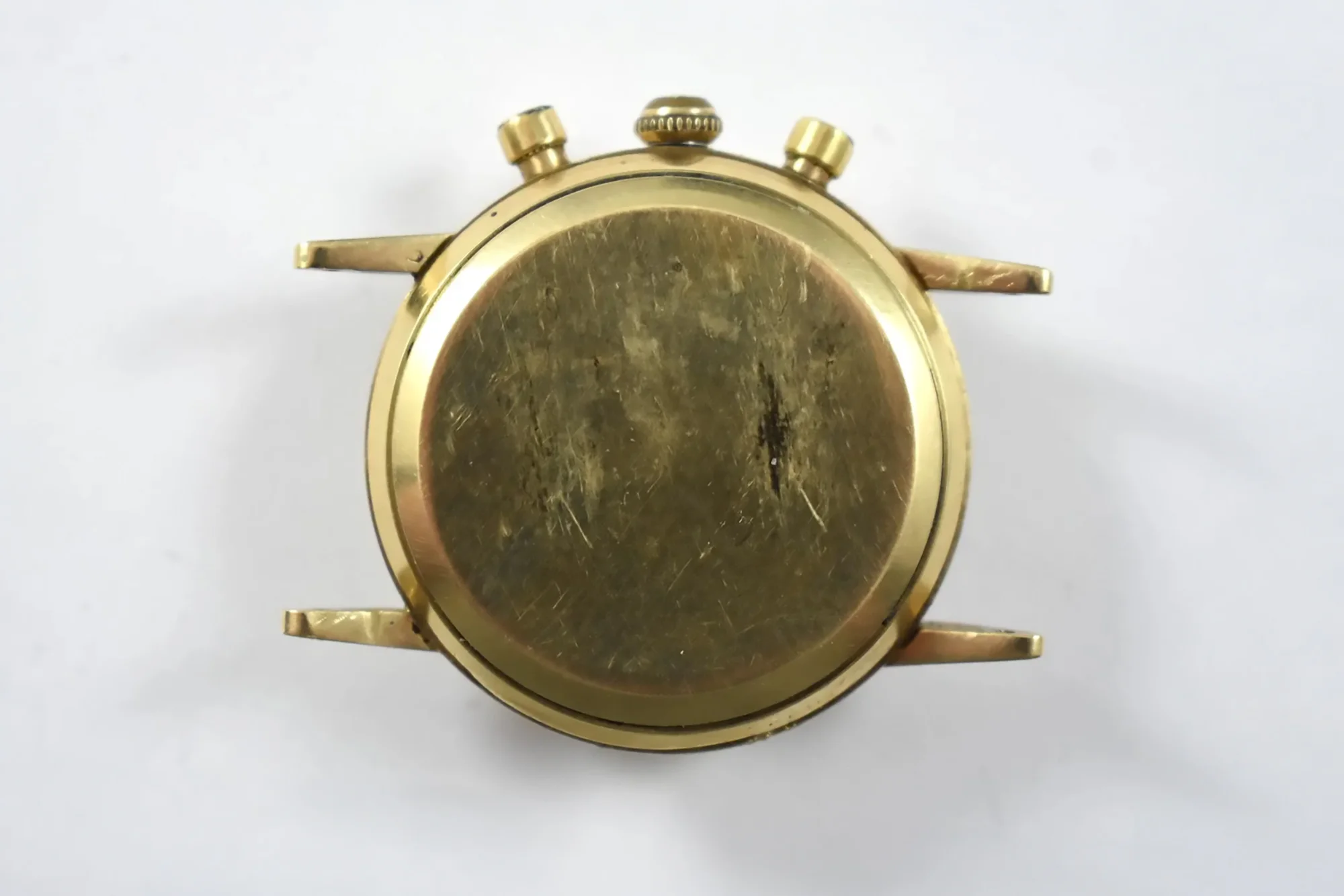
The seller notes the watch will need to be serviced, which is to be expected (and presents yet another opportunity to become friends with your local watchmaker). This is exactly the sort of watch I open eBay hoping to find, something in need of care but still retaining its original glory. It’s $2,025 at the time of writing, and the auction ends Sunday evening.
Weston Cutter
2026-03-27 15:00:00