
Anegada is almost level with the water. The highest point reaches about 28 feet above sea level, a faint rise in a landscape otherwise defined by horizon. Sail toward it and the island appears late, a thin strip of white and green that seems to float on the Caribbean. Early Spanish explorers called it “Anegada,” meaning “drowned,” a reference to how low it sits and how easily it blends into the sea. The name held. So did the character.
This is the only coral island in the British Virgin Islands, formed from limestone and reef rather than volcanic rock. There are no peaks, no switchback roads climbing into the clouds. Just open sky, salt ponds, scrub and some of the widest beaches in the region.
On the north shore, that geography delivers something extraordinary.
Cow Wreck Beach.
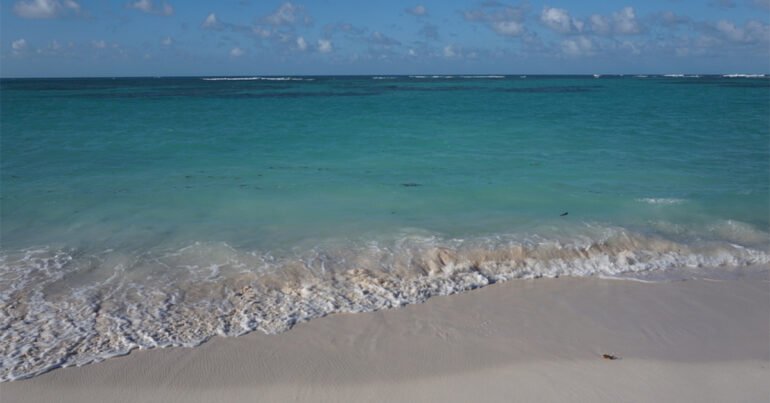
Cow Wreck Beach is one of those places that resets your expectations of what a Caribbean beach can be. It is expansive without feeling empty. It is quiet without feeling remote. You can walk for 20 minutes and pass only a few other people. You can swim out and still see the sandy bottom below you.
This is the north shore of Anegada, and it delivers.
The Beach That Carries the Island
The sand at Cow Wreck is powdery and bright, edging into dunes and low vegetation. The reef offshore breaks the Atlantic swell before it reaches the beach, leaving a wide, swimmable stretch of water that stays calm most days. The color shifts from clear at your feet to deep aquamarine farther out, with darker blue where the reef runs parallel to shore.
You can wade far before the water reaches your shoulders. You can float without drift. You can walk east or west and feel like you have the island to yourself.
There are no towering resorts behind you. Just a scattering of beach bars, guesthouses and private villas tucked behind the trees. The infrastructure is minimal. The experience is direct.
This is what draws people back to Anegada. The the clarity of beach, water and sky.
The Cow Wreck Beach Bar
At the center of it all is the Cow Wreck Beach Bar, a low-slung, colorful wooden structure steps from the sand. Painted signs hang from the beams. Surfboards and license plates decorate the walls. The tables are simple wood. The floor is sand.
You order at the bar. Painkillers arrive cold and strong, finished with grated nutmeg. Rum punches lean heavy on the local pour. Cold Carib and Presidente line the coolers. The soundtrack is easygoing — reggae, classic rock, island standards — carried by the wind.
The kitchen turns out conch fritters, grilled fish, burgers and lobster when it’s in season. The portions are generous. The setting does the rest.
You can sit under the shade of the bar’s roof or take your drink back to a lounger facing the sea. Shoes are optional. Time is elastic.
The Cow Wreck name dates back to ships that once ran aground on the reefs off Anegada’s coast, their cargo — including cattle — washing ashore. Today, the only wreckage you’re likely to encounter is a sunburn if you forget how strong the light is out here.
Ann’s Guest Houses
Just beyond the bar, tucked behind the beach, you’ll find Ann’s Guest Houses. This is Anegada at its most personal: simple cottages, bright colorful paint, porches with chairs angled toward the breeze.
The rooms are comfortable and unfussy. Air-conditioning where you need it. Kitchenettes in some units. Outdoor seating that quickly becomes your evening headquarters.
You wake up and walk to the beach in under a minute. You spend the day in the water or under a thatched umbrella. You head back to your porch as the sun drops and the sky turns soft pink over the north shore.
There is no front desk bustle. No valet stand. Just keys, sand and the sound of wind moving through the trees.
Beyond This Beach
Anegada’s beaches stretch far beyond Cow Wreck, and each one feels like its own address on the horizon.
On the north shore, Loblolly Bay runs wide and bright, with offshore reef keeping the water calm and clear. Beachfront spots like Big Bamboo and Tipsy’s put chairs in the sand and cold drinks within reach, but you can walk a few minutes in either direction and find open shoreline with no one else in view. The sand stays white and fine, the water shallow and glassy over patches of sea grass and coral.
Farther west, Flash of Beauty delivers a long, uninterrupted sweep of beach with barely a structure behind it. The Atlantic shows more energy here on certain days, sending in steady sets that roll and flatten near shore. It’s the kind of place where you bring a cooler, plant an umbrella and stay put.
On the southern side of the island, near Setting Point, the water turns calmer and more protected. The sand narrows in places, giving way to small marinas, fishing boats and dockside restaurants. This is where ferries arrive and charter boats tie up, where you can watch tarpon move in the shallows near the pier.
Across Anegada, the common thread is space and access. No gates. No long rows of loungers. Just miles of white sand edged by low vegetation and open sky. You can spend a full day driving from beach to beach and still leave stretches unexplored.
Cow Wreck may carry the name and the bar, but the entire island reads like one extended shoreline.
Lobster, Done the Anegada Way
Anegada is famous for lobster, and Cow Wreck is one of the places to eat it.
In season, the spiny Caribbean lobster arrives split and grilled, brushed with butter and garlic, served with rice, salad and fried plantain. The meat is sweet and firm, pulled straight from surrounding waters. Portions are generous, often spilling over the edge of the plate.
Across the island, lobster dinners are a ritual. Restaurants set up long tables. Coolers fill with beer. The grills fire up before sunset. At Cow Wreck, the setting adds another layer — lobster eaten with your feet in the sand, the Atlantic just yards away. There’s even an annual lobster festival.
It is simple food, cooked well, served without ceremony.
Why Anegada Feels Different
Most of the British Virgin Islands rise sharply from the sea. Anegada stretches out flat and wide, the highest point barely cresting 28 feet. The result is constant horizon. You see sky in every direction. You feel the trade winds without obstruction.
Flamingos gather in the salt ponds on the island’s interior. Bonefish move through the shallows. The reef system offshore, including the Horseshoe Reef, is one of the largest in the Caribbean, drawing divers who know the region well.
The roads are sandy and quiet. Traffic is light. You rent a Jeep or a Moke and navigate by memory more than signage. The island rewards slow exploration: Loblolly Bay on the north shore, Flash of Beauty Beach farther west, the small settlements near The Settlement and Setting Point.
There is a grocery store, a handful of restaurants, a ferry dock and a small airstrip. That’s the framework. The rest is beach and water.
Cow Wreck stands out even here because it captures all of it in one place: wide-open shoreline, easygoing bar, local lobster, guesthouses steps from the sand.
Getting to Anegada
Part of what makes Cow Wreck feel special is the journey.
You can reach Anegada by ferry from Tortola, typically from Road Town or Trellis Bay. The ride takes around 45 minutes to an hour, depending on conditions. The approach across open water builds anticipation — the island appears slowly, a thin line on the horizon.
Small planes also connect Anegada to Tortola and, at times, to San Juan in Puerto Rico. The flight is short and low, offering a clear view of the reef and the island’s pale outline against the blue.
Once you arrive at Setting Point, you rent a vehicle or arrange a taxi for the drive across the island to Cow Wreck Beach. The ride takes about 15 to 20 minutes, crossing scrubland and salt ponds before the north shore comes into view.
There are no cruise piers. No mega-yachts lined up offshore. Access requires a decision. That filters the crowd.
The Case for Cow Wreck
There are beaches across the Caribbean with softer sand or more dramatic backdrops. There are bars with larger menus or louder music. There are resorts with longer amenity lists.
Cow Wreck offers something else: satiated simplicity. Beach, bar, guesthouse, lobster, horizon — all within a few hundred yards.
You swim in clear water protected by reef. You eat seafood pulled from nearby waters. You sleep in a cottage you can leave barefoot. You wake up and see nothing but white sand and blue sea.
Guy Britton
2026-02-24 23:01:00