
From the imposing astronomical clocks of Tudor England to the exquisite pendant watches of Victorian Britain, timekeeping has long been a symbol of power, prestige, and technological marvel within Europe’s royal courts. This new series explores the fascinating evolution of clocks and watches crafted specifically for royalty, tracing how these intricate masterpieces reflected the tastes, ambitions, and innovations of monarchs. Through the lens of craftsmanship, artistry, and historical significance, we reveal how these royal timepieces marked the passage of dynasties and empires.
Cosimo I de’ Medici (1519–1574), the first Grand Duke of Tuscany, is remembered as a masterful statesman who unified Florence’s power. Yet behind his political authority lay a profound curiosity for the sciences, especially the study of the heavens and the measurement of time.
The Medici family rose to power in Florence primarily through their wealth and strategic use of the Medici Bank, which became the largest and most powerful bank in Europe during the 15th century. They leveraged this financial power to influence Florentine politics, eventually establishing themselves as the de facto rulers of the city, although they maintained the appearance of a republic.
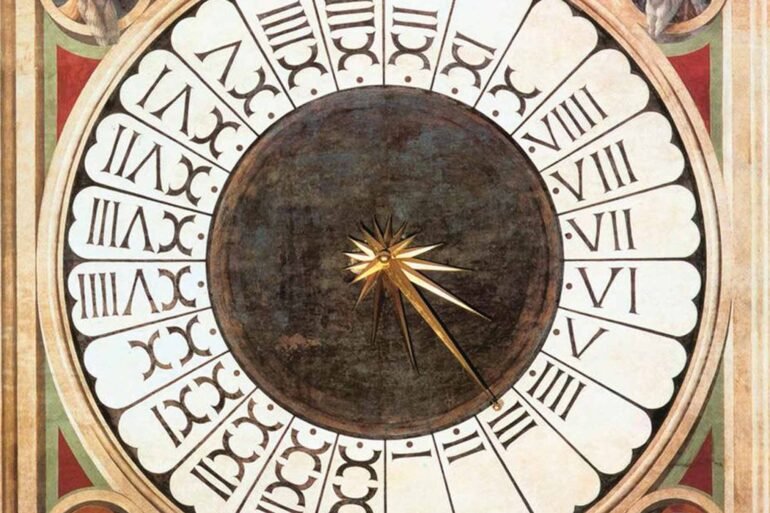
They used their wealth and influence to transform Florence into a leading capital of trading and a place for the greatest creators to work and develop incredible scientific instruments, such as the clock in the Cathedral of Santa Maria del Fiore, also known as The Duomo clock.
From the earliest years of his rule, Cosimo I invested in the creation of specialised workshops where mathematicians, engineers, and artisans worked side by side. Their task was to design and perfect instruments that brought the mysteries of the universe within human grasp. Globes charted the expanding known world, armillary spheres traced the paths of the stars, and clocks captured the steady heartbeat of time.

These instruments were far more than practical tools. They embodied the Medici vision of knowledge as power, symbols of order, mastery, and intellectual prestige. Displayed in the ducal court, they demonstrated that Florence was not only a city of art and beauty but also a centre of scientific inquiry and innovation.
A Global Scientific Obsession
The Medicean collection of scientific instruments was begun by Cosimo I, who housed it in the Wardrobe of Palazzo Vecchio, known today as the “sala delle carte geografiche” (Map Room). The room was decorated between 1563 and 1581 by Egnazio Danti and Stefano Buonsignori, who painted on the 57 doors of the wardrobes the geography of the known world.
Against the end wall was the planetary clock by Lorenzo della Volpaia (below). According to the original project, two large globes, one terrestrial, the other celestial, were to hang from the ceiling.

I have had the pleasure of seeing this faithful working replica of the planetary clock designed and built by Lorenzo della Volpaia in 1510 which was reimagined in 1994. I visited the Galileo Museum in 2023 to see the Italian Hours exhibition which was amazing. The clock’s dial was highly innovative in design, allowing the motions of all the planets to be seen at a glance for the first time. It showed the motions of Mercury, Venus, Mars, Jupiter and Saturn, the phases and age of the Moon, and the mean motion and true position of the Sun. It also indicated the time (by striking the hour), the day and the month. The wheelwork, drawn by a single weight, operated with a verge escapement and a regulator ring.
Patronising and Supporting Artisans
Cosimo I founded the Accademia del Disegno in 1563, the first art academy in Europe and supported various great artists including, Giorgio Vasari, Bronzino, Benvenuto Cellini, and scientific minds such as Ulisse Aldrovandi. He commissioned Egnazio Danti (Dominican mathematician and cosmographer) to design astronomical timekeepers similar to the example below, that displayed not only the hours but also the position of celestial bodies.
He was also instrumental in the restoration of the monumental Duomo Clock in the Florence Cathedral originally by Paolo Uccello, ensuring it was maintained as a symbol of civic and dynastic pride.

This table clock has a richly decorated pavilion-shaped case, with a fretworked dome surmounted by an armillary sphere. Each side of the clock carries dials with different functions, operated by gear mechanisms inside the case. Of the two larger dials, one is of the planispheric astrolabe type, with an external hour circle numbered from I to XII twice and a reversible tympanum for locating star positions and determining the planetary hours. It is preset for latitude 48° on one side and latitude 40° on the other.
The other larger dial, also reversible, displays months, dates, major saints’ days, the seasonally changing duration of light and darkness from dawn to sunset, and some hour computations. The armillary sphere, with the Earth placed at the centre and a small magnetic compass in the base, is operated manually.

The chime for the hours, quarter-hours, and minutes is under the dome. The alarm mechanism is missing. The iron movement has three trains driven by springs inside barrels with a fusee mechanism; one train is for timekeeping, one for the hours chime, and one for the minutes chime.
The back of the astrolabe dial is stamped twice with the initials CR. The clock was likely to have been made for Maria Cristina of Lorraine, wife of Grand Duke Ferdinando I de’ Medici (son of Cosimo I). This magnificent clock remained in the possession of the Medici family. It was restored to working order in 1878.

Several elaborate astrolabes and planetary clocks were made for court display, emphasising Medici sophistication, such as the one above. This astrolabe above has a single tympanum for latitude 43°40′ (Florence). It is placed on an octagonal table, whose inclination is adjustable and there are a rete and an alidade. The planisphere is surrounded by the calendar with the names of the months; a shadow square engraved on an arc in an eccentric position; a zodiac circle; a Tychonic scale for dividing the degrees into twelve parts; a wind rose; and a degree scale. The instrument was preserved in the Uffizi Gallery, and Galileo himself used it for astronomical calculations. For this reason, it is known as ‘Galileo’s astrolabe’.
The Medici family supported Galileo’s scientific work and were generous patrons. In return he tutored members of the family, including Cosimo II, who after becoming Grand Duke, appointed Galileo as his personal mathematician and philosopher. This solidified their relationship and further elevated Galileo’s status.
It is stated that Cosimo I had a fascination for scientific instruments during this intriguing time in Renaissance Tuscany. This is borne out by the collection that now resides in the Museo Galileo in Florence. One of the most interesting examples is the quadrant below, which was made by Giovanni Battista Giusti in 1556 and dedicated to Cosimo I de’ Medici.

In the centre of Florence is the Piazza della Signoria, in which stands a replica of the splendid statue of David by Michelangelo. Overlooking the square is the Palazzo Vecchio (Old Palace), the town hall of the city as seen below. This magnificent building became the residence of Cosimo I in c.1500 when he made further changes to the structure.

The clock on the tower’s facade was Florence’s first public clock, made by Niccolò di Bernardo, a Florentine clockmaker in c.1353. The clock was replaced in 1667 with a clock built by George Lederle di Augusta and modified by Vincenzo Viviani. It is still in working order and has a single hand with counterweight.
Cosimo I owned finely crafted pocket watches and table clocks, some by Augsburg and Nuremberg masters, often decorated with Medici arms. As with the great royal courts across Europe, these often served as diplomatic gifts to foreign rulers and ambassadors.
In Renaissance political culture, clocks were symbols of order, divine harmony, and the ruler’s control over civic time. By commissioning horological marvels, Cosimo I was visually claiming to be the orchestrator of both political life and the cosmic order.
The commissioning of these extraordinary timepieces continued throughout the dynasties of Medici family members ordering some of the most important horological items during their time in power, including this remarkable example below.

This wonderful clock cabinet was made in the Grand Ducal workshops in Florence for the daughter of Grand Duke Cosimo III, Anna Maria Luisa de’ Medici, who was married to the Elector Palatine, Johann Wilhelm von der Pfalz. When the elector died, Anna returned to Florence. She was the last of the Medici to live in the Pitti Palace and left all the Medici treasures to the Florentine state, on the proviso that nothing was ever removed from Florence.

It was made by two of the greatest artists of the time, namely, Leonard van der Vinne and Giovanni Battista Foggini (1652-1725). Foggini was first appointed Grand Ducal sculptor in 1687, and in 1695 court architect as well as director of the Galleria dei lavori (Grand Ducal workshops). The pink stone used for the skin of the face of Dionysos in the central panel (above) is calcedonio di volterra, its natural hues enhancing the realistic appearance of flesh and facial expressions.
A Legacy That Lives on Today
Cosimo I de’ Medici’s patronage laid the foundation for a tradition that his successors would expand, culminating in the Medici collections forming the core of modern-day Florence’s Museo Galileo. Each instrument, with its blend of artistry and precision, reflects a world where science, politics, and aesthetics were inseparable.
Through these remarkable objects, Cosimo I continues to speak across the centuries as a ruler who measured his dominion not only in land and power, but also in the stars and time.
Andrew Canter
2026-05-05 14:00:00