
:max_bytes(150000):strip_icc():format(jpeg)/This-Food-Famous-China-Has-Museum-FT-DGTL1225-Sculpture-9a2b4bc3970648b3b686390256618b6e.jpg)
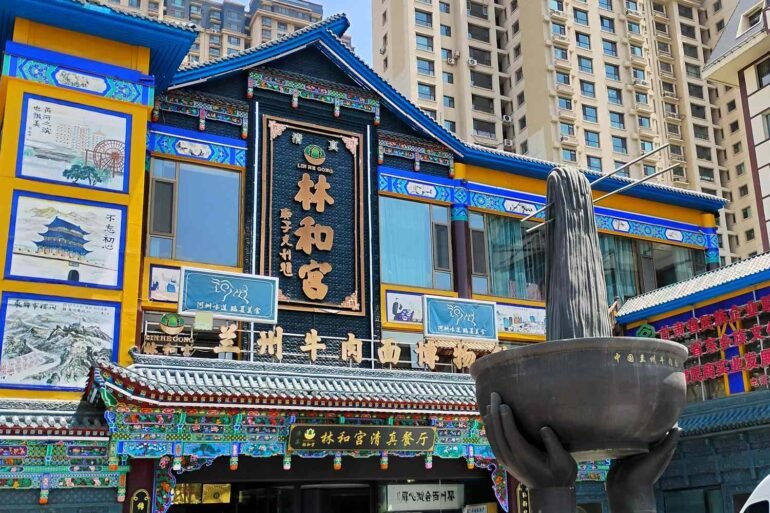
Meet the “First Noodle of China,” as the China Cuisine Association dubbed it in 1999: Lanzhou beef noodles. It’s startling to see sculptures of a noodle bowl, a chef hand-pulling noodles, and people slurping them in front of the Lanzhou Beef Noodle Museum and its restaurant in this city in Gansu province, once an outpost on the fabled Silk Road. (The city’s also famous for the “Flying Horse,” a sculpture of a horse at full gallop in Gansu Provincial Museum’s Silk Road exhibit.) The noodle is so legendary, it was added to China’s National Intangible Cultural Heritage list by the Ministry of Culture and Tourism in 2021.
It looks deceptively simple: a generous amount of sliced beef, wheat noodles painstakingly hand-pulled for unusual elasticity, broth simmered for hours with beef bones and many spices (peppercorns, star anise, ginger, cardamom, coriander, fennel seeds, etc.), cilantro, green onions, and vivid red chile oil. It’s filling, nutritious and very cheap, often about $1.50 in Lanzhou, a city with more than 3 million people where more than 1,200 eateries serve it, especially for breakfast, according to People’s Daily Online.
The dish took China by storm, and over 50,000 noodle shops served it as of 2015, according to the book Modern Chinese Foodways (2025, MIT Press). A video of noodle-pulling shows it’s an art requiring constant kneading and “tears” of the dough, and adding a powdered plant ash (peng hui) for that seductively stretchy texture.
Many believe the dish became popular in 1915 in Lanzhou, when chef Ma Baozi, a Hui Muslim, developed the recipe of five colors (clear, for the broth; white, the radish slices; red for chile oil; green for cilantro and green onions; and yellow for noodles). But its origin may be as early as the Tang Dynasty (7th-10th centuries).
“Growing up, it felt like part of our city’s everyday rhythm, as familiar to us as ramen in Tokyo or pasta in Italy,” says Dawei Wu, a Lanzhou native and director of The China National Tourist Office in Los Angeles. “When I was posted in Europe years ago, I never expected to see it outside China, since the dish relies so much on local ingredients and skill in hand-pulling noodles. So it’s a surprise and joy to discover them abroad, in the U.S. and elsewhere.”
Here are a variety of places to try Lanzhou beef noodles in the United States, where watching the noodle-pulling is part of your meal.
Ox 9 Lanzhou Handpulled Noodles (San Mateo, California)
Sharon McDonnell
Murals explain the history of the dish, note the broth is simmered for six hours with 28 spices, and show the skyline of Lanzhou, dubbing it “a golden city on the silk road,” at this modern eatery across from the Caltrain San Mateo station, a half-hour ride south of San Francisco. Ox 9 offers six noodle shapes – large flat (pappardelle-like), small flat, regular, small or medium round, and belt flat – for its beef noodles, which cost about $15 at time of reporting. Add-ons include egg, vegetables, and extra beef, noodles, or soup.
The name and logo refer to a Chinese proverb about the stubbornness of the people of Lanzhou: “Even nine bulls cannot pull them back.” Founder David Liu, who trained in noodle-making in Lanzhou, opened the first eatery to serve Lanzhou beef noodles in Northern California in 2017 in Milpitas (it’s now closed). Ox 9’s San Mateo location opened in 2022; others are in Cupertino, Mountain View, Fremont, and the Westfield Valley Fair mall in Santa Clara.
Lanzhou Handmade Noodles (Flushing, New York)
The beef broth is richer and cloudier, it’s simmered with both beef and chicken bones for 12 hours, and bok choy replaces radish at this eatery opened in 2016 at the New World Mall food court in Flushing. Lanzhou Handmade Noodles serves 27 noodle bowls, including beef, squid, and vegetables like eggplant and barbecue cauliflower, for $7.50 at time of reporting.
1919 Lanzhou Beef Noodle (Arcadia, California)
East of downtown Los Angeles in the San Gabriel Valley, where 25% of the population is Asian, 1919 Lanzhou Beef Noodle is just one of several restaurants serving the dish. (Others are in Monterey Park and Walnut.) Seven noodle shapes, from angel-hair to twisted (called prisma), are available for about $14 at time of reporting, and extra cilantro or leek are among the add-ons.
DH Noodles (New York, California, Texas)
Named after Dunhuang, the home of Gansu’s most famous sight, the Mogao Caves (a UNESCO World Heritage site known for Buddhist art), about 700 miles west of Lanzhou, this chain has about 15 locations in New York and California (Manhattan, Brooklyn, Syosset, Jersey City, Edison, Cupertino, Milpitas, Irvine), and in Plano, Texas, opened in 2025. DH Noodles serves a broader Northwest China menu, such as cumin lamb and Shaanxi chile oil noodles, in addition to Lanzhou beef noodles.
Silk Road Lanzhou Beef Noodles (San Diego)
Courtesy of Silk Road
The playful decor in this newcomer one block from the beach features a large upside-down blue-and-white noodle bowl as lighting fixtures and colorful plates depicting black-and-white landscapes in the center. Opened in May in Pacific Beach Marketplace, Silk Road offers four noodle shapes for about $15 at time of reporting, and add-ons include soy-marinated egg and extra beef or noodles.
Sharon McDonnell
2025-12-06 13:56:00