
:max_bytes(150000):strip_icc():format(jpeg)/Northernmost-Restaurant-Huset-FT-DGTL1125-Huset5-c0d6b53e631b438d8c2ccefc19591770.jpg)
High above the Arctic Circle in the northernmost town in the world, a remarkable restaurant wows diners with a rare taste of Nordic flavors, unusual Arctic ingredients, and, amazingly, one of Scandinavia’s largest and most extensive wine cellars.
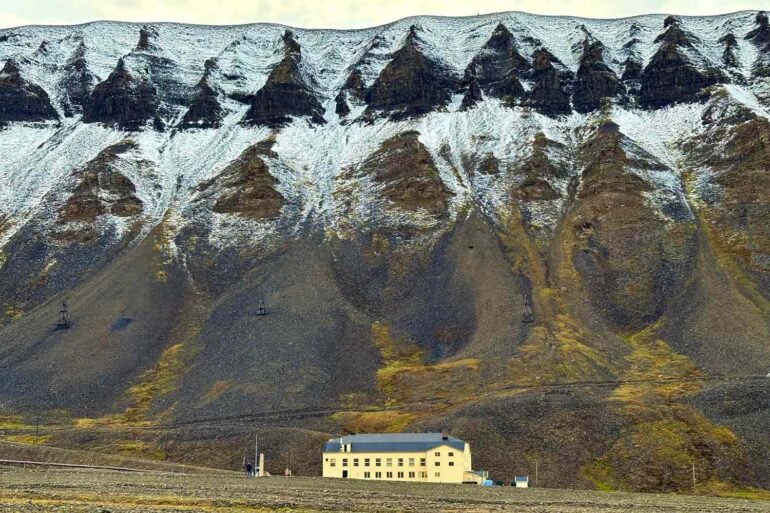
Huset Restaurant, which began as a community hall for coal miners on the Arctic frontier in 1951, has grown into one of Norway’s top restaurants in tiny Longyearbyen, which has a population of just 2,400. Its butter-yellow building stands guard over the stark treeless Arctic tundra.
Since 2022, Spanish chef Alberto Lozano has elevated Huset’s menu higher than the sharp-peaked, snow-tipped mountains surrounding the town. He sources nearly all his food locally — a remarkable feat, considering the limitations of the harsh frozen environment. By showcasing Arctic ingredients and local preservation methods, such as fermentation, Lozano is shining a spotlight on the flavors of the northern polar region — often with a Spanish approach from his homeland.
“For us, local ingredients and historical preservation methods are not just components of a dish; they are equal partners in our storytelling,” he says.
Lozano is proud of his sustainability efforts. From reducing food waste through collaboration with local businesses to turning kitchen oil into eco-friendly soap, he endeavors to protect the fragile environment at the top of the world.
But he’s up against impenetrable permafrost as soil (which also prevents locals from burying their dead here) and extreme Arctic cold, which make growing anything nearly impossible in the Svalbard archipelago where Longyearbyen is located. Glaciers cover more than half of Svalbard. So Lozano cultivates herbs in his small greenhouse. And hunting, fishing, and foraging yield exotic Arctic treasures: reindeer, seal (Norway is one of the few countries to allow seal hunting), ptarmigan (a game bird), mushrooms, Arctic king crab, sea urchin, plankton, sea buckthorn, mountain sorrel, cloudberry, and various kinds of seaweed.
“Our proteins are exclusively wild harvested from the surrounding environment,” says Lozano. “We also have our own fishermen who provide us with fresh cod, wolf fish, and shrimp. Beyond this, we personally forage for ingredients like mountain sorrel (the only source of vitamin C on the island) and wild mushrooms.”
“It certainly presents its challenges, but we see it as a source of creativity rather than limitations,” adds Lozano.
That creativity is unleashed in Lozano’s exquisite 14-course tasting dinner, which I am here to sample. You can choose pairings of innovative nonalcoholic drinks — such as cloudberry shrub cured with elderflower and fennel, and white tea with mountain sorrel vinegar — or wines from the collection of 1,000 titles and 6,000 bottles. Since 2006, Huset has been honored with the Best of Award of Excellence from Wine Spectator Magazine.
The dishes are as artistically presented as they are delectable. They perch on stones, wood planks, pebbles, bones, straw, and gorgeous handmade pottery.
The meal kicks off with reindeer jerky, salami, and chorizo, served with a black shallot paste. No gamey reindeer flavor here, these cold cuts are exceptionally tasty. They are accompanied with beer sourdough bread (using recycled flour from the local brewery), and in a nod to the chef’s Spanish roots, pan de aceite (olive oil bread).
A course of small bites features Arctic shrimp tartare with lacto-fermented green tomatoes, escovitch cod nestled under miso leaves, and grouse-like ptarmigan (the only land-based fowl that overwinters on Svalbard) served two ways: pralines of salted and cured leg meat dusted with blackberry and “anchovies” fashioned from breast muscle rillettes, preserved in high-fat Røros butter, and placed on toasted seed bread. Chef Lozano explains how the bird collects seeds in its storage pouch, which he used to delicately pepper the meat.
Following a palate cleanser of foamy sea buckthorn (a cold-tolerant tart berry found in the Arctic), vinegar, and dill, served in a miniature guksi (a traditional cup from the Indigenous Sámi of northern Scandinavia), I dig into thinly sliced salt-cured and dried seal meat resting in creamy ajo blanco (called “white gazpacho” in Spain). It is adorned with deep-fried almonds and fermented tomato to enhance the umami flavor.
A dish called “King Crab Art” follows — finely sliced Arctic king crab with fermented red cabbage, pickled cloudberries, and dill mashed into a radish gel that resembles an abstract impressionist painting. An amazake-cured scallop sitting on sea urchin emulsified with fermented black apple paste is a sweet-salty taste explosion. Next, squid ink-flavored rice dabbed with piquillo pepper– or plankton-infused mayonnaise accompanies Norwegian langoustine. The seafood dishes end with cod tongue and ramps in pil pil sauce.
Photo by Veronica Stoddart
More ptarmigan is prepared with sea buckthorn sauce and fermented chantarelles — simple and sensational. The fowl is accompanied by showstopping housemade brioches drenched in smoked butter, black garlic, and local seaweed. Pickled mushrooms — harvested this morning — resemble a traditional Norwegian fish ball bathed in fermented fish sauce. Reindeer appears again, this time cherry-glazed alongside a crunchy Jerusalem artichoke.
Dessert is fermented-honey popsicles flavored with sea buckthorn heart, apple juice, and coffee, as well as pickled rhubarb, strawberry sorbet, and rhubarb fizz. Petit fours appear as polar bear gummies of black koji and elderflower (Svalbard has more polar bears than people), while a ceramic whale’s mouth holds pralines of plankton, cloudberries, and lavender.
All in all, it is a deliciously extreme meal perfect for an extreme place.
Huset Restaurant is open Tuesday through Saturday. Book a table at gastroplanner.no or by calling +47 48 04 45 45.
Veronica Stoddart
2025-12-03 13:58:00