
:max_bytes(150000):strip_icc():format(jpeg)/Hemp-Derived-THC-Legislation-Explainer-FT-DGTL1125-1b686be079814421849b173b53bc150b.jpg)
- The new federal funding law signed on November 12 quietly redefines hemp, closing the loophole that enabled intoxicating hemp-derived THC drinks such as delta-8 seltzers to flourish.
- The change could effectively eliminate most THC-infused beverages from mainstream shelves, setting a 0.4-milligram THC cap and prohibiting synthetic cannabinoids while giving producers a one-year transition period.
- Industry leaders say the move will reshape the $571-million-and-growing market, dividing it between regulated state cannabis sales and non-intoxicating functional beverage alternatives.
On November 12, President Donald Trump signed funding legislation to end the longest government shutdown in American history. That legislation brought good news, including paychecks for federal employees and the full reinstatement of SNAP benefits. However, it also came with another surprise: the potential undoing of the entire THC-infused beverage industry. Here’s what you need to know about the future of America’s buzziest drinks.
How we got here: the loophole that created a new industry
In 2018, Congress passed an updated Farm Bill that decriminalized hemp-derived products and took hemp off the controlled substances list, aiming to boost hemp production in the U.S. and help farmers generate new income. However, that bill had a loophole, allowing producers to extract cannabinoids from legal hemp, which can be intoxicating, just like those from its cousin, the cannabis plant.
Food Dive explained that the 2018 law specified that hemp could not contain more than 0.3% delta-9 THC by “dry weight.” The bill did not define what that meant in terms of measurement in products like drinks and edible gummies. Food Dive pointed to the Cato Institute, which reported that because of the ambiguous nature of the language, “a 12-ounce seltzer weighing about 340 grams could contain around 10 milligrams of THC and remain within the limit.”
What’s the difference between traditional THC and Delta-8-THC?
The Association of Cannabinoid Specialists explained that both delta-8 THC and delta-9 THC are present in the cannabis plant. They have similar chemical structures but are “regulated differently and have different safety profiles.” Delta-9 THC is the more common, “classic,” form of THC, and it is responsible for the plant’s “psychoactive effects and medicinal benefits associated with cannabis,” which, they added, have been studied for more than seven decades.
The association explained that although the cannabis plant also produces Delta-8 THC, it does so in much smaller amounts and is generally less potent. While Delta-9 remains a Schedule I controlled substance, the association added, “Delta-8 THC … exists in a legal gray area,” as it can be derived from hemp.
As the association added, “At present, there is no regulation of, or safety testing for, hemp-derived cannabinoids, including Delta-8 THC. Since Delta-8 THC is manufactured by chemically converting CBD, there are many isomers, enantiomers, and by-products of the reactions involved, none of which have been studied for either safety or efficacy. Purifying these chemicals is non-trivial, and studies have shown significant contamination.”
None of this, however, will affect cannabis products sold in dispensaries in states where recreational use is legal. (Cannabis does, however, remain federally illegal.)
How much is the THC-infused industry really worth?
The numbers are a bit all over the place, but, according to Brightfield Group, the U.S. hemp-derived psychoactive cannabinoid market was projected to reach $571 million by 2025, up from just $400,000 in 2020. Euromonitor projected sales will hit $4 billion in 2028. Additionally, the industry employs an estimated 300,000 people, according to the Food Institute.
Why the alcohol industry pushed for change
While experts noted everyone from the prison industry and the pharmaceutical industry, the leading lobbying group loudly celebrating this change is from the alcohol industry.
According to the Food Institute, in October, after more than three dozen state attorneys general sent a letter asking federal lawmakers to clarify the definition of hemp, the American Distilled Spirits Alliance, Beer Institute, Distilled Spirits Council of the U.S., Wine America, and Wine Institute issued a joint statement that said: “As you know, the clear intention of the 2018 Farm Bill was to reintroduce industrial hemp as an agricultural commodity, not to legalize an entirely new industry of highly intoxicating products. Unfortunately, the ambiguous language has been manipulated and exploited by certain actors, fueling the rapid growth of a largely unregulated market that is knowingly and willfully ignoring the FDA’s position that the addition of intoxicating cannabinoids to food is illegal. The FDA has consistently warned consumers about the safety risks associated with these products.”
What the new law actually does
Seth Goldberg, co-chair of the Cannabis & Hemp Law practice, shared with the Food & Wine that it’s critical to note that the change is not a ban on hemp; instead, “it sets the limit on the amount of naturally occurring THC that can be in THC beverages and other ingestible products.”
The change, he explained, also prohibits artificial intoxicating THCs, “like delta-8, that are made by chemically converting non-intoxicating hemp cannabinoids like CBD. The loophole was closed because it was never the intent of Congress for hemp to be marketed as intoxicating, so redefining hemp ensures that it will be marketed as natural and non-intoxicating.” Goldberg added that states can regulate hemp differently than the federal government, “just as a majority of states have legalized and regulate adult-use and medical marijuana, so too can they regulate ingestible hemp products.”
Goldberg further explained to the Food Institute that the new language doesn’t mean that businesses must shut down immediately. Instead, “The legislation includes a one-year off-ramp for hemp-related companies to respond to the changes.”
The move has some support in the industry, including from Jake Bullock, the CEO of Cann, a leading THC-infused beverage brand.
“This isn’t a ban — it’s a one-year shot clock to finally get the rules we’ve always wanted. From the beginning, our vision has been to sell Cann alongside alcohol wherever it’s sold, and today marks the start of making that vision a reality,” he shared with Food & Wine. “High-potency, synthetic products have no place in the market. The industry’s inability to solve that problem is what led us to today.”
Bullock added that his company is ready for the next chapter, along with “the good actors who care about real regulation.” He noted that regulation doesn’t necessarily have to be a bad thing, as it “gives Americans access to the lowest-potency drinks, and keeps them away from minors. Alcohol has been doing this for nearly a century, and we should leverage their rules as a model for these adult beverages, to create smart, sensible rules that let this category thrive responsibly.”
Still, the updated language, many brands say, may not provide the wiggle room they need to survive. “The appropriations rider would decimate not only my own company, but the vast majority of the THC beverage market,” said Chelsie Spencer, a cannabis attorney and COO of Revolution Apothecary. “Adults are turning to this category in droves as they learn that THC beverages can provide the same experience as alcohol without the hangover and terrible-for-you ingredients. Consumers deserve the ability to make that choice.”
According to Spencer, the drinks often require more than .4 milligrams per serving “to achieve the alcohol substitution effect. I think Congress is vastly underestimating consumer appetite for this market, particularly considering THC beverages are one of, if not the, fastest growing category in alcoholic beverage retailers today.”
Spencer’s sentiment is one we repeatedly heard from more than two dozen cannabis experts Food & Wine spoke with while working on this piece.
“For us, the proposed 0.4 mg total THC cap isn’t a tweak; it’s an eraser,” Toby Streett, the founder of Cbdeeme, an online retailer that curates lab-tested CBD and hemp-derived THC products, shared. “Most of the THC beverage consumers actually use are in the 2–10 milligram per serving range.”
As Streett noted, that level of THC is considered “sessionable,” meaning it’s a low dose that can be enjoyed over an extended period. “[It’s] quite conservative compared to a standard 10-milligram dispensary edible. A 0.4 mg limit would make these products essentially placebo drinks and would wipe out the functional THC beverage category overnight.”
The updated language has led some companies to consider a pivot, with many noting alternative functional beverages and gummies may be next.
“We knew this legislation was coming and prepared for it by expanding into more states where cannabis is legal,” Kush Queen’s cofounder Olivia Sawyer said. “We challenged ourselves to diversify with non-THC products. That led us to launch into 700 Spencer’s stores with our exclusive line of Sex Gummies for him and for her.”
The same goes for Gentlemen Smugglers, whose spokesperson shared, “If the rules change, we’ll absolutely find a responsible path forward. That may include leaning into non-THC functional beverages, expanding our licensed THC partnerships in regulated states, or adjusting dosing and formats. But we’d prefer not to be forced into pivoting because of overly broad language that punishes good actors right alongside the bad.”
Others, however, will go back to only selling in states where cannabis is fully legalized. “We’d go back to operating the way we had to when we first launched Artet in 2019,” Xander Shepherd, the cofounder of Artet, said. “Production and distribution would be limited to states that have amenable laws. Based on our understanding, that would be states that have legal, recreational cannabis markets.” While he noted that California and Illinois would remain viable, “we’d likely have to pull out of the entire Southeast and several states in the Midwest, where Artet is immensely popular.”
The changes could also be exceptionally hard-hitting for smaller American startups. “It’s just me and my husband operating the business.” Megan Pralle, the cofounder of Yonderbound, a small, Iowa-based company that makes Trail Mixers, a low-dose, hemp-derived powder, explained. “If the proposed language goes through as written, our product would be illegal, and we’d likely be out of business.”
While Pralle remains confident the language will change in the legislation, the uncertainty is “already impacting our business. Instead of building on the momentum we’ve worked so hard to create these past 6 months, we’re now looking at mostly treading water for the time being … It’s extremely difficult to grow a business when the road ahead is murky at best.”
What does this mean for consumers?
Brandon Dorsky, a California-based attorney and member of the International Cannabis Bar Association and the National Organization for Reform of Marijuana Laws, explained that while intoxicating THC products will still be available in state-regulated cannabis markets, “the costs of intoxicating THC products will inevitably increase as a result of the closing of this loophole.” He added, “Regulators and lawmakers should also appreciate that closing this loophole could lead to constituents choosing other intoxicating alternatives that may have more risks for public health.”
Michael Moeller, founder of Kentucky Hop Water, an alcohol-free sparkling water and a hemp-derived THC product, agreed, noting that consumers should understand that if this law stands as written, “most of the THC drinks and gummies they see in regular retail channels today will be gone or pushed into state cannabis dispensaries by late 2026. They should also know that the problem is not that THC drinks are unsafe by definition, it is that Congress chose a near-zero limit instead of a sane dosage and labeling standard.”
As for what consumers who rely on these products should do, Moeller recommended they contact their representative to ask them to “regulate it like alcohol, do not ban it,” which he added is the “only realistic path” to keep this category alive outside of dispensaries.
“From where I sit, this is not just about hemp drinks; it is about how we handle new categories in American beverage culture,” Moeller added. “There is a one-year window built into the law. If lawmakers want to protect kids and still support small businesses, farmers, and responsible brands, that year should be used to replace a 0.4 mg per container ban with a science-based framework that treats THC beverages like any other adult product — not like a drafting error to be erased.”
Hemp-derived products at risk
If the new legislation stands, a sweeping range of hemp-derived products could vanish from store shelves by late 2026. The law caps total THC at just 0.4 milligrams per container and bans synthetic or chemically converted cannabinoids such as delta-8 and delta-10. Here’s what’s on the chopping block:
- THC-infused drinks: Seltzers, sodas, and “mocktails” containing hemp-derived THC — most currently have 2 to 10 milligrams per serving, far exceeding the new limit.
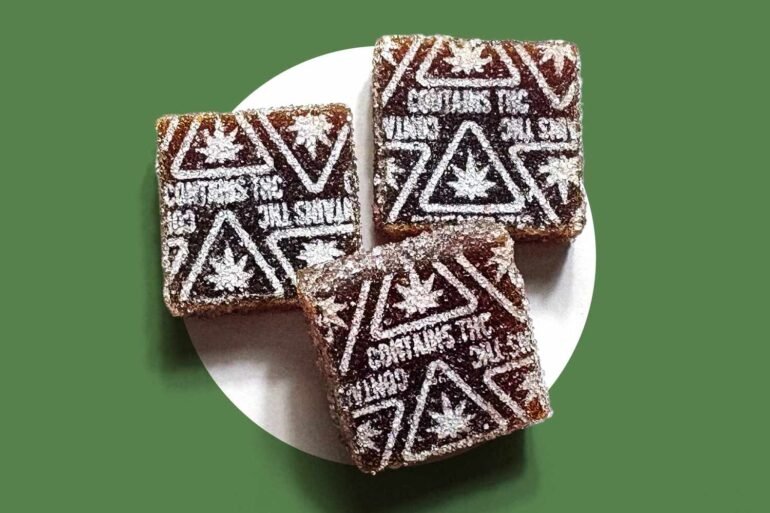
- Edibles: Hemp-based gummies and candies with delta-8, delta-9, or other psychoactive cannabinoids, even at low doses.
- Vape cartridges: Products using hemp-derived or chemically synthesized THC, now considered “intoxicating hemp cannabinoids.”
- Topicals and creams: Lotions or balms marketed for relaxation or “buzz” effects may fall under new prohibitions.
- High-THC CBD products: Some full-spectrum CBD oils or tinctures could lose compliance if their THC content exceeds trace levels.
Stacey Leasca
2025-11-25 11:01:00