
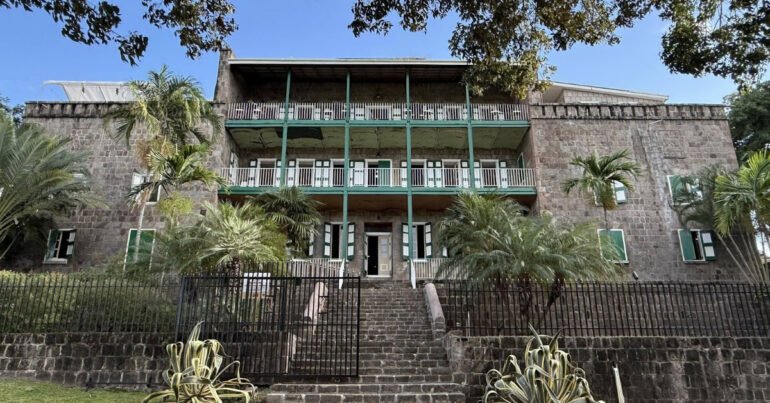
Steam still rises from the hot springs at Bath, just as it did more than 200 years ago, even though there are no more hotel guests.
Stone walls stand where travelers once arrived by carriage, seeking relief in mineral waters long before the Caribbean became a leisure playground. The Bath Hotel, widely regarded as the first hotel in the Caribbean, is now undergoing a major conservation and stabilization effort designed to protect one of the region’s earliest tourism landmarks.
The multi-year restoration is supported by a $403,000 grant from the United States Ambassador’s Fund for Cultural Preservation. The project’s second phase was completed in January 2026.
A Defining Site in Caribbean Tourism History
Built in the early 19th century around Nevis’ natural hot springs, the Bath Hotel is considered the Caribbean’s first intentionally designed spa resort.
Long before all-inclusive packages and beachfront towers, travelers came here for wellness. The hotel was constructed to harness the island’s geothermal waters, creating a destination rooted in therapeutic bathing and extended stays.
If you visit today, you can still see how the property was positioned: close to the springs, open to breezes, oriented toward the landscape. The hotel marked a turning point in the region’s evolution from colonial outpost to health and leisure destination.
Its restoration is more than architectural—it safeguards a chapter of Caribbean tourism that predates the modern resort era by more than a century.
What the Restoration Includes
The current conservation effort is focused on stabilizing and preserving the historic structure to prevent further deterioration.
The work is being led by the Nevis Historical and Conservation Society in partnership with the Nevis Island Administration and local community stakeholders. The collaboration reflects a shared effort to balance heritage protection with long-term cultural tourism planning.
The $403,000 grant from the U.S. Ambassador’s Fund for Cultural Preservation is supporting technical conservation work, stabilization measures, and preservation planning designed to ensure the building remains structurally sound for future generations.
Phase two of the project was completed in January 2026, marking a significant milestone in what is expected to be a continued multi-year initiative.
Why It Matters for Nevis
Nevis has long positioned itself as one of the Caribbean’s quieter destinations—an island where history, landscape, and community remain visible.
The Bath Hotel sits at the intersection of all three. It represents early Caribbean travel, wellness traditions tied to natural hot springs, and a piece of Nevisian identity that extends beyond tourism.
Preserving the site strengthens the island’s cultural infrastructure at a time when travelers are increasingly interested in destinations with depth and story. For visitors, the Bath Hotel provides context. It reminds you that Caribbean tourism did not begin with beachfront mega-resorts. It began with mineral springs, health cures, and travelers seeking restoration.
Safeguarding that legacy reinforces Nevis’ broader approach to sustainable travel—one that prioritizes heritage alongside hospitality.
A Shared Commitment to Cultural Preservation
The restoration effort underscores a growing regional emphasis on cultural conservation as part of tourism development.
By partnering with local organizations and government leaders, the project reflects a model where preservation is community-led and internationally supported.
The Bath Hotel is more than a historic structure. It is a physical record of how travel evolved in the Caribbean—how natural resources shaped early hospitality, and how islands like Nevis became destinations long before the jet age.
As the conservation effort continues, the goal is not to modernize the landmark but to stabilize and protect it, ensuring that its story remains visible.
When you stand near the hot springs today, you’re looking at one of the Caribbean’s earliest tourism experiments. The restoration now underway is designed to make sure that chapter of history remains part of the region’s future.
Caribbean Journal Staff
2026-02-18 19:09:00