
The official role of Heritage Director seems to be growing in prominence across watch brands. It makes sense – a reverence for history has always been at the heart of the art of watchmaking. With that in mind, it is likely there have long been resident historians at established maisons or perhaps even those holding the title Heritage Director working behind the scenes. But more and more, we are seeing these individuals at the forefront, and there seems to be a direct correlation with what is happening in the industry at large within the vintage and pre-owned spaces.
For more than five years now, we have seen the vintage and pre-owned market grow in new ways with both a greater emphasis and prevalence of reputable dealers and marketplaces and a greater interest and demand from collectors. In turn, more and more brands seem to be getting invested in the acquisition, preservation, and in some cases redistribution of their own vintage pieces. While the role of Heritage Director was perhaps once limited to elements like museum curation and historically contextualizing modern collections, the position seems to be expanding into new realms.

Jaeger-LeCoultre is the perfect case study. Matthieu Sauret stepped from the role of Director of Product to the maison’s Heritage Director 2013 after starting his career at Yves Saint Laurent, another historic brand whose legacy spans more than six decades. “In 2019, Catherine Rénier, our CEO called me into her office and said she was very happy with my work and our latest collections, then she asked me what I might like to do next,” recalls Sauret. “I guess she was thinking that I was going to ask for a marketing position, or maybe communications or visual merchandising but instead I said I would like to be named Head of Heritage, and she was surprised, but now she understands,” he explains. “When you work with products, especially at a brand with such a long history, my customers are not just the people who come in the store and buy the new watches,” Sauret explains, “I go to watch dealers. I go to auction houses. It is a continuum. So, when we create a new watch, what I’m thinking is that it is not just going to sell in two years’ time. I think about how this watch is going to last for 100 years.”

A decade into his role as Heritage Director, the landscape around the primary and secondary markets started to take a new shape. By now, you know the story well: the pandemic hit, production in the primary market slowed to a halt, and the vintage and pre-owned market exploded to an unprecedented degree. While the initial boom has since softened and recalibrated, we have never gone back to the primary market’s level of chokehold on the industry. Vintage and pre-owned remain strong, and the movement has trickled down from both veteran dealers and new-wave online marketplaces to the brands directly taking a renewed interest in their own vintage and pre-owned pieces.
While other brands have taken more straightforward approaches, like instating their own CPO programs, Sauret wanted to do something different. Part of his role as Heritage Director had always been curating pieces for the museum and traveling exhibitions, but with the new momentum in the secondary market, he found himself discovering more and more exceptional examples of Jaeger-LeCoultre’s rich history. So, in 2023, in conjunction with the Maison’s monumental 190th anniversary, he developed the idea that would become The Collectibles program – small batch capsules of vintage models that are emblematic of an important moment in time in Jaeger-LeCoultre’s legacy.

The inaugural capsule from 2023 was fittingly unveiled at the Maison’s Manufacture in the Vallée de Joux and featured a retrospective of the brand’s most significant models. Since then, Jaeger-LeCoultre has introduced four subsequent capsules in cities around the globe, including Los Angeles, Singapore, Paris, and now New York City for the fifth capsule celebrating the model that is arguably the brand’s most iconic: the Reverso.
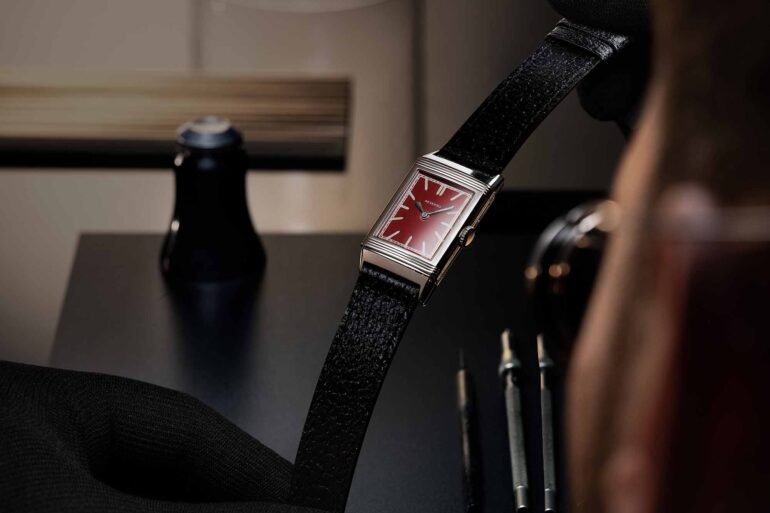
The Reverso capsule consists of eight highly sought after models of museum quality that span from 1931 to 1937. This includes the original 1931 Reverso with a black dial, which was unique at the time when silver dials dominated. In addition, it features a railroad minute track and trapezoidal indexes, which have gone on to inspire the modern Reverso Tribute aesthetic. Next up, you have a rare two-tone steel and 9-karat yellow gold edition from 1936. This model is equally notable under the hood thanks to the Manufacture Caliber 410, the first in-house movement developed specifically for the Reverso. With this new movement, you also get the addition of a small seconds register at 6 o’clock. This layout continues to be showcased in the next iteration – a Reverso from 1937. This model stands out as one of the first models to bear the name Jaeger-LeCoultre as opposed to just LeCoultre following the historic merger of the LeCoultre and Jaeger maisons in 1937.
Cait Bazemore
2026-02-17 19:00:00