
Few other watchmakers enjoyed as much success and cachet as Heuer, especially during the fervent 1960s and 1970s. Not only had it launched one of the world’s first automatic chronographs, but it pushed the envelope on modern design with midcentury-cool chronographs like the uniquely square Monaco. Heuer was riding high on the glamor of Grand Prix: the Heuer shield was as indelible to the backdrops of Monza and Le Mans as Ferrari, Porsche, and McLaren themselves as the official timekeeper of Formula One.
But, inevitably, the quartz revolution came for Heuer. Jack Heuer was the third-generation CEO of the company that bore his name, and he had been a savvy marketer, personally hawking chronographs to drivers like Jo Siffert and Nikki Lauda. By the 1980s, however, he found himself backed into a corner, and in 1982, he was forced to sell the company to Piaget and Lemania—a humiliating low point in his life, as he recounted in his autobiography.
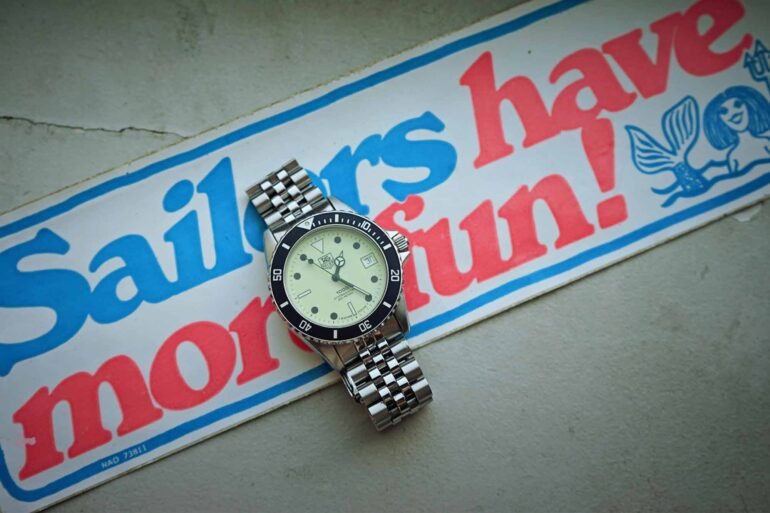
Yet, before he departed, he gave Heuer one saving grace. In 1979, he commissioned Heuer’s first dive watch, the Professional Series. At a trade show Jack had overheard a brief conversation about the unreliability of existing dive watches, and he aimed to emulate Rolex’s success with the Submariner and Sea-Dweller. (Incidentally, Rolex owned half of Heuer’s stock market shares, and nearly took over the company around this time.)

Heuer had spent the decade building an electronic timing division, which by 1978 was its pride and joy: digital LCD watches and stopwatches comprised most of the pages of its catalog, as well as touting its role as the official sponsor of the 1980 Winter Olympics.
A quartz dive watch never has to be wound, reducing strain on the crown and its corresponding gaskets. It rarely has to be set, and it rarely loses consistent timekeeping until the battery dies. As quartz technology improved around the world during the seventies, the movements were becoming more robust, heat and pressure-resistant, with the ability to take standard batteries and get more life out of them. Plus, with one compact movement, watchmakers could experiment with case dimensions, gilded finishes, groundbreaking dials, and different sizes to fit every wrist.

After the French-built Monnin Reference 844 of 1979, which still featured a mechanical automatic movement, Heuer went all in on divers. Catalogs from the period showcase a dizzying array of models with two-tone silver-gold, some combining gold and blacked-out PVD, and many having fully-lumed dials that lit up like a flashlight. Hell, such evolution would have made Darwin take notes. By the nineties, the original 1000 Series—with its Rolex Submariner-inspired case shape and bezel—seemed downright plebian. Model families were going up to 4000 Series, with sizes ranging from 28 to 42mm. There were chronographs, always Heuer’s forte, alongside Super Professional models good for 1,000 meters (and equipped with ETA automatic movements, a departure from the more common ESA quartz). And they rode high on the rounded, avant-garde design of the late-1980s and early 1990s, incorporating everything from gold-studded bezels to protruding triangles that resemble cartoon suns, or starfish.

With their inherent ruggedness and availability, the Heuer divers were perfect for silver-screen tough guys, giving the brand pop-culture cachet in a way that hadn’t been seen since two decades before, during the Golden Age of Motorsports. To wit: the PVD-coated Night Diver was worn by Timothy Dalton as his relatively brief role yet underrated as James Bond in The Living Daylights. In the 1987 Hong Kong movie City On Fire (and thoroughly underrated), Chow Yun-Fat rocks a “military” version of the same watch, albeit in olive. In Die Hard, Bruce Willis wears a 3000 chronograph whose screen-worn version went up for auction in 2018 with a relatively modest estimate. More recently, Leonardo DiCaprio dons a 1000 Professional in The Wolf of Wall Street, which he claims is a “forty-thousand-dollar watch.” Seems like the falsehood reflects the character. Which, incidentally, is also good news for collectors.

And while underpinning the success of a single line might sound melodramatic, it’s without a doubt that Heuer’s quartz dive watches saved the company, and were responsible for nearly doubling Heuer’s sales, year-after-year, well into the nineties. In 1985, the watchmaker was acquired by Techniques d’Avant Garde (TAG), a consortium from Saudi Arabia that dabbled in everything from airplanes to turbocharged Porsches. TAG’s sponsorship of Williams and eventually McLaren meant that Heuer was back in F1 racing. And without the know-how of quartz production, the cult-classic Formula One line would have never existed.
Today, the line of TAG Heuer divers lives on under the fitting Aquaracer moniker. It’s a savvy companion to the high-end racing chronographs and limited editions that proliferate across the brand, allowing TAG Heuer to embrace deep-sea professionals as well as yacht racing and regattas. And if nostalgia moves in thirty-year cycles, then it’s time to harken to this colorful era of functional, rock-solid watches. The resurrected Night Diver, for example, is a good start.
Blake Z. Rong
2026-02-03 20:00:00