
When I’m planning to leave the house for a full day – whether I’m headed to work or someplace else – I’m a chronic overpacker. To me, there’s peace of mind in knowing I have an extra charger, granola bar, or jacket with me, especially when returning home isn’t easy. Traveling to the office adds an additional layer of expectation when considering a bag, as I bring multiple laptops and a lunch with me most days.
I’ve gone back and forth on whether I’m Team Messenger Bag or Team Backpack when it comes to my corporate 9 to 5. I like the significant storage options that a backpack offers and the stability and comfort it provides when walking long distances. Yet messenger bags fit my usual style in a better way, and I like that I can access the main compartments while on the go (not possible with a backpack). I was really intrigued by the Global Briefcase ($149) from Topo Designs as it meant I didn’t have to commit to one camp or the other. I was curious if the brand could do both modalities equally well.

My needs in a work bag are very different from my needs in an outdoor bag. The Topo Designs Rover Trail Pack I reviewed in May held all of my gear in a stacked, vertical fashion. I didn’t need to access anything particularly urgently, which meant I loaded the bag from the top down. This sort of set-up isn’t ideal for my work needs though, when I prefer all of my items to have their own space. To test out this bag, I used both carry styles over a few consecutive days. For the backpack, I walked the better part of San Francisco on foot while in town for a conference. I kept the bag in messenger mode for a week in the office in Colorado.

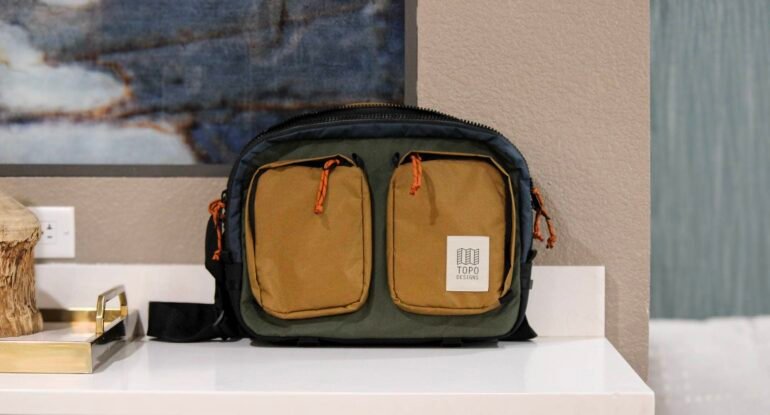
This 20L Global Briefcase is about 16.5 inches long and 11.5 inches high. It’s made of 400D recycled nylon with a 1680D recycled ballistic nylon base. This means the bag has high abrasion-resistance and water repellency – these materials are common in outdoor and tactical gear for a reason. It can be carried three ways: as a traditional briefcase, as a messenger bag (with a removable shoulder strap), and as a backpack with stowable straps. There are two main compartments – one with a padded external laptop compartment – and both are designed with a U-shaped entry complete with heavy-duty YKK zippers.

My favorite aspect of this pack was the sheer volume of it. Between the two main compartments and the large exterior pockets, I felt confident in packing a full day’s-worth of items. In the smaller exterior pockets, I kept all of my smaller essentials like my phone, keys, headphones, snacks, wallet, and a notebook tucked away in the front for easy access throughout the day. In the tech compartment, I was able to store two 13-inch laptops, though the bag can easily accommodate a laptop up to 16-inches. I was also able to fit a puffer jacket and an ungodly amount of books in the main compartments during my San Francisco strolls. I was surprised that both the backpack straps and the messenger bag sling were comfortable while remaining thin. Though I didn’t use it for airport travel specifically, I enjoy that the back panel that stores the backpack straps also doubles as a pass-through option for compatibility with a rolling suitcase (and that it’s personal item compliant on most airlines).
This bag exceeded my expectations. It’s comfortable, practical, and the olive and khaki colorway fits nicely with my style day to day. Topo Designs is known for their multi-attachment capabilities and the Global Briefcase is no exception. There are a healthy amount of their PackFast™ loops on the bag, which allows the user to clip on external storage pouches or gear.

While my experience with the Global Briefcase was a positive one, every piece of equipment has areas for improvement. The first thing I’d update is a purely aesthetic concern and doesn’t impact the bag’s use in any way. In making a triple-carry bag, there are going to be design choices that work for one carry modality and not another. From a design perspective, my primary wish for this bag is that the backpack straps could more neatly tuck into the back panel when one wants to use the bag messenger-style. This could have been achieved by extending the panel enough to provide total coverage for those straps, or even adding another zipper on one side so the straps could be completely secured. This wouldn’t have burdened the pass-through function in any way, and would have provided a cleaner look.

There’s also another handle on one side so the bag can be held or stored when in backpack mode and it feels superfluous. It doesn’t tuck into the back panel at all so it always remains visible. Extending that panel would have also fixed this issue, though removing it entirely would have been my design choice. The bag can be held or hung up using the heavy-duty messenger bag handle, even while in backpack mode, so including two handles on one bag seems like overkill.

The second thing I’d update is not superficial, and is something that could have real ramifications for those relying on the external storage pockets – especially those prone to not zipping up bags all the way (a group in which I consider myself a member). The visual design of the zippers mirrors each other – the left pocket zips to the left and down (with 50% of the pocket being a zipper and the other 50% being sewn shut), and the right zips to the right and down. This gives the bag a sense of symmetry when looking at it head-on, and for that reason, I can see the appeal of this design choice. When the bag is in messenger mode, there are no issues with this set-up. However, once you switch the bag to a backpack and rotate it the necessary ninety degrees, the contents of the right external pocket (now at the bottom) are in a position to put all the weight on the zipper instead of the reinforced part.
Whether you look at it from a position of user-error (not zipping the pocket all the way) or a position of physics (and that pesky gravity), this is a potential point of failure. Making the right pocket zip to the left instead would have created natural redundancy by ensuring any contents rested against the securest part of the pocket. Though this all speaks to overall security, which was my initial concern, it’s also simply a UX issue – opening the bottom pocket while the backpack is being worn means all of the contents left outside the inner mesh component would fall to the ground. A simple change could fix this issue – though those only using the main compartments in the bag might not encounter it at all.

Overall, the Topo Designs Global Briefcase impressed me with how thoughtfully it bridges the gap between messenger bag and backpack without losing the core functionality of either. Its durable build, organization, and versatility make it an optimal daily companion, whether commuting across a city or weaving through an airport. The few design quirks I encountered don’t overshadow the bag’s strengths, but they influenced my experience of the bag enough that they warrant mentioning so other prospective users can get the full picture. With some refinement to strap storage and zipper orientation, the Global Briefcase could easily become an ideal hybrid carry for anyone who wants reliability and style in one work-ready package. Topo Designs
Meg Tocci
2025-12-18 15:00:00