
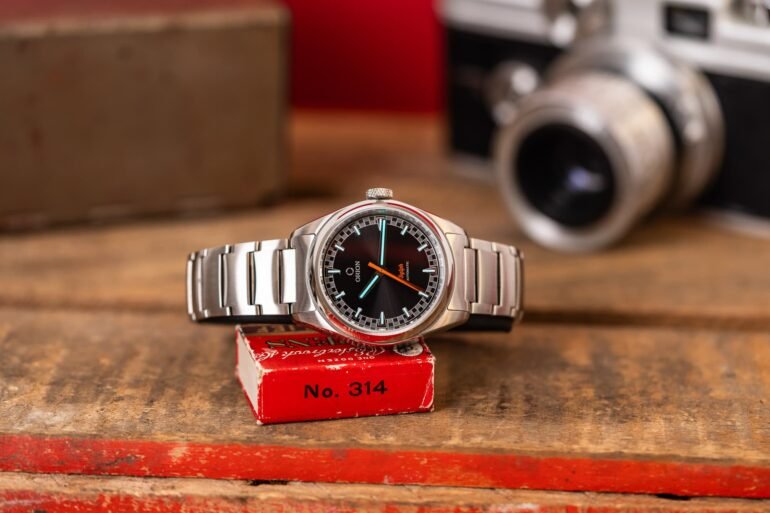
I’m going to go out on a limb and guess that most of you reading this right now won’t know the name Nick Harris. Don’t worry, I’m not calling anyone out; if you weren’t a dedicated Seiko modder on the right forums at the right times, it’s not a name you’re likely to have come across. Nick, despite being an accomplished watchmaker and avid enthusiast, just isn’t as well-known as the brand he created, Orion Watches.
It’s not a huge surprise. As enthusiasts, we tend to have a better memory for brands and watches than we do for people (how many of us have pulled some variation of the classic, “I can’t remember his name, but he had that great vintage Sub”), and that tendency easily extends to brands, even small ones. It’s easy to forget that many of the brands we talk about on Worn & Wound, and so many of the watchmakers that get us excited, aren’t really “brands” in the typical sense.
Many of our favorite brands aren’t machines operating with marketing departments, state-of-the-art production facilities, and overflowing C-Suites. What we broadly call “brands’ are usually the result of the passionate work of one, or maybe two, dedicated creators, their brand names and logos serving more as a personal maker’s mark than as an identifier for a sprawling and impersonal corporate structure. The consequence here is that it can be easy to conflate these small one-man shops with their more established brethren.

That can make it particularly difficult when a brand, or more specifically, the man behind a brand, starts to run into the kinds of hurdles life seems to throw at us all, something we were all reminded of in stark fashion when friend of Worn & Wound (and founder of Vortic and Colorado Watch Companies) RT Custer faced a sudden and dramatic health challenge earlier this year. It was an incredible sight to see the watch community rally around him, and to be reminded of just how personal this hobby can be.
Which brings us back to Nick Harris. As I mentioned before, Nick is the founder and watchmaker behind the American watch brand, Orion Watches. It’s a brand that should be familiar to the deep cut Worn & Wound reader — after all, we’ve been talking about the brand for just about a decade now (Zach Weiss went hands-on with one of his Seiko mods back in 2015, and followed that up with a look at his first Orion watch a year later). Nick’s watchmaking has progressed immensely in that time; something made tremendously obvious in Nathan Schultz’s look at one of the brand’s more recent offerings at this time last year, but the same decade that has seen Orion grow and evolve has also seen Nick face a series of personal challenges.
Origins of Orion
How’d you get into watches? There are plenty of ways people do; hand-me-downs from parents and grandparents, tech exhaustion, habit, boredom, movies, wanting to mark a moment — the start point can be almost anything. For Nick, it started how it starts for so many of us, with an old watch.
“I graduated college, and I was just working my job, and kind of had a lot of idle time on my hands when I wasn’t working, and figured I needed a new hobby,” Nick told me in an interview. “And I had this broken family heirloom, which was my great-grandfather’s Omega Constellation which I had inherited, and it was broken. So I figured, ‘Hey, this could be a new hobby. I could teach myself to fix this watch.’ And I just started researching these old Omegas, I started researching watch repair, and I very quickly realized I was out of my depth, but I’d fallen in love with the world of horology.”
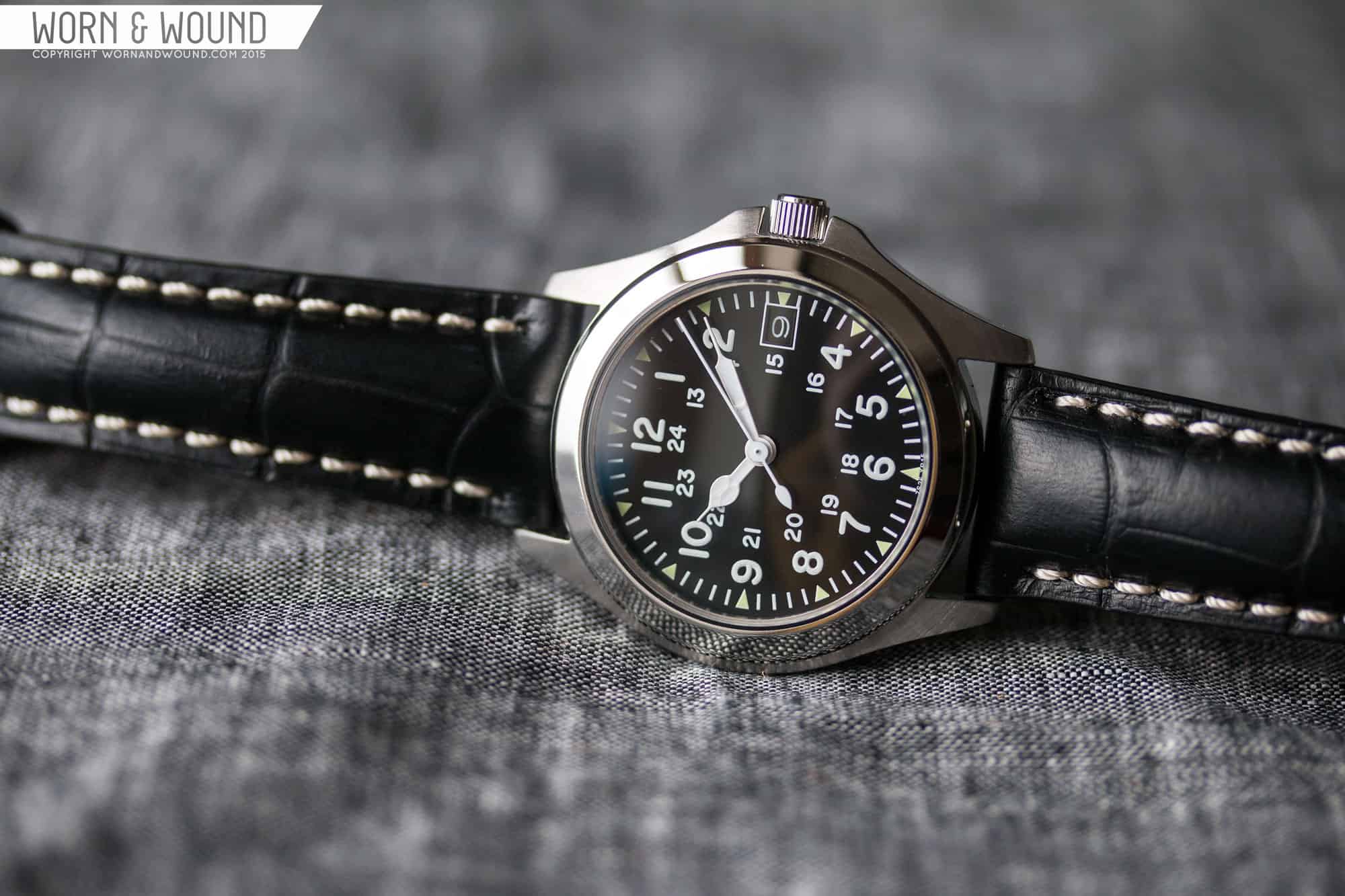
Soon, Nick was buying other broken watches, trying to fix them. “It was kind of like the grain of sand that got it started.” Eventually, this path led him to Seiko, and through experimenting with repairing broken Seikos, Nick found the Seiko modding community. But he didn’t stop there. Where most of us find Seiko modding, maybe mess around with a few bezel swaps or dial changes, then throw a sapphire crystal in an SKX and call it a day, Nick plunged right into the deep end, working directly with factories around the world, developing custom parts, and leading directly to the creation of his first watchmaking business, Watches by Nick.

“It got to the point where I was like, ‘Hey, do I really want to spend another decade in academia for biology, or maybe should I try this watch thing?’ I was basically having different factories make most of the components for a watch, so I figured I’ll just make my own watch, go to watchmaking school, and if I don’t like it and it doesn’t work out, it’s not too big of a time loss compared to higher education for biology or something.”
This inflection point also happened to come at exactly the right moment for Nick, who, like all of us, was facing the barrage of questions that await us all as we make the transition into our post-academic world, whatever that means for each of us. “It’d become a passion at that point, and I was totally in love with it. I spent so much time playing with watches, and I’m getting this question from everyone, like, ‘What’s your career gonna be? What are you gonna do?’ And I could see it, you know? I could see becoming a watchmaker, producing my own watches.”
“I don’t know if that makes sense, but when you can kind of see the path forward in your mind’s eye… I felt like it was pretty tangible,” Nick continued. “And I loved every moment of it. I think it was the culmination of a hobby turning into a passion, and then it crystallized. Like, ‘Hey, people are paying me to do this, why not go to school and get even better? Why not stop making parts for Seiko’s watches, and just make my own watch?’”

With any big move, like starting your own brand or diving headlong into a new career path after a lifetime in traditional academics and academia, there has to be a turning point, a moment that pushes you over the edge, into the willing unknown. For Nick, that moment came when he started getting deep into producing hands, dials, and crystals for the Seikos he was modifying, but the move to producing watches under his own name has hardly been the last evolution for Orion. The decade since has seen a dramatic evolution in the look, feel, and identity of Orion watches.
“The Field Standard is a very traditional field watch, and it’s based on a Seiko mod — probably one of my most popular Seiko mods,” Nick explained. “You know, I must have assembled hundreds of those things, but when you have your own brand, you’re not constrained to other people’s stuff anymore… Initially, with the first few models, I wanted something that was easy for people to modify, that was modular. It was based on Seiko, so it wasn’t super exclusive in terms of price, and people [could] mod it if they wanted to.
“And then I realized that modders weren’t going to buy a whole watch to modify. Some people did, but most people bought it because they liked it. After that [realization] I started thinking about what was really missing in the watch world, and how [could] I develop a brand style and aesthetic, because I think that’s also largely missing in a lot of microbrands — they just release whatever, and if you remove the logos, you might not know they’re from the same brand.
“So after the Orion One, the first SYLPH, and the first Field Standard, I was like ‘What can I do to tie this all together?’ And it started becoming a similar case design with very thin, curved case backs, and ergonomics. I developed a typeface on the Hellcat, which eventually found its way through all the models made after that.”

Unexpected Setbacks
[Author’s Note: The following portion of this story includes somewhat graphic and candid descriptions of severe health challenges involving pain and the brain.]
In the midst of building Orion, and in developing his skill as a watchmaker, Nick began to experience the types of life challenges that can throw even the most careful planning off course. “In my second year of watchmaking school, I started getting sick with a bunch of weird symptoms,” he told me. “It started with these migraines and headaches, and then my memory started going bad. And then, right before my final exam — which, if you fail, you fail everything, regardless of how well you’ve done — my eardrum spontaneously ruptured and there just… There was so much pressure in my head. I basically was getting sick, and doctors would be like, ‘Oh, it’s allergies, you’ll get over it.’ But there [were no] allergies.”
Without a clear diagnosis, there was no solving the problem, so Nick opted to push through, finishing the SAWTA Certificate program at North Seattle College, one of the few full-time two-year watchmaking programs offered in the United States.
“My goal was really to [take] a hybrid approach, where I was using global supply chains to make a watch, and then I would also be manufacturing stuff on my own. So the plan was to just head home and kinda take care of my health. I figured it was just stress, and I’d get some good rest, and then I’d feel better.
“But it kind of dragged on, what turned into weeks [then] turned into months, and, during this time, it got harder and harder to work, and then doctors kept dismissing me, [still] saying it’s just allergies. I started seeing more specialists, and then it went from allergies to, ‘Oh, you have a brain tumor!’ There were a ton of ups and downs during this time. It got so bad that I basically wasn’t able to work, and then I ran out of inventory, and I thought Orion was done. Because I was just lying around in pain, and nobody could solve what was wrong with me, and I wasn’t able to think, I wasn’t able to work.
“Before, during watchmaking school, I was doing twelve to fourteen–hour days because I was obsessed, and I was in love, and it was just a very stark contrast. [Going from] trying to make cool watches, and this hyper-fixation with watches, to all of a sudden a hyper-fixation with trying to feel normal. Coming out of that, it has shifted my perspective on watches and business quite a bit. You really just need to be kinder to yourself, and maybe watches aren’t that important, right? When juxtaposed with your health and the health of others. Things like that really put it into perspective for me.

“But another hard thing was just having to come to terms with [the idea that] I’m not really going to get my old body back. I’ll never have that kind of energy, and, you know, there might always be some level of pain and discomfort. Coming to terms with that has been, and still is, pretty hard.”
Nick was diagnosed with Intracranial Hypertension (IH), a rare condition primarily characterized by an overproduction of cerebrospinal fluid. When the brain produces too much spinal fluid, or the fluid can’t drain, it puts pressure on the brain that can cause a variety of painful symptoms. Not just headaches, but it can lead to vision changes, hearing loss, and a variety of other ailments.
It’s also incredibly rare. According to the Cleveland Clinic, IH (or specifically, Idiopathic Intracranial Hypertension, the most common form of the disease) is found in just .2 to 2 people per 100,000. It’s also most commonly diagnosed in women between the ages of 20-45 with a BMI of at least 30, a category which Nick decidedly does not fit into.
“Doctors couldn’t believe that I had it, and then someone diagnosed me with it, and the medication worked… and they pulled me off the medications, and it got worse.” Eventually, Nick was able to work through a treatment plan that seemed to push his IH into remission, but earlier this year, the disease came back in full force and necessitated a return to a treatment plan that is, by all accounts, unpleasant. In the midst of all this, an electrical fire broke out in his home, forcing him out of not only his living space but out of his workshop as well.
Now, things are better. Nick is recovering and is close to being back in his own space, but the challenges he’s endured have left their mark.

“I have to accept that I need help with watches now; that I’m not as fast as what I once was, you know? So if I’m repairing or servicing for people, I take my time, and it takes a lot longer. You know, I’ve got way fewer active hours in a day. I can’t do a twelve-hour day, or a fourteen-hour day. I might be lucky if I can do a four or a six–hour day.”
The Path Forward
So, where does all this leave Orion? Well, if my time speaking with Nick is any indication, the brand still has a definite future. Nick still has big plans, and there’s a whole lot on the horizon. I can’t quite say more just yet, so I’ll leave you with some final words from the man himself, Nick Harris:
“In terms of Orion, it slows things down a bit. It means having to find help and learning to trust someone else with the brand, [which is] a compromise in some way. It’s also reduced my neuroticism, with being obsessive about watches. There’s still space, I’m still fired up to create great watches, but there seems to be less neuroticism, and more peace with something that’s great, and it doesn’t need to be perfect. I guess in watchmaking, we say ‘perfect is the enemy of great,’ and I’m feeling that a bit more. I think I was very hard on myself before with all this stuff — a bit of a perfectionist, and you just can’t do that. You have to be kinder to yourself and more gentle with everything.”
Griffin Bartsch
2025-12-15 19:00:00