
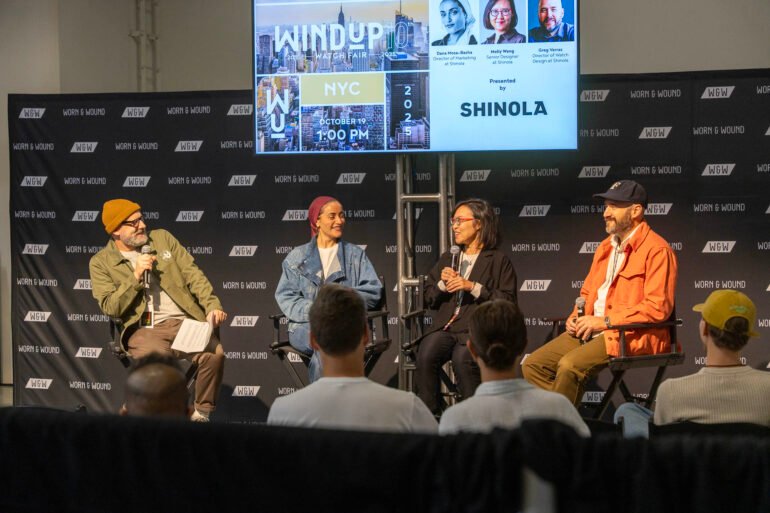
Kyle Snarr
Greg, when you think about the craftsmanship and the industry communities that care about deep craftsmanship as well as bringing some sort of spirit to a product—some sort of life force within the product—what kind of stories can you pull out that talk about how a product’s design direction has changed along the process based on making sure you’re not only reflecting craftsmanship, but giving it a soul?
Greg Verras
Yeah, for sure. We talked about manufacturing a lot last year and so we wanted to dive more into the design and the cultural influence. So we pulled together just a few examples that we could share today—raw files from the design desk. First of all, before we get to that though, we’ll—Is this working? Where do I point it? I realize I didn’t show images in my first answer. It’s OK. We’ll cover it. We had a really great project—probably our biggest moment of the year—was the J Dilla collaboration. Every year we pick a great American that we want to celebrate and their contributions to culture. So J Dilla, born in Detroit but had a global impact on music as a whole. We worked with his family and his estate to arrive at this watch. It sold out in, I think, under a day, so a good moment for us. But more importantly than that, it was the meaning behind it, creating a moment for his friends and family and his fans. It was really a delicate moment as well. You don’t want to just throw a donut on the dial and call it a day. We really wanted to offer something new, add to the culture, as opposed to just be derivative. Here we have one of the variants inspired by… Some of the Easter eggs of this design: the cassette tape influence that came into it was our way of saying—J Dilla was known for the way he thought about time and the way he structured his songs. It was very unique, and there was a kind of a before and after J Dilla. Part of that story was some of the first tools he had were just a simple cassette tape. Before he got into more digital means, the cassette tape was really where it started. That was our way of saying the genius is in him and not in the tools. Some of the tracking and marks on the dial don’t actually make sense on a watch, but it shows how he thought and really felt time. Eight bars on the strap. Just all these little Easter eggs. The process can be wild sometimes. Actually, we work with the marketing side to kind of bonsai that story into something digestible, and that’s where Dana comes in to help us curate. That’s J Dilla.
Kyle Snarr
I’ll just quickly say I love how you guys used the sub dials to be kind of like the cassette tape reference there. It’s very subtle. It’s super classy, but not overdone. But once you see it, you can’t unsee it.
Greg Verras
Yeah, it’s kind of finding that balance of something subtle. Once you see it, you see it. And at Shinola, that was the first time we used discs. So we really had to vet that with our factory and make sure that we could do that in a quality way. Some of these things that seem simple, when you have your own factory, can be more difficult than you think. That was a cool moment that we were able to achieve. So, yeah, I wanted to spend a little bit of time with the Mechanic today. This is the final result. The theme of the topic today is: how does culture impact design? Looking back almost six years to when we were working on this, I tried to find a few moments that illustrated that. It kind of started with—the initial name was Project Granddad—and we just wanted to do the most vintage watch that we had ever done. Along the way, we got excited by our surroundings. Places like this—and the next two slides—are basically on my drive home from work. The culture of sign painting, especially in Detroit but in a lot of cities, is alive and well in places like this, and there’s a new wave to it as well. We got to know a few sign painters—people that have been working in the city for 30 years and others that are new in this next wave. That impacted the design. We started really simple—3D models we had built. Sort of looks like a vintage watch. We were deciding things like: do we do a round watch? Do we do a shaped watch? Then we worked through which movements we wanted to incorporate. We felt the chronograph was probably too much to start with, so we landed on the simple three-hand date. But how do you layer interesting things into that? That’s where sign painting marries up with watchmaking culture. Very much informed by watch culture in the sizing and the movements people are excited about—but how do you stir more into the pot? We did a font study, seeing what font we wanted to choose. One night on the couch I went down a rabbit hole of sign painting fonts—gold leaf, the ways they convey information and make it super poppy. One of those moments where a whole world opens up for you creatively. We used that. This is really a story of how breakfast tacos influenced the design. This image—from Atlanta where my brother lives—you can see how it impacted the colorway. Eventually we added that 3D drop shadow. All done with really precise pad printing. The challenge was squeezing three different colors into a number with pad printing—yellow, blue, and red. There’s the name element too. Sign painters used to call themselves mechanics. I think they wanted to be taken more seriously or something back in the day—working with carpenters and plumbers—really a trade, working alongside these guys. Part of the research was learning that—there’s a great book on it. When those kinds of moments click—Mechanic—and we had been working on a manual-wind movement, you start to feel like you’re onto something. This is pitching it internally. It carries all the way through to the launch party. We worked with Jordan—Motown Signs—an active sign painter in Detroit doing great work. He helped us launch the product and designed some of the packaging—font work on it. This is gold. This is not something that would have happened if we just stayed in a watch box. Mixing in the cultural element helps us add to rather than be derivative.
Kyle Snarr
I think it’s pretty incredible, because you guys set out to make a non-quartz watch—something mechanical, in this case hand-wound. What impressed me is that you weren’t just saying, okay, let’s find a really good hand-wound movement and jam it in this case over here. The thoughtfulness you put into creating the story, the culture, the connection to roots in your location—it’s very evident. Well done. That’s an awesome example.
Greg Verras
Thank you. Final detail—even the strap. I call it the ladder strap because ladders are a tool. So the bracelet and the leather strap—you see this very simple ladder pattern.
Kyle Snarr
Amazing. Awesome. Here’s my next question, I’m going to shoot it to Molly. When you’re designing a thing, do you start by asking who it’s for, then dig for cultural influences that answer that question? Or is it the other way around—you get sparked by a cultural thing, then say, okay, I have an idea for an object, and then go look for who it’s for?
Molly Wong
I think that’s such a great question. I feel like you’re from a design background—really digging into our thinking process. So I would say it goes both ways. For example, this project started with an idea: we wanted a vintage manual-wind watch. Then we started discovering sign painting. So for this, we started with an idea, then developed the cultural influence on the design—less thinking about who the watch is for in the beginning. But in the end, if we create something that’s so unique and cool, people will love it.
Kyle Snarr
Dena, in marketing it’s usually the other way around—target audience first, then create to capture that person. Molly’s explaining that you’re making great things and putting them into the world, trusting the right people will love them. How does that make you feel as a marketer?
Dana Mosa-Basha
I think so much of what Molly says resonates with our marketing approach and brand direction. We’re always in this seesaw between designing into a consumer we’re trying to go after, or designing into a world we’re creating. At the moment, we exist a little bit more on the latter. I love hearing Greg and Molly talk about the nuances of design, and I love when people visit the factory and HQ and see all the ways they flex design language into things other than watches—poker sets, Monopoly, candles, leather—there are so many extensions. It’s important to focus on who you’re talking to, but we don’t love to fixate on it. The great thing about Shinola is the massive array of people with us: a 55-year-old man from Oklahoma who’s been with the brand since day one; a 20-year-old buying a Shinola as their first piece; someone who loves our journals and has been buying our stationery for 12 years. I don’t love to pigeonhole us. Know who you’re speaking to, but if you build a world, people will come.
Kyle Snarr
With so many stories to tell, is it hard to decide what to keep in and what to leave out? Is that more data-driven or gut instinct?
Dana Mosa-Basha
Being data-driven is important—it gives you direction. However, I’m more instinct-driven, and a lot of our team is too. That’s valuable in marketing because many ideas can’t be taught, and a lot of the things that resonate with people can’t be pulled from a consumer profile that tells you where they’re shopping and eating. Marketing Shinola means asking how it’s going to fit into your world. So, in our campaigns—even in a simple on-model shot—we don’t use agency models. Most people we work with are creatives, business owners, designers, chefs. We use a wide array because our audience is massive, and we want different people to resonate with our marketing and product in different ways. We launched series to showcase this. Factory Sessions: we work with musicians and artists to film an episode in the factory; they give a live performance, we film it. We worked with Slum Village—dear friends and collaborators of J Dilla—part of our J Dilla work. They came to our flagship in Detroit and performed “Selfish.” Ten Thousand Hours: we travel around the U.S. and find chefs, painters, designers, DJs—movers and shakers—spend time with them, learn their craft and journey, essentially their 10,000 hours building their world, all while wearing a Shinola watch. New episodes in New York with a tailor and a painter—imagining our product in situations where, say, a DJ can still be part of this brand. The Movement: building a watch is way more complicated than it looks; years of training go into watchmaking—dexterity, vision. We bring different people into the factory to work with Titus—who is at our booth if anybody wants to learn how to set a watch—and they try to build a watch while getting interviewed. It leads to a hilarious but frustrating process—our version of Hot Ones. We recently had Zach Fox—amazing episode. These are ways to not just say “here’s a stunning watch and beautiful pictures,” but to create an environment of all the languages Shinola speaks and the world we live in.
Greg Verras
I love The Movement in particular because we have a factory—and you can only say “we have a factory in Detroit” so many times. This gets people inside the factory and does something fun in it. A good way to communicate that without repeating ourselves too much.
Dana Mosa-Basha
Totally. It’s always hilarious. It’s important to bring new eyes into the brand because once people are a part of it, they stay for a long time. These are the bulk of what’s driving new eyes to Shinola. Even just the comments on Zach Fox—so many people ask: what is he wearing, what is he doing, why does he have those things on his fingers? It’s a funny interview, but they’re also learning about the art and precision of watchmaking, which is very important.
Kyle Snarr
I appreciate you pulling the curtain back because a lot of people—especially general consumers—just don’t know. We have a few more questions, just a little time, then we’ll open it up. Can you guys advance to the next slide real quick? This is an example of one of your own watches—the Circadian 36—and this fascinates me. I want to direct this to both Greg and Molly. For a company with a bolt of electricity on its dial and a lot of quartz watches powered by batteries over the years, you now have multiple lines of mechanical movements assembled in Detroit. Take the Circadian 36, which you’re both wearing today. I was blown away because it fit into my enthusiast category really well: 36mm mechanical everyday go-anywhere-do-anything watch by a company who also makes a 47mm Runwell quartz and has a wide variety. Here at an enthusiast event, having something that checks so many boxes for enthusiasts, but also having watches tuned for a general watch consumer seeking something big and hefty as a statement piece—you have such range. What cultural signals are you taking in to make sure you have watches that range from enthusiast design to heritage pieces? How do you make sure you’re checking all those boxes, and what are those signals? I’d love to hear from both Molly and Greg.
Greg Verras
Sure. How do you have those two watches in your collection? It’s pretty simple for us. If you think about saying, “you should only wear 34-size pants,” it doesn’t make any sense. Shinola is all about making a bigger tent for watch people—inviting as many people as we can in. If you can show you can do both—the style thing and the watchmaking thing—it becomes super powerful. It comes down to proportion. Some people have bigger wrists and 47 looks great on them. We have seen trends over time—47 is a smaller part of our collection now as size comes down. We re-released the 36mm, which when we launched the brand was harder to sell then, and it went away. People focused on the 47 part of it. We always had 41 and 36mm Runwells. So whatever size of Runwell people want to buy—it’s more about the idea of what Runwell is: built in Detroit, super high-quality heirloom, fits into your life really well. How do we get to something like Circadian? Events like this really inform—talking to people, but even talking to people around the office, talking to women who want to get into automatics as well; we didn’t have as many options in that category. That helped us. And, yeah, I’ll admit a little bit of a chip on the shoulder—we floated the idea of a 36mm automatic unisex we can sell to men and women, and not everybody believed in it. We’re a year into Circadian now—it’s been amazing—and we’re releasing the new black and gold one this weekend.
Kyle Snarr
Congratulations. And coming to events like this was part of this path?
Greg Verras
For sure. Concentrated conversations with people who enjoy stuff like this.
Kyle Snarr
Molly?
Molly Wong
By coming to this event and talking to people—it’s how we get inspiration and learn from customers. Especially for the Circadian, we’re seeing female customers coming to the show feeling more comfortable trying on watches. Sometimes we just need to push our brand a little further. Management can feel hesitant about introducing or pushing boundaries, but when we meet real people and hear what they want, we push our design team to push the message inside the organization and then just go for it.
Greg Verras
I think one of our goals—planned months in advance—was to be the most welcoming brand for women in the building. Not a secret anymore, but that was part of the intention. We’re well suited for that with the leather goods and the feel of the brand.
Kyle Snarr
Amazing. Thank you for choosing Wind-Up as a place to get this information and be influenced by our culture, and thank you for making it a big tent where everyone can celebrate watches together. Quick questions from the audience?
Audience Member
As time has progressed, have you each had a dream project you’ve wanted to do in the company? Have you already done it, or is there something you’re potentially working towards?
Greg Verras
The Mechanic for me was definitely one of them. There’s always another one. This is kind of the next one for me that I’m putting a lot of heart into—trying to get alignment internally to launch something. We all have our little passion projects.
Molly Wong
For me, Circadian is a good start—creating more mechanical watches for ladies.
Kyle Snarr
Not just for ladies—I’ll wear that in a heartbeat. So good job.
Dana Mosa-Basha
I think for me, more collaborations—which we have some exciting ones coming in the watch world in 2026. We’re now starting to collaborate on different items—not yet watches. We just released, or are releasing, a knife with Giant Mouse next week. But we have exciting watch collabs coming in 2026 as well.
Audience Member
Product and brand marketing question: if you have a product company and a marketing spend on amazing content like what you’re creating, how do you balance that? Marketing spend might not be direct dollars—lost dollars potentially. How do you balance product and marketing, and do you ebb and flow between spends?
Greg Verras
We’re all battling for dollars within the company, but we also know they’re both essential—legs on a chair. I think we find a good balance. There are maybe some watchmaking tools I’d like in the factory that I quibble about, but there’s a pretty good balance of spreading those dollars around.
Dana Mosa-Basha
This is an every single day question. For example, J Dilla was our highest marketing spend this past year, but it sold out—one variant in 15 minutes, the second in three or four hours. Do you spend higher on something that will potentially sell out immediately? My take is you should spend the most on building the world and having the most interesting story—which J Dilla was for us—from both product and story perspectives. We look at the entire year and ask: what are our biggest moments? Then we split the budget based on that and keep some filler to pulse specific products and moments. It goes back to spending more on building a brand.
Kyle Snarr
I’m learning a lot here as one of your advertising partners.
Audience Member
Curious about the timeline of a project and how it gets started. The Mechanic—where did it start, how did you kick off the project, and what was the total timeline to hit market?
Greg Verras
Every project is different. For that one, our founder loves to participate in design—super creative—and he started us down that road. He’s good about handing off the initial idea and giving us room to operate. He wanted something super vintage with a domed dial—that was the brief. We built it out from there. I thought it sounded like a good opportunity for our first manual-wind watch. Then the sign painting influence comes in. For something brand new from the ground up, we target around two years. We can operate quicker; sometimes it takes longer. Two years gives time to follow a non-linear process—you might go down a design path that leads nowhere and have to start over. Even in the design process for one dial, we probably design hundreds of dials across many rounds to finally land on one design for production.
Dana Mosa-Basha
From my perspective that makes my life hell because we had our 2027 kickoff almost six months ago, and you kind of have to be like what’s going to be important to everybody in 2027. It’s hard to see the future.
Kyle Snarr
You can’t see the future?
Dana Mosa-Basha
I try, but I’m not Raven-Symoné.
Audience Member
I just visited Detroit for the first time earlier this spring and it’s a very interesting city. What’s it like being a brand and having a business in Detroit? Challenges or advantages?
Greg Verras
To have a watch company in Detroit—you’re not in Switzerland, there aren’t watchmakers around every corner. It can be hard to find, but we do a lot of job training—DNA of the brand: teach somebody to be a watch technician. We’ve had people go on to watchmaking school and we love to see people graduate—we hope they come back someday. I was in design school in Detroit around 2000–2010, and seeing the transformation of the city—the creatives moving back—things click, there’s more opportunity. We’ve been riding that wave. The launch of our brand overlapped with a resurgence—lucky timing or great vision.
Molly Wong
There’s a big benefit to being in Detroit. There’s a reason we chose it as our home—it has a strong culture of craftsmanship and industries, and talent is already in the city. It’s hard to build a watch industry because there was none in the United States, but there’s factory-setting talent we could grab, train, and make something truly our own.
Kyle Snarr
Give everyone from Shinola a big round of applause. You guys were awesome. Please swing by their lead sponsor booth here on this floor and check out some of the watches we discussed today. And thank you once again for being our partners. You guys—you’re the best. Thanks so much.
Worn & Wound
2025-11-27 15:00:00