
:max_bytes(150000):strip_icc():format(jpeg)/Copenhagens-Cant-Miss-Holiday-Markets-FT-DGTL1124-Hojbro-Plads-177542035ada41ff907908b1b4e66eb0.jpg)
Holiday season in Copenhagen is dark and cold. The nights are long and the sun might hide behind thick banks of clouds for weeks at a time. Strong winds drive the cold rain down collars and wet streets wick up trouser legs. People stay inside and get cosy hygge at home. This all makes the Christmas lights adorning the squares and markets vital points of light and community. Festive markets spring up across the city’s neighborhoods selling Christmas trees and artisan food and crafts. Though the Christmas market tradition is arguably more German than Danish it has been adopted across Copenhagen.
What is absolutely and proudly the city’s own is Tivoli Gardens. The inspiration for Walt Disney to create his Disneyland, this is the original amusement park. Pretty and fun at all times of year it really comes alive over the festive period — with both locals and tourists. The short days quickly turn to darkness in the early afternoon and the thousands of lights brighten the sky. Right in the city center you can ride roller coasters or an Elf train; ice skate or drive bumper cars; even meet Father Christmas.
As you would expect, there is an admission fee, but it’s well worth the costs. Over 1,000 decorated Christmas trees and thousands upon thousands of lights illuminate the festivities. It also hosts the city’s largest Christmas market.
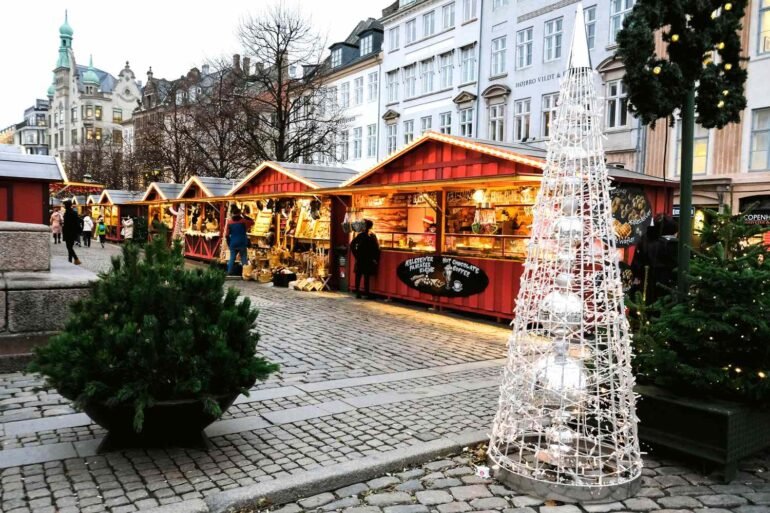
There are Christmas markets that are free to enjoy across the city. Nyhavn is particularly pretty sitting along a canal bordered with beautiful old houses. Højbro Plads is a central market made up of little wooden huts strung with lights. There is a market at Kongens Nytorv that also hosts an outdoor ice rink during the festive period. At all of these you will come across trees and wreaths; hand-knitted hats, gloves and scarfs, traditional toys, and handmade ceramics. And, of course, sweet cakes and cookies.
In the markets, look out for Vanilla Kranse, the Danish butter cookies; Pebernødder, or pepper nuts, hard cookies flavored with species and pepper; and Brunkager, crisp cookies spiced with ginger. These are often shared as gifts.
To eat hot in the market, you’ll smell the Æbleskiver before you see them. These little round fluffy pancake balls are irresistible. And you might want to munch on a bag of brændte mandler, caramelized almonds. To drink, you’ll be offered warming cups of hot gløgg, a sweet, spiced mulled wine often given an extra kick with a spirit like brandy — so watch out on your bike.
To taste traditional Danish festive food that isn’t sweet, visit one of the city’s traditional smørrebrød restaurants like Restaurant Kronborg. If you’re really lucky, you can snag a table at Schonnemanns, one of the oldest establishments in the city dating back to 1877 and still one of its best. These city institutions offer julefrokost, Christmas lunch menus where you can sit side by side with Copenhagen natives enjoying the full works. Don’t expect turkey and trimmings. Smørrebrød are open-faced sandwiches on dark rye bread topped with pickled and smoked fish, meat, poultry, and cheese. These dishes are all washed down with plenty of beer and schnapps. Again, watch out on that bicycle.
New Year’s Eve marks the final festivities. Friends and family gather and share Kransekage, a series of dry cake rings in a tower of diminishing size. They are flavored with marzipan and decorated with white icing. If that sounds rather tame, go out into the streets where market stalls set up everywhere selling fireworks – they are completely legal for anyone to buy. As soon as the sun sets, they go off everywhere in crazy abandon. It’s terrifyingly fabulous, perhaps the rampaging Viking blood surfacing in this eminently sensible city.
Henrietta Lovell
2025-11-24 08:58:00