
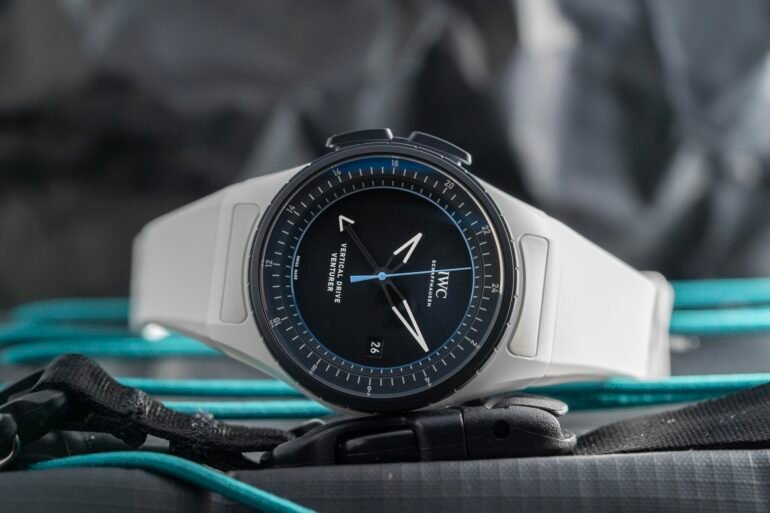
Space is having a huge moment right now, and if you’re at all like me, you’ve been transported to a time in your youth when you were soaking up anything space exploration related as much as the sun. Well, IWC is going to keep space at the forefront of everyone’s mind here at Watches & Wonders as they’ve just released their Pilot’s Venturer Vertical Drive, their first watch engineered and certified for spaceflight.

I actually got to see this watch back in February while I was out in Los Angeles with IWC at Vast’s headquarters. Vast is the company building what is set to become the first commercial space station, Haven-1. And that context matters, because this isn’t just a “space-inspired” watch. The Venturer Vertical Drive was designed for actual use in orbit, and it’s already been certified for flight in partnership with Vast.
Historically, space watches have basically just been modified aviation watches, but IWC took a different approach here. Instead of adapting something that already existed, they started from a much simpler question: what does a watch actually need to do in space? The answer led to a few decisions that feel genuinely new, starting with the most obvious one — there’s no crown.
From an outsider’s perspective, this feels almost like a flex (and it kinda is). But the way that IWC CEO Chris Grainger-Herr explained it during our live presentation was that in a zero-gravity environment, as astronauts are moving through tight spaces, wearing gloves, and working around sensitive equipment, anything sticking out becomes a liability. It can snag or be difficult to use. So IWC removed it entirely and replaced it with a bezel-based control system.

Using what they call a Vertical Drive mechanism, the rotating bezel now handles winding the watch, setting the time, and adjusting the GMT hand, while a rocker switch on the side of the case lets you toggle between those functions. It’s a different way of interacting with a mechanical watch and I found it quite fun once I got a hang of what positions did what.
That functionality wasn’t developed in a vacuum either. While at Vast, I spoke with Kelton Temby, their Senior Mission Manager, about what it actually takes for something like this to be used in orbit. His role involves defining how equipment is used during missions and building the test plans to ensure it can safely exist in that environment. “Anything that flies has to meet an incredibly high bar, not just for performance, but for safety and predictability” he told me.


For the Venturer Vertical Drive, that meant pressure testing and standardized testing based on NASA-derived human spaceflight frameworks most of us are familiar with. Passing that process is what allows the watch to actually be worn during a mission. As Temby put it, “we’ve shown that this watch is safe for flight,” which in turn “enables crew to have this watch with them.
Another decision that made more sense to me after I spoke with the Vast team was why IWC decided to use a GMT instead of a Chronograph. One thing I wasn’t aware of was that astronauts can see something like 16 sunrises and sunsets in a single day, so obviously time can get a bit disorienting on a mission, therefore having the watch run on UTC, a fixed 24-hour reference time, made the most sense to keep the astronauts more in tune with real time.
So the Venturer has a dual-time display, pairing mission time with a 24-hour reference, along with a second time zone. And that second time zone is maybe more important than it might sound. Temby spoke to me about how maintaining a connection to home helps the crew stay grounded and maintain routines — “One of the things that we are really intentional on in station is to maintain the psychological wellness of the crews. We actually do what we call circadian entrainment. We literally dim the lights to make sure that the crew has true sleep time and we keep that schedule in place. So it is really important for the crew to understand what time of day it is for them personally, but also being able to connect back home to friends and family for their well being.”

Inside of the Venturer Vertical Drive is the IWC-manufactured caliber 32722, an automatic movement with a 120-hour power reserve and an integrated GMT function. It beats at 4 Hz and includes a date at 3 o’clock, all packaged in a case that feels very much in line with what IWC does best.
The watch measures 44.3mm across and 16.7mm thick with a lug to lug of 57.5mm. Its casing is white zirconium oxide ceramic paired with a Ceratanium bezel and caseback. It’s also rated to 100 meters water resistance, which makes sense given there’s no open crown and it’s on rubber. Between launch forces, vibrations, and extreme temperature swings, the watch is built to handle conditions far outside anything most of us earthlings will ever experience.
That overlap between watchmaking and spaceflight is something Kris Young, Vast COO, pointed out directly. When you look at what it takes to build a spacecraft, like material selection or precision manufacturing, the parallels to watchmaking aren’t that far off. “It’s true for watches, it’s true for spaceships,” he said, and after physically seeing both sides of that equation in the same room, it’s hard to argue with him.

What makes the Venturer Vertical Drive interesting to me isn’t just that it’s different. It’s that this piece was built from the ground up specifically for those in space. And of course, the crownless design and the bezel-driven controls tie back to this very specific use case. So this isn’t just another already made model turned into a space watch, this is brand new.
It’s also not a limited edition. This is a regular production watch, which I think says a lot about how confident IWC is in the idea and I’m personally excited to see how this line evolves, especially with upcoming space launches.

It’s clear to me that the Pilot’s Venturer Vertical Drive isn’t trying to fit into an existing category, and it’s probably not meant to. And while IWC has spent the last few years bringing back some watches from their vintage catalogue (which don’t get me wrong — I love), I’m digging that this is an out of the box approach and one that is certain to create a lot of buzz at Watches & Wonders this year.
The IWC Pilot’s Venturer Vertical Drive is priced at $28,200. To see hands-on video of this watch and more from IWC, head to our YouTube channel. IWC
Kat Shoulders
2026-04-13 22:01:00