
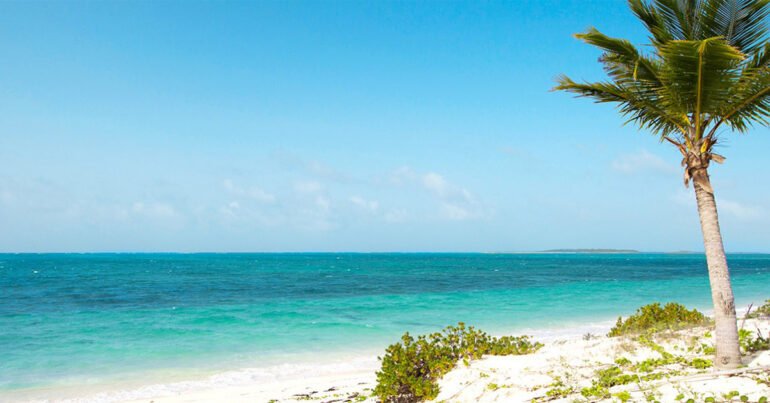
It’s one of the most remote, hard-to-reach little islands in the whole region. Or at least it was. Now, a tiny Caribbean island has a huge new future.
The Bahamas has officially unveiled a new airport terminal on the island of Mayaguana, a remote outpost with fewer than 400 residents and a reputation for white-sand beaches, expansive bonefishing flats and some of the clearest water in the region. The project is part of the government’s sweeping Family Islands Airport Renaissance, and for Mayaguana, it represents a fundamental shift in access, opportunity and long-term development.
Positioned approximately 334 miles southeast of Nassau and about 520 miles off Palm Beach, Florida, Mayaguana is the easternmost island in The Commonwealth of The Bahamas. It sits almost midway between South Florida and Puerto Rico, a geographic detail that has long made it intriguing to planners but difficult to fully leverage due to limited infrastructure.
With the completion of its new airport terminal, that equation changes.
From Boat Access to Modern Air Infrastructure
Mayaguana’s airport was first constructed in the late 1950s and opened in 1960. Before that, the island was accessible only by boat — a reality that defined daily life, commerce and emergency response for generations.
More than six decades later, the new terminal signals a new chapter.
Construction on the facility was completed in December 2025, with full electrical power connected in January 2026 through a dedicated transformer. The building measures just under 3,200 square feet and is fully equipped for modern airport operations.
Inside, the terminal includes a ticketing area, restrooms, dedicated airline offices and vendor spaces. There is capacity for both indoor and outdoor seating, allowing flexibility for regular scheduled service, charter operations and private aviation traffic. The facility also includes full operational capacity for airport security and police, bringing Mayaguana’s aviation standards in line with broader national infrastructure upgrades across the Family Islands.
For an island with a population that hovers around 400 people, the new terminal is significant. It provides a more reliable, comfortable and secure gateway for residents, visitors and investors alike.
A Strategic Position in the Southern Bahamas
Mayaguana’s location has always set it apart. Roughly halfway between South Florida and Puerto Rico, and situated on routes frequently traveled by private boaters heading toward the eastern Caribbean, the island occupies a unique point on the regional map.
The Bahamas’ Deputy Prime Minister and Minister of Tourism, Investments and Aviation Chester Cooper described Mayaguana as well positioned geographically, with the potential to serve as a logistics and transshipment hub for the southern Bahamas, much as Grand Bahama functions in the north.
“I envision a strategic hub between Europe – Africa – the Bahamas and the Caribbean. It is designed to support the additional development that is coming,” Cooper said.
While commercial aviation on Mayaguana has historically been limited, upgraded facilities expand the island’s capacity to handle increased passenger flows, private jets and potential cargo operations. Improved infrastructure can also support emergency diversions and regional connectivity, especially as broader development plans advance.
Emergency Access and Critical Services
One of the most impactful additions tied to the airport upgrade is the placement of a new world-class ambulance at the terminal, donated by a private partner. The vehicle will be stationed on-site to facilitate air evacuations.
On a remote island hundreds of miles from the capital, emergency response capability carries outsized importance. The ability to rapidly transfer patients to larger medical facilities in Nassau or beyond can be life-changing for residents.
The new airport infrastructure strengthens that chain, pairing aviation access with dedicated medical transport support in a way that enhances resilience for the entire community.
Part of a National Aviation Overhaul
Mayaguana’s new terminal is one piece of a broader transformation across The Bahamas.
In September 2021, the government committed to what Prime Minister Philip Davis described as the most ambitious Family Islands Airport Renaissance in the nation’s history. Since then, major works have been completed at Ragged Island, Great Harbour Cay, Grand Bahama’s domestic terminal, Lynden Pindling International Airport in Nassau, Long Island’s Stella Maris Airport and now Mayaguana.
Active construction is underway at more than 10 additional sites across Abaco, Bimini, Cat Island, Eleuthera, Exuma and Grand Bahama International Airport. Further airport projects are in the planning stages for Abaco, Andros, Crooked Island, Exuma and Rum Cay.
“This airport, this new terminal standing before us, is a declaration of the importance of Mayaguana to our plans for development,” Davis said, underscoring the broader national strategy. “It is a declaration that every Bahamian, regardless of which island they call home, deserves world-class infrastructure and a government that keeps its word and delivers.”
For Mayaguana, inclusion in that national program carries particular weight. The island has often been described as one of the most secluded in the country, known more to seasoned anglers and adventurous boaters than to mainstream travelers.
Unlocking Development Potential
Beyond aviation itself, the new airport aligns with larger development ambitions for the island.
The government has already committed to a three-phased deep-water seaport project in partnership with Mayaguana Island Developers and Global Lead Consultant Group Limited. Plans call for a cruise ship terminal, a deep-water transshipment port and adjacent land development. The project will be jointly owned by the Government, the Mayaguana Island Development Fund and private partners.
Officials project that the seaport initiative could create 2,000 jobs over its lifetime on the island — a transformative figure for a community of 400 residents.
“The economy of Mayaguana will be forever changed by this progress, and this is just the beginning of our plans,” Davis said.
A modern airport is a prerequisite for many forms of sustained development, from tourism and second-home investment to logistics and light industry. With improved air access, the island is positioned to attract new interest while maintaining its distinctive character — vast stretches of white sand, uncrowded flats and reef systems, and a reputation for quiet remoteness.
A Turning Point for a Tiny Island
Mayaguana has long existed on the margins of Bahamian tourism, prized by those who seek isolation and natural beauty rather than resort corridors and large-scale attractions. Its population density is among the lowest in the country. Its shoreline remains largely untouched. Its marine life continues to draw anglers and divers who value pristine conditions.
The new airport does not change those physical realities. What it changes is access.
Reliable, modern aviation infrastructure narrows the psychological and logistical distance between Mayaguana and the rest of The Bahamas — and beyond. It shortens supply chains, strengthens emergency services, increases investor confidence and improves the experience for residents who travel for work, education or healthcare.
For decades, the airport represented a basic link to the outside world. With the completion of the new terminal, it becomes something more: a platform for growth.
On a Caribbean island where fewer than 400 people call home, a 3,200-square-foot building can carry enormous weight — and where the region has a brand-new destination.
Caribbean Journal Staff
2026-03-04 03:02:00