
A series of features identifying the most extraordinary mechanical masterpieces in history, blending precision, innovation, and craftsmanship. We all have our favourite timepieces either in our collection or those incredible horological masterpieces that have been invented or created through the ages. This series will showcase examples from the previous centuries up to the present day and look at the importance and impact on modern day timekeeping.
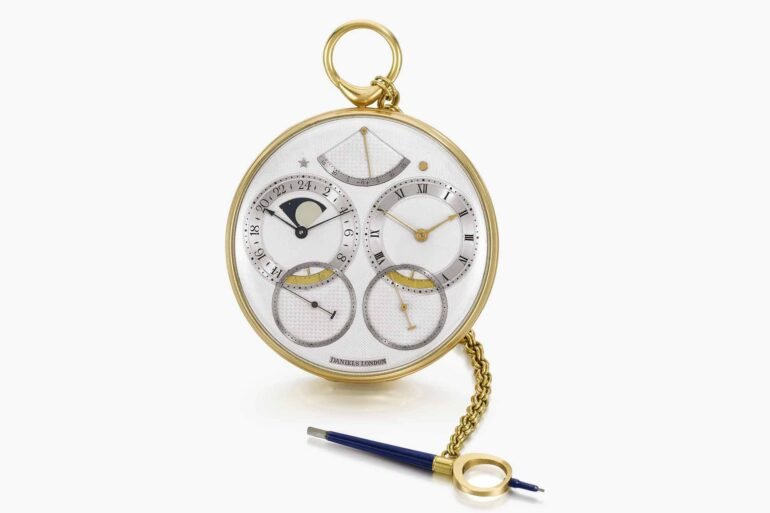
The ‘Space Traveller’ was conceived as a timepiece to honour the astronauts that George Daniels admired. He was determined that his watch would be one that could be theoretically used by an astronaut, therefore he set out to make a watch that displayed, simultaneously, mean-solar and sidereal time.
“When I was a boy, going to the moon was the stuff of science fiction. The astronauts who went were brave chaps, the technology was the most advanced in the world and if the opportunity presented itself, I would have liked to have gone with them.”
George Daniels, Master Watchmaker
George Daniels made some of the most important watches in his lifetime, fusing together art, science and engineering. Every part of the two Space Traveller watches were hand-made by Daniels (except for the springs and the glass) and represented the pinnacle of independent watchmaking at the time. This practice, known as the ‘Daniels Method’ was taken on by his apprentice Roger W. Smith, today a highly acclaimed independent watchmaker in his own right, and renowned for his exceptional craftsmanship in creating his stunning eponymous timepieces.

During his illustrious career, Daniels made 23 pocket watches, but his Space Traveller is considered to be the finest of his creations.
Origin Of the Space Traveller Pocket Watch
The Space Traveller pocket watch was envisioned as a tribute to the astronauts George Daniels admired so greatly to commemorate the 1969 moon landing and reflects his fascination with space exploration. Determined to create a timepiece of practical use in space, he set out to design a watch capable of simultaneously displaying both mean solar time and sidereal time—essential for celestial navigation.
Back in the 18th century, if you wanted to check the accuracy of your watch, you needed a highly precise clock — one that was calibrated using the stars. Some advanced timepieces could do this calculation for you by displaying both solar and sidereal time, accounting for a daily difference of about 3.555 minutes.

Sidereal time, traditionally used by astronomers, measures the Earth’s true rotation by tracking its transit relative to a fixed star. This interval—known as a sidereal day—lasts approximately 23 hours, 56 minutes, and 4.1 seconds. In the 18th century, checking the accuracy of a watch required a precision clock set to the stars.
Daniels used his precise double wheel escapement (below) and added separate dials for both mean-solar and sidereal time. He also included a display for the equation of time at the top of the dial. This meant he didn’t need to compare his watch with another clock that showed sidereal time.
The equation of time shows the difference between what a sundial reads (apparent solar time) and the average time we use daily (mean time). Because the Earth’s orbit is not a perfect circle, this difference can vary from about +15 minutes to -16 minutes. The two times match up roughly on the 15th of April, 14th of June, 1st of September, and 24th of December.

George began working on his Space Traveller watch in 1979, which was the same year that he was elected as the Master of the Worshipful Company of Clockmakers. Original design drawings for the solar and sidereal trains which are dated for the year 1980, show that planning was already at an advanced stage at the beginning of the decade.
The Space Traveller is a manual wind pocket watch with twin independent going trains and two escape wheels. This dual-gear system allows the watch to simultaneously display mean solar and sidereal time with remarkable accuracy. The watch features a chronograph, a split-seconds function, and an equation of time indicator.
The watch itself is breathtaking in its balance. Measuring 62mm in diameter, the case is made of 18K gold — a warm, subtle contrast to the silver dial and mechanics within. The dial is a study in functional beauty with its silvered engine-turned dial with gold and blued steel hands: two sub-dials for mean solar and sidereal time, seconds register, regulation and moonphase. It is simultaneously complex and harmonious, technical and romantic all at once.
The Space Traveller is considered one of the most important watches of modern times and is seen as Daniels’ most famous and sought-after creation. Daniels loved the watch so much that, after selling the first one and regretting it, he decided to make a second version.
“The two Space Traveller watches were the culmination of thirteen years of making highly original one-off pieces and went on to be the catalyst for many future developments.”
Dr. Roger W. Smith OBE, Master Watchmaker
In 2019, the Space Traveller sold at auction for a staggering £3.6 million, a testament to the rarity and reverence surrounding Daniels’ work.

Continuing The Journey with Space Traveller II
This second watch, known as the Space Traveller II, stayed with Daniels’ as his personal watch until his death in 2011. Daniels once said that making a watch should require no external assistance—that a true watchmaker should be able to build it entirely themselves. Space Traveller II is the physical embodiment of that ethos. It’s not just the ultimate expression of independent horology—it’s Daniels’ own time machine, made not to impress, but to satisfy his own standards.

“The level of creativity throughout is out of this world, and you can see how George circumvented a potential design issue with simplistic brilliance. One of the stand-out features for me are the two escape wheels, which drive the common balance. This is George’s unique double-wheeled escapement but with this piece the Sidereal train has an escape wheel of fourteen teeth, whereas the Solar train has just thirteen. The geometric difficulties that this feature creates are mind boggling and I am sure the very idea would have stopped most makers in their tracks. For George however, it was simply another challenge that had to be overcome.”
Dr. Roger W. Smith OBE, Master Watchmaker
When George Daniels wanted to improve the accuracy of the gear train in one of his watches — already precise to within 0.8 seconds per year — he reached out to a friend at Cambridge University. He asked if they knew a mathematician who might be interested in horology. In a twist of fate, the reply came quickly — and incredibly, the mathematician’s name was also Daniels: Professor Henry Daniels. Professor Daniels managed to refine the ratio further, bringing the watch’s accuracy to within just 0.28 seconds per day, a result that delighted George.
“When you’re on your package tour to Mars, you’ll need a watch like this. And if you’re making a long-distance phone call, just switch the chronograph to sidereal time — you’ll save 3.555 minutes a day on your bill.”
George Daniels, Master Watchmaker
The watch was originally nicknamed the “Daniels Squared” in recognition of Professor Henry Daniels’ contribution. But George felt the name didn’t quite capture its spirit. Inspired by the Apollo Moon landing — the greatest space journey of the 20th century — he renamed it the Space Travellers’ Watch.

George Daniels built only two of these remarkable timepieces. The one known as the Space Traveller II is the more complex of the pair, featuring an added chronograph function. When you compare the two side by side, the enhanced complexity of the chronograph mechanism on the backplate of the Space Traveller II is immediately striking (above). The watch sold for £3.2 million at auction in 2017.
A Lasting Legacy of The Space Traveller Watches
Daniels didn’t just make a complicated watch—he rethought the core logic of timekeeping for someone “travelling through space”, where civil time (mean) and star time (sidereal) matter equally. The Space Traveller watches are widely regarded as some of the most technically advanced pocket watches ever made. Daniels demonstrated that a single person, using traditional tools, could rival the output of entire watchmaking manufactures.

In my role as a Volunteer Tour Guide at the Clockmakers’ Museum in the Science Museum, London, I am fortunate to see the Daniels Space Traveller II watch (plus several other examples of his outstanding creations) at least once a week.
It is always an absolute joy to stand beside the cabinet dedicated to George Daniels in the museum, finishing my tour on a high, never tiring of talking about Daniels’ extraordinary contribution to horology and talking about his exquisite timepieces and lasting positive legacy on the horological industry. Perhaps the true legacy of the Space Traveller watches is not just in how they measure time — but in how they inspire us to think about it.
We will never know what the next iteration would have been, but wouldn’t it have been wonderful to have a Space Traveller watch on your wrist?
Andrew Canter
2026-02-23 19:00:00