
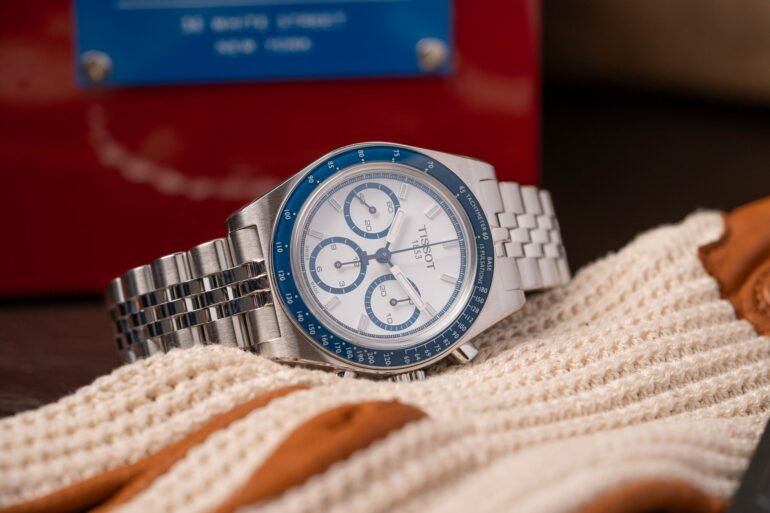
The chronograph — that is, a watch that includes a stopwatch complication — is one of the most storied watch variants. Originally invented by French watchmakers in the early 19th century, the modern chronograph wristwatch was first introduced by Longines in 1913. It’s best to address the common misconception here: a chronograph does not necessarily equal a chronometer. While both utilize the same Greek prefix of khrónos, or “time,” meter connotes a measuring instrument while graph denotes the measurement itself (“to write”). As such, while a chronograph can also be a chronometer, a chronometer is not necessarily a chronograph. Think rectangles and squares.
The mid-twentieth century would prove to be the chronograph’s finest hour. The rising sport of motor racing led to some of the genre’s most iconic references from the 1950s into the 1970s. The link between watch manufacturers and racing grew stronger with teams and drivers becoming associated with these watches, such as Jim Clark and Enicar during the early 1960s. But if there is one brand synonymous with racing, it is Heuer. From the Carrera — named after the Carrera Panamericana road race in Central and South America — to the Autavia and beyond, Heuer’s history is intertwined with performance cars. The brand recently took over from Rolex as the official timekeeping partner of Formula One, signifying its continued commitment to motorsports.

Yet for all of Heuer’s provenance, perhaps the most iconic racing chronograph sharesits name with another circuit: The Daytona. The model has become closely associated with racing thanks to Rolex’s involvement with major series like the 24 Hours of LeMans, Formula One, the 24 Hours of Daytona, and more. Perhaps most famous are the references owned by legendary actor and driver Paul Newman, one of which sold at auction in 2017 for a blistering $17.8 million.
Pilots are the other group commonly associated with the chronograph. From the first Longines wrist chronograph to the Citizens Skyhawk, the chronograph continues to be closely associated with aviators. Omega’s recent Speedmaster Pilot Flight Qualified —requiring potential owners to be flight-qualified military personnel — perfectly encapsulates the mythology binding aviators to their wrist watches. The Breitling Navitimer is another purpose-built example, launched in 1952 following a commission from the US Aircraft Owners & Pilots Association. Its iconic slide-rule bezel and multiple-scale dial, overwhelming at first, point to its function-first mandate.

Most famous of all is the Omega Speedmaster, first introduced as a racing chronograph in 1957. It received NASA Flight Qualification in 1965 and has accompanied all six lunar landings, earning it the enduring nickname “the Moonwatch.” Other chronographs have departed Earth’s atmosphere, however, including Seiko’s 6139 Speedtimer to a purpose-built Bulova to Fortis’ Cosmonaut. Each performed at the utmost limits of aeronautical achievement, cementing the chronograph’s reputation as a versatile timepiece.
An underappreciated variant of the complication, diving chronographs represent the utmost limits of the watch. Originally introduced in the 1960s, they posed a unique challenge for manufacturers. Extra holes in the case represent extra water ingress points. Some of the best, like the Aquastar Deepstar favored by the crew of Jacques Cousteau’s Calypso in the late 1960s and 1970s, also allowed for their pushers to be operated underwater. Countless brands produced them during the period, including dive company-branded examples from the likes of Voit and U.S. Divers Co., with later examples from TAG Heuer and IWC acting as more modern takes on the format.

The chronograph pulls at the heartstrings with its useful complication and romantic past. Speaking to petrol heads, space enthusiasts, and aviation nuts alike, they have been worn by engineers and racing drivers alike for more than half a century. With their unique combination of function, style, and heritage, they are one of the first places new enthusiasts turn to and a standby for collectors. To see more of our favorite chronographs, be sure to check out the Windup Watch Shop. As always, the Windup Watch Team is available via consultation to answer any questions you have. In addition,all of these products are eligible for free domestic shipping across the US.
Windup Watch Shop
2026-04-12 16:00:00