
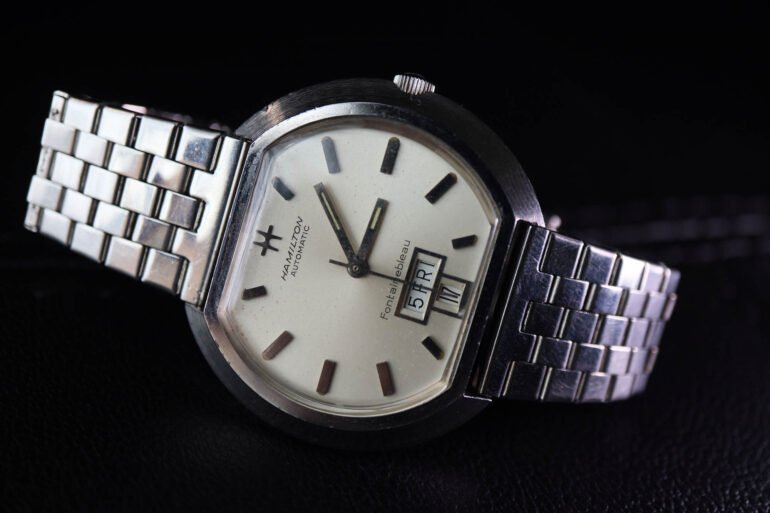
I feel that the contemporary watch market has a noticeable lack of fun, exciting, and unique watch case designs. Brands have put a major emphasis on dials made from rare materials or composed of intricate designs recently, but very few companies have put time into producing cases that offer a special experience for the wearer. Round and tank-styled timepieces are, and will forever be, the norm within the watch industry. However, this gap in the modern market gives collectors a chance to look back into vintage catalogs to familiarize themselves with fads and stylistic ventures of previous horological eras. With this in mind, I’d like to take a trip back to 1968 and examine the creation of the Hamilton Fontainebleau series, specifically the 6004 “Day ‘N Date” reference, to exhibit just how innovative case design can truly be. It’s typically an overlooked piece of the design formula, but when a watch features a case profile unlike any other, it certainly stands out among the pack.
A Brief History of Fontainebleau and the 6004
In 1966, the patents for Hamilton designer Ulrich Nydegger’s new case were published. A couple of years later, the first few Fontainebleau models hit the market and garnered a decent amount of popularity. It wasn’t until 1969’s Fontainebleau Chrono-Matic chronograph, however, that the line would see a substantial amount of press and recognition for its innovative design. The collectibility of the Chrono-Matic model continues to increase over time, with market estimates reaching well over $2.5k for good condition examples. The first few models of the series, however, may just be the perfect gateway into the Fontainebleau line for those of us with a more conservative amount of “fun money” to spend. While these models certainly won’t cost you the price of an F-91W, they’ll save you and your wallet quite a bit of headache.

The initial models featured relatively basic, but well-built, three-hand movements with varying complications (strictly time, day window, and day-date window). All three range in rarity, with the 6004 featured here being the rarest of the pack. Very little information about this model is available online or in any archival resources I was able to locate. The only official Hamilton documentation I was able to locate is the original line book entry for this model, with a black-and-white illustration and the “Day ‘N Date” moniker written below. I wasn’t able to determine what its original MSRP was, but the much more complicated Chrono-Matic model retailed for roughly $200, so I could only assume the 6004 could be obtained for much less.
Design and Specifications
We must, of course, start with discussing the incredible case design of the Fontainebleau before diverging into its other attributes. Its measurements––at 40mm in diameter, 36mm lug-to-lug, and 14mm thick––leave little to be desired. Pictures may do the 6004 an injustice, as proportionally, the watch offers a perfect wearing experience for almost any wrist shape or size because of its dimensions. Moving to its construction, those patents Nydegger applied for related to how the case comes together and houses the movement. To disassemble, the user must first use a case back tool to turn the outer stainless steel ring clockwise until the sides protrude from the lug area. Then, the ring and movement can be removed, with the crystal still fitted to the bezel and removable by applying pressure from the front of the case. The crown assembly is constructed with both a male and female attachment to allow the crown to be fully removed from the stem. The last piece of this tricky case is the gasket that holds the crystal to the dial once inserted into the bezel/case (a topic we will come back to shortly).

Moving to its overall design, the 6004 came in three variants: a gold tone, a stainless steel with a navy blue dial, and a stainless steel with a silver dial. Both were originally fitted on a Hamilton-branded bracelet that has become increasingly difficult to source on auction sites and the current watch market at large. Because of its 20mm lug width, however, the 6004 can look good with just about any third-party strap or bracelet it’s paired with. Inside, the 6004 is powered by the Hamilton Cal. 66 movement. While I desperately tried to find details regarding this specific calibre and what ETA equivalent it might have, I wasn’t able to locate any conclusive information. If anyone has any ideas or theories, please include them in the comments below; it would do the collecting community a big favor.
Pricing and Buying Guide
What makes the Fontainebleau line so intriguing to me is its ability to both stand out on the wrist and fit so incredibly well. The case shape is so unique that you’ll have a hard time finding another method of obtaining such a profile from any other watch, but because there really are no downsides to this model in my eyes, why would you need to look anywhere else? If you’re looking to obtain an example of your own, these occasionally pop up on eBay and other online platforms for around $600 or less, depending on condition and seller awareness. Because I am unable to determine what an ETA equivalent may be, parts for this movement could be difficult if the Cal. 66 is its own beast.

Besides mechanical condition, aesthetic aspects to look out for are crystal condition, case finish blemishes, and the inclusion of the original crystal gasket. Crystals for these models can be difficult to source because of their oblong shape, and because they’re only acrylic, an example that is cracked may cost the new owner a massive headache in the long run. The case finish is unique and incredibly dynamic, with a mixture of polished and radial brushed surfaces found throughout. Unless you have a passion for case refinishing or know a watchmaker who can get the job done, I’d recommend keeping an eye out for a more well-preserved example.
Lastly, the dreaded crystal gasket. For those less privy, these crystal gaskets are notoriously prone to simply being missing from many examples of these models or deteriorating beyond repair. NOS replacements are typically never available, and no companies have come up with a modern solution because of their overall rarity. I highly recommend verifying whether the example you’re attempting to purchase still has the crystal gasket installed. Not only does this preserve the water resistance of the watch, but it also ensures a snug fit between bezel, crystal, and dial.

Conclusion
Intriguing design elements are what make a watch marketable to consumers. Especially for the modern market, we have been spoiled with accessibility to online shopping platforms that allow us to purchase watches created at any time––meaning we’re exposed to silver dial, rounded case watches at nauseum almost every day. The Fontainebleau takes what we know about a wristwatch and turns it partially on its head, not pioneering some crazy colorway or dial configuration, but instead offering dependable timekeeping with just a little bit of extra flair.

As with many of the timepieces I write about, this won’t be one for everyone, but it’s a watch many collectors should keep an eye out for. I hope that contemporary watch companies take note of what can be done with case design and work away from the round cases we’ve come to know and love; everyone’s watch box needs a little spice from time to time.
Tommy Demauro
2026-04-07 18:00:00