
From the imposing astronomical clocks of Tudor England to the exquisite pendant watches of Victorian Britain, timekeeping has long been a symbol of power, prestige, and technological marvel within Europe’s royal courts. This new series explores the fascinating evolution of clocks and watches crafted specifically for royalty, tracing how these intricate masterpieces reflected the tastes, ambitions, and innovations of monarchs. Through the lens of craftsmanship, artistry, and historical significance, we reveal how these royal timepieces marked the passage of dynasties and empires.
During Henry VIII’s reign (1509–1547), portable watches as we know them today had yet to emerge in significant numbers. Timekeeping was dominated by grand and stationary mechanisms, with tower clocks or ornate table pieces, serving both practical and symbolic purposes as a show of wealth and status. Watches, if present at all, were nascent and extremely rare.
The first clocks and watches were expensive luxuries and only in the reach of royalty and landed gentry. There was, however, a sufficient demand for these items in the Tudor royal court which spread to a prosperous London. The beginnings of the horological industry were probably first initiated by King Henry VIII. During this period there was somewhat of a technical revolution, starting with the invention of the printing press which changed the way people received information. This filtered through to the court where there was a revolution in the way the privileged received and processed time.
Henry encouraged foreign makers and mathematicians to settle in London, and bring their skills with them. Religious persecution in the Low Countries in Europe provided further inducement. As a result, a group of domestic clock and watchmakers working in the Renaissance style flourished in the City of London by the end of the 16th century.
Henry was interested in astronomy, and he purchased ‘clokkes and dialles’ from France and the Low Countries. There seems to have been a fascination with the workings of the mechanical timepiece, which is borne out by David S. Landes who wrote in his meticulously researched book on the history of timekeeping, Revolution In Time, ‘Few inventions in history have ever made their way with such ease. Everyone seems to have welcomed the clock’.
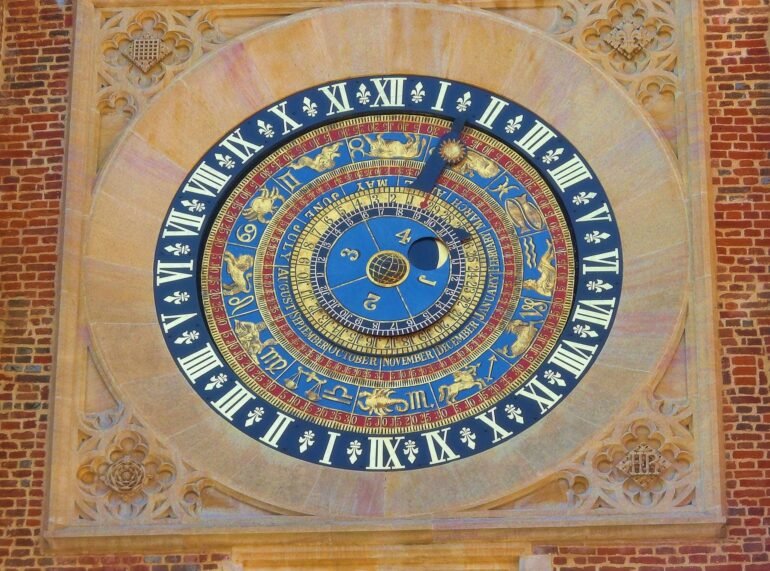
In the golden age of Tudor splendour, King Henry VIII commissioned a masterpiece that fused science, artistry, and royal prestige: an astronomical clock for his palace at Hampton Court. The commission was entrusted to Nicholas Kratzer (below), a Bavarian mathematician, astronomer, maker of sundials and confidant of Hans Holbein working in concert with the French clockmaker Nicholas Oursian. Installed around 1540, their creation was not merely a timepiece, but a triumph of early modern engineering and courtly display.

Kratzer came to England around 1517 under the patronage of Henry VIII and was made ‘deviser of the King’s horologes’ in 1520. He was appointed lecturer in astronomy at Oxford by Cardinal Wolsey and tutor in mathematics to Sir Thomas More’s children who was a prominent member of the royal court.
The inventory of King Henry VIII was compiled after his death in 1547 as a list of the possessions of the crown. It is clear from the 3,690 items of gold, silver and jewels that Henry loved expensive ‘shiny things’ and perhaps more extraordinary is that more than 200 timepieces were listed in the inventory. This catalogue of royal assets includes many details of the King’s clocks, watches, dials and hourglasses displayed throughout various palaces or worn as accessories to his often flamboyant and extensive wardrobe as seen below.
Although there is a record of these items, given that the majority if not all would have been made of precious metals and jewels, it is not surprising that there are so few examples that exist today, as they would have probably been melted down and recycled.

In the above portrait, Henry is wearing a round watch enclosed in a profusely engraved gold case set with a magnificent diamond at the centre. It hangs around his neck on a heavy gold chain with links in the form of a capital ‘H’ letter. We can only imagine the beauty of the watch inside the case as there are not any glimpses of the style and workings of his watches in any of the four portraits of Henry where he is shown wearing timepieces around his neck.
The Astronomical Clock Hampton Court Palace
This monumental clock did far more than mark the hours. It traced the month, the day, the Sun’s journey through the zodiac, the Moon’s phase and age, and of special significance to the King, the exact moment high tide would surge at London Bridge, ensuring smooth passage by royal barge. Two dials originally graced either side of the palace gatehouse, both powered by Nicholas Oursian’s ingenious gearing. His initials, ‘N.O.’, along with the date 1540, remain proudly stamped into the mechanism, a signature any collector would recognise as the mark of provenance. Oursian, a Huguenot immigrant, was appointed as the first royal clockmaker by Henry to care for the extensive and growing collection of timepieces.
The smaller Base Court dial, intended for guests, was replaced in 1835 by a slate face from St James’s Palace, bearing William IV’s monogram. The grander dial, over 2.5 metres in diameter, still presides over the royal courtyard today, its paint scheme simplified but its presence undiminished as seen below.

For today’s horological enthusiast, Hampton Court’s astronomical clock stands as an object lesson in rarity and endurance, a witness to half a millennium of royal ritual, technological innovation, and artistic grandeur. Just as Henry VIII once studied its face, so too do thousands of visitors each year, gazing upon a survivor from the age when time itself became a stage for royal power.
The Gifting of Timepieces
It was well known that Henry had a passion for timepieces, and gift-giving, both domestic and foreign, was plentiful throughout the Tudor court and other royal courts across Europe. At the Tudor court, clocks became a currency of exchange. Clocks were popular as political tools for the diplomats that frequented the royal courts.
Henry gifted timepieces to his wives, perhaps the most famous example being the clock he bequeathed to Anne Boleyn on the occasion of their marriage, as seen below. It was said that Henry gave it to her on the morning of their wedding on the 25th of January 1533.

This stunning wall clock is made of bronze and has a small bird-cage style lantern clock type movement and bears the inscription of Anne’s motto, ‘The Most Happy’. There are several aspects that link the clock to Henry and Anne, with the weights being the most prominent feature, which both have the initials ‘HA’ entwined in love-knots on them. Each of the weights also include the motto of Anne as mentioned above and Henry’s royal motto ‘Dieu et Mon Droit’ (‘God and my Right’). Henry’s connection with the clock is further seen in Henry’s coat of arms, which appear on the shield at the top of the clock, held by a leopard, and again on the sides of the clock.

Following Anne’s execution, the clock came into the possession of Lady Elizabeth Germain, who gifted it to the famous antiquarian Horace Walpole in 1760. When Walpole’s estate was sold in 1842, it was bought by Queen Victoria for £110 5s and has remained in the Royal Collection ever since.
There are two portraits that show Henry’s queens’, Jane Seymour and Katherin Parr, wearing watches. The group portrait below shows (L to R) Prince Edward, Henry VIII and Jane Seymour who is wearing a watch hanging from her hands.

Henry’s last queen, Katherine Parr, is shown wearing a cameo girdle, which ends in a double-faced watch whose dials are visible above the crimson and gold tassel as seen below.


One of the most remarkable timepieces from Henry’s collection is perhaps the combination of a table clock and salt cellar, the Royal Clock Salt (below) is thought to have been made in Paris by the royal goldsmith, Pierre Mangot, in around 1530–35.
An extraordinary survivor of Tudor diplomacy and craftsmanship, this opulent clock salt was almost certainly presented as a diplomatic gift from King Francis I of France to Henry. In an era when Anglo-French relations swayed between rivalry and alliance such a gift would have served as a tangible seal of friendship between two Renaissance courts.
Every detail speaks to its princely origins: clawed feet clutching polished agate spheres, exquisitely carved cameos of classical figures in tropical shell, each mounted in rich enamelled plaques. More than a work of art, it was also a potent symbol of status. In the Tudor dining hierarchy, proximity to the salt cellar reflected rank—the closer one sat, the greater one’s standing.

Salt itself was a precious commodity in the 16th century, and this object’s dual function as both timekeeper and ceremonial table piece elevated it to the pinnacle of courtly luxury. Eleven clock salts are recorded in the posthumous inventory of Henry VIII’s possessions; of these, this is the sole survivor.
Its provenance is impeccable: retained in royal inventories for over a century, dispersed only during the Civil War in 1649, and ultimately secured by The Goldsmiths’ Company in 1968. Today it stands as the only extant witness to a form once admired across Europe, uniting horology, goldsmithing, and the theatre of royal dining into one unparalleled masterpiece.
Influence of Time
Following his death in 1547, Henry was succeeded to the throne by his daughter, Elizabeth I, the only child of Anne Boleyn. The fascination with timepieces continued with a growing emphasis on watches. An account of jewellery belonging to Elizabeth showed that she owned twenty-four watches including one in the shape of the ‘Order of the Garter’, like the one shown below, and records show that dozens more were owned by her courtiers.

One of the Queen’s watches cost £12 (c.£6,500 today), and although ‘it looked pretty, did not keep time’. Others were ‘shaped like walnut and pomegranate’. They required frequent cleaning, adjustment, and repair which explains the presence of immigrant Huguenot clockmakers in the royal court. Following on from Nicholas Oursian, Elizabeth appointed Bartholomew Newsam as her royal clockmaker in 1590 who was then succeeded by Randolph Bull, son of the leading goldsmith and clockmaker, John Bull.
The astrological table clock below was made by Nicholas Vallin, one of the most famous immigrant clockmakers in London at the time. This superb miniature gilt-and-silver dial drum clock tells the time, functions as annual calendar, and provides the user with solar, lunar and other kinds of astronomical and astrological data. It is believed that it was made for Queen Elizabeth I who had a great interest in horological masterpieces such as this magnificent example.

I was fortunate to see and hold this wonderful timepiece and view the intricate work that has gone into making this extraordinary table clock. I can honestly say that it is worthy of royal ownership.
During this period, displays of wealth in paintings often took the form of horological objects. In the portrait of Sir Thomas More and his family shown below, a beautifully decorated wall clock, a fine example of a mid-European Gothic design, occupies the central position. Its prominence suggests it was not only a marker of status and affluence, but perhaps also a prestigious gift from a member of the royal family.

An Obsession with Time
King Henry VIII was an early and enthusiastic collector of clocks, watches, and other timekeeping marvels, at a time when portable and precision horology was still in its infancy. His collection reflected both his fascination with new technology and his desire to display wealth, sophistication, and royal authority.
Henry acquired pieces from leading European makers, particularly from France, Germany, and Italy, often through diplomatic gifts or commissions. They ranged from monumental astronomical clocks to ornate table clocks, ‘clock salts’ for ceremonial dining, and early watches worn as pendants. These were richly decorated with enamel, precious metals, cameos, and exotic materials, often incorporating allegorical or astronomical imagery.
By patronising foreign craftsmen and showcasing complex pieces in prominent locations, Henry helped set a fashion for horology among the English elite, laying the groundwork for the growth of clockmaking in England in the following centuries.
His collection was both a personal indulgence and a statement of power, aligning him with the Renaissance rulers of Europe who saw mastery of time as part of the art of kingship.
Andrew Canter
2026-03-31 18:00:00