
There really aren’t many waterfalls in the Caribbean like Trafalgar Falls. Two separate cascades drop side by side through dark volcanic rock, with mist hanging in the air and warm pockets of heat rising from the ground nearby. You can reach them in minutes, but they feel far removed from anything resembling a typical Caribbean stop.
This is Dominica — an island where waterfalls are part of the landscape, not an attraction set apart from it.
And right now, it’s growing faster than anywhere else in the region.
A Breakout Year in the Caribbean
Dominica recorded 98,724 stayover visitors in 2025, a 17.6 percent increase, the highest growth rate of any Caribbean destination last year, according to Caribbean Tourism Organization data provided to Caribbean Journal. For an island that has long operated just outside the region’s main tourism circuits, that number stands out.
For years, the question wasn’t what Dominica offered. It was how difficult it could be to get there.
That’s beginning to ease in a way that is finally measurable.
The Flights That Are Changing Access
The most important development has been airlift — specifically, the addition of United Airlines’ nonstop service from Newark.
That route connects Dominica directly to one of the most important gateways in the United States. From Newark, travelers can reach the island from across the Northeast and much of the country with far fewer steps than before.
Flights from Miami continue to provide another reliable option, while regional connections through San Juan and Antigua remain part of the network. What’s changed is how these routes work together. The trip is more predictable. The timing is easier to manage.
Dominica has not become closer in distance, but it has become easier to reach.
That distinction is showing up in the arrival numbers.
What You Find When You Arrive
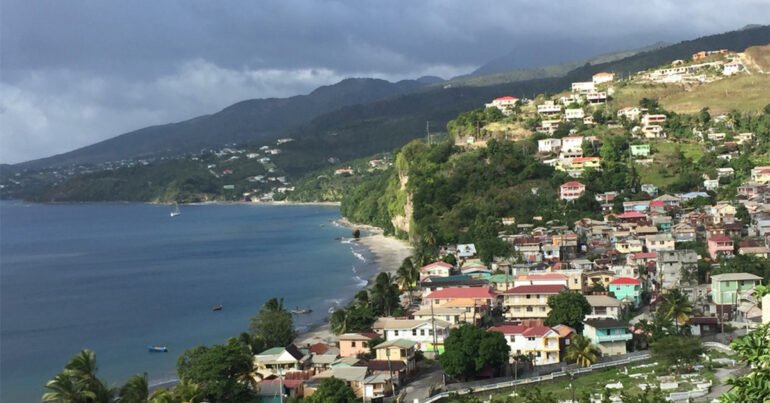
Dominica is often described as “the Nature Island,” but that phrase becomes clearer once you begin moving through it.
The terrain is immediate.
You leave the airport and within minutes you are in dense forest, with rivers running alongside the road and hills rising quickly on either side. The landscape doesn’t ease you into it.
Much of what you come to see is concentrated within Morne Trois Pitons National Park, where some of the island’s most recognizable sites are located.
Emerald Pool is one of the simplest to reach, a short walk through shaded forest leading to a waterfall and a basin where visitors tend to stay longer than planned.
Trafalgar Falls is closer to Roseau, with its twin cascades and nearby hot springs. From there, rougher paths lead down toward the rocks, where the heat from the ground becomes more noticeable.
Further in, the hike to the Boiling Lake is a full-day effort, crossing ridgelines and descending into a valley where steam vents cut through the landscape. The lake itself sits inside a volcanic crater, its surface gray and unsettled, heated from below.
Along the coast, the same geology continues underwater.
At Champagne Reef, volcanic gas escapes through the seabed, sending a steady stream of bubbles through shallow water. You can snorkel through it, with fish moving through the currents.
Rivers are constant here. You cross them, follow them, and return to them throughout the island.
This is not a place where you remain in one location.
Where You Stay on the Island
The accommodations follow the same pattern as the landscape — relatively small, positioned with intention, and closely tied to their surroundings.
Secret Bay is the premier luxury resort on the island, set along a hillside overlooking the Caribbean Sea. The property is made up of individual villas, each separated enough to create a sense of privacy.
The villas are built in wood and glass, with open-air living areas, private plunge pools, and large terraces. You have direct access to two beaches — Tibay Beach and Secret Beach — both reachable by foot or golf cart.
Dining is flexible. Guests can arrange private chefs for in-villa meals or dine at the Zing Zing Restaurant, where menus draw heavily from local ingredients. The Gommier Spa, built into the hillside, offers treatments that incorporate regional oils and plants.
The experience is unlike anything else in the region — or the hemisphere. This remains one of the best hotels I’ve ever visited — and it’s the region’s signature six-star resort expreince.
Further south, Jungle Bay offers a different, more rustic feel.
The property is spread across a hillside near Soufriere, with cottages connected by walking paths. The design keeps things simple and open, with views out toward the sea.
Jungle Bay centers on wellness and activity. There is a daily schedule of yoga sessions, guided hikes, and wellness programming, along with a spa that uses local ingredients. The Calabash Restaurant focuses on Caribbean dishes, and the Sky Top Bar provides a vantage point over the coastline.
Guests tend to spend less time inside their rooms and more time participating in what the island offers.
In the north, InterContinental Dominica Cabrits Resort & Spa provides a larger, more traditional resort setting.
Located near Portsmouth, the resort sits beside Cabrits National Park, with access to trails and historic sites, including Fort Shirley.
The property includes multiple pools, a full-service spa, and several dining venues. Cabrits Market focuses on local and regional cuisine, while Kweyol Beach Café is set closer to the shoreline.
Rooms and suites are modern, with terraces facing either the ocean or the surrounding landscape. It’s one of the few places on the island where you have a broader range of amenities in one place, while still remaining close to the natural environment.
Elsewhere, smaller guesthouses and eco-lodges fill in the rest of the island’s accommodations.
Where you stay influences how you experience Dominica.
Why More Travelers Are Choosing Dominica Now
Dominica hasn’t added a defining new attraction or changed what you come here to see. The waterfalls, the hiking, the volcanic terrain — those have always been here.
What’s different is the path to reach them.
The addition of United Airlines’ Newark service has changed how the island fits into travel planning. A direct connection from a major U.S. hub removes a layer of uncertainty that used to come with booking a trip to Dominica.
At the same time, flights through Miami and regional hubs have become easier to coordinate. Schedules align more consistently. The trip requires fewer adjustments.
That change is reflected in the growth.
It also aligns with what many travelers are looking for now — destinations where time is spent outside, where each day involves a different part of the island, and where the experience is not centered on a single beach.
Dominica has always offered that. More travelers are now able to act on it.
Planning Your Time on the Island
You plan a trip to Dominica with distance in mind, even when the map suggests otherwise. Getting around isn’t easy, or quick.
Roads wind through hills and along valleys, and travel takes longer than expected. That shapes how you structure your days.
A day is usually centered around one part of the island. You might spend the morning at Trafalgar Falls and nearby hot springs, then continue into Morne Trois Pitons National Park. Another day might be reserved for a longer hike, with a guide, starting early and returning in the afternoon.
Time near the water tends to be quieter — snorkeling at Champagne Reef or staying closer to your hotel.
You leave space between plans.
That space becomes part of the trip.
What Comes Next
The growth in 2025 points toward continued expansion.
Additional flights are expected as demand builds, particularly from the United States. Airport development is underway, with the goal of accommodating larger aircraft and increasing direct access over time.
At the same time, Dominica is not expanding at the pace seen in more developed Caribbean destinations. New hotel inventory remains limited, and much of the existing product is smaller in scale.
That balance will shape how the island evolves.
Why It Stands Out Right Now
The headline is the growth: nearly 100,000 stayover visitors and a 17.6 percent increase, the strongest in the Caribbean.
Water runs through forest. Trails lead into volcanic landscapes. Heat rises from the ground near the falls.
Dominica remains what it has always been. It’s just easier to get to.
Getting to Dominica Now
Flights from Newark to Dominica are about $653 right now on Google Flights. They’re considerably more from Miami, although that number tends to fluctuate. Right now? $1,231 in mid-April.
Karen Udler
2026-03-30 02:02:00