
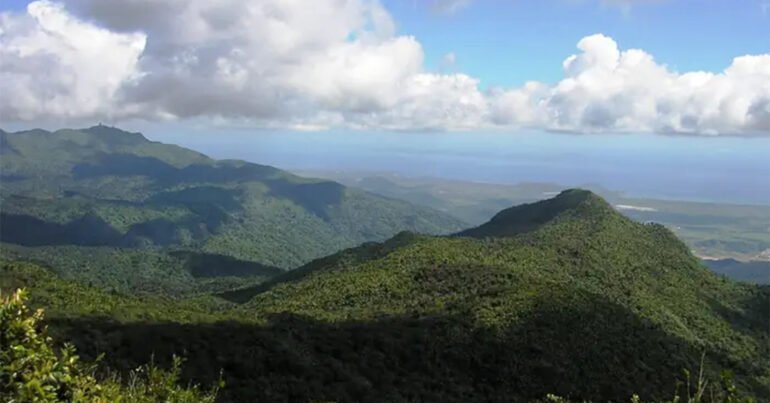
Water moving over rock. Tree frogs cutting through the canopy. Leaves shifting in wind you don’t feel at ground level. The air cools and the light changes — filtered, green, constant. By the time you step out of the car, you’re already inside it.
El Yunque isn’t introduced the way most destinations are. There’s no reveal moment, no single viewpoint that explains it. It builds slowly, with sound and moisture and elevation, until you realize you’re in a place that operates on a different set of conditions than the rest of Puerto Rico.
That difference is the reason you go.
The Only Tropical Rainforest in the U.S.
El Yunque National Forest is the only tropical rainforest in the United States National Forest system. It covers just under 29,000 acres across Puerto Rico’s northeast, stretching through municipalities like Río Grande, Luquillo, and Fajardo.
It’s small in size compared to other national forests, but the density is what defines it. The forest holds hundreds of plant species, layered vegetation, and a range of ecosystems that shift as you gain elevation — from lower, thicker forest to cloud forest near the peaks.
That variation is part of what makes the experience feel immediate. You don’t travel far to see change. You drive a short distance and step into something completely different.
Getting There Is Part of the Experience
From San Juan, the drive takes about 45 minutes.
You leave the coast, pass through Río Grande, and begin climbing into the forest. The main route — PR-191 — takes you into the most accessible part of El Yunque, where trails, waterfalls, and viewpoints are clustered along a single corridor.
The road itself is narrow, winding, and shaded. You’ll pass small pull-offs, trailheads, and signs pointing toward rivers and short hikes. Traffic can build later in the day, especially on weekends.
Early arrival changes everything. The forest is quieter, parking is easier, and the temperature is cooler. If you want a good place to stay, this one is right on the foothills of the park.
Start at El Portal
The main visitor center, El Portal de El Yunque, is where most visits begin.
The building sits at the base of the forest, with exhibits, orientation materials, and access to maps that help you understand the layout before heading up the road. It’s also one of the few places where you can step inside, use restrooms, and get a sense of conditions on the trails.
If it’s your first visit, it’s worth stopping here. If you’ve been before, you may skip it and head straight into the forest.
What Makes It Feel Different on the Ground
Humidity is constant. The air is thick, but cooler than the coast. Rain can arrive without warning, then disappear just as quickly.
Water is everywhere.
Rivers run alongside the road, cutting through rock and forming natural pools. Small waterfalls appear without signage. Larger ones draw crowds, but even those feel part of a broader system rather than isolated attractions.
The sound never stops. Coquí frogs, birds, insects — all layered into a steady background that replaces the usual silence of hiking trails elsewhere.
You don’t walk through El Yunque expecting quiet. You walk through it listening.
La Mina Falls and Access
For years, La Mina Falls was the most visited waterfall in the forest, accessible by a relatively short hike.
Access has changed over time due to storm damage and infrastructure updates, and conditions continue to evolve. Depending on current access, you may or may not be able to reach the falls directly.
Trails here lead you toward water. If one is closed, another offers a similar experience — a river crossing, a pool, a cascade.
The key is flexibility. You don’t come to El Yunque for a single stop. You come for the environment as a whole.
Short Trails, Immediate Payoff
Many of the trails in El Yunque are short, but they don’t feel limited.
Angelito Trail is one of the easiest. It leads to a wide section of the river where you can step into the water, sit on rocks, and stay for as long as you want.
Yokahú Tower requires almost no hiking. You climb a spiral staircase and reach a viewpoint that stretches across the forest canopy toward the Atlantic Ocean.
Mt. Britton Trail is longer, steeper, and leads to a stone tower at higher elevation, where the air is cooler and the forest shifts toward cloud cover.
Each option gives you a different version of the same place. You can combine them or choose one and spend your time there.
Swimming in the Forest
Swimming is part of the experience, but it’s a free for all.
There are no designated beach areas, no lifeguards, no marked swimming zones. You find a section of river, check the depth, and step in. Water temperature is cool compared to the coast. Rocks can be slippery. Rain upstream can change conditions quickly.
It’s informal, and that’s part of the appeal.
You’re not at a resort pool. You’re standing in a river that’s been cutting through this forest long before the road was built.
What to Bring (And What You’ll Actually Use)
You’ll want shoes with grip. Trails can be muddy, and rocks near water are slick.
A light rain jacket helps, but many visitors skip it and accept getting wet. The rain tends to come and go quickly. Bring water, even though you’re surrounded by it. Bring a towel if you plan to swim.
Leave anything you don’t need in the car. You’ll carry less, and the experience will feel easier.
Timing Your Visit
Morning is best.
Arrive early — ideally before mid-morning — and you’ll have more space on trails and at river spots. By midday, parking areas fill, and popular stops become crowded.
Weekdays are quieter than weekends. Cruise ship days and holidays bring more visitors.
Weather shifts throughout the day. Rain is common in the afternoon.
If you plan it right, you’ll have a few hours of clear conditions before the clouds build.
Why It’s Worth Leaving the Beach for a Day
Puerto Rico is known for its beaches. That’s where most trips are centered.
El Yunque offers something else entirely.
You trade open sky for canopy. You trade ocean horizon for layers of green. You trade salt air for humidity and freshwater.
It resets your sense of place.
You don’t need multiple days here. Even a half-day changes how you experience the island.
You leave the forest, return to the coast, and notice the difference immediately.
Combining It With the Coast
El Yunque sits close to the northeast coast, which makes it easy to combine with other stops.
Luquillo Beach is a short drive away, with calm water and a long stretch of sand.
The Luquillo Kiosks offer food options ranging from traditional Puerto Rican dishes to quick snacks, making it an easy place to stop after the forest.
You can spend the morning in El Yunque, then head to the beach for the afternoon.
That combination is one of the simplest and most effective day plans on the island.
Access and What to Know Before You Go
Visitor capacity is managed due to limited parking and ongoing infrastructure work. Entry systems and access requirements can change, so it’s worth checking current conditions before you go.
The main corridor along PR-191 remains the most accessible route.
Some areas may be closed at any given time for maintenance or recovery from storms. Flexibility is part of the experience.
You plan a route, but you adjust once you’re inside.
Why El Yunque Stands Apart
There are rainforests across the Caribbean. El Yunque is different because of where it is and how it’s protected. It’s part of the U.S. National Forest system, which means maintained access, structured trails, and a level of infrastructure that allows you to experience a tropical rainforest without needing a guide or specialized planning.
Guy Britton
2026-03-24 00:07:00