
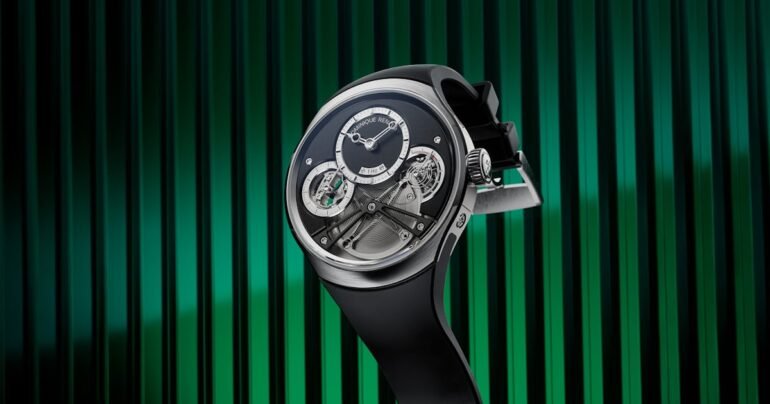
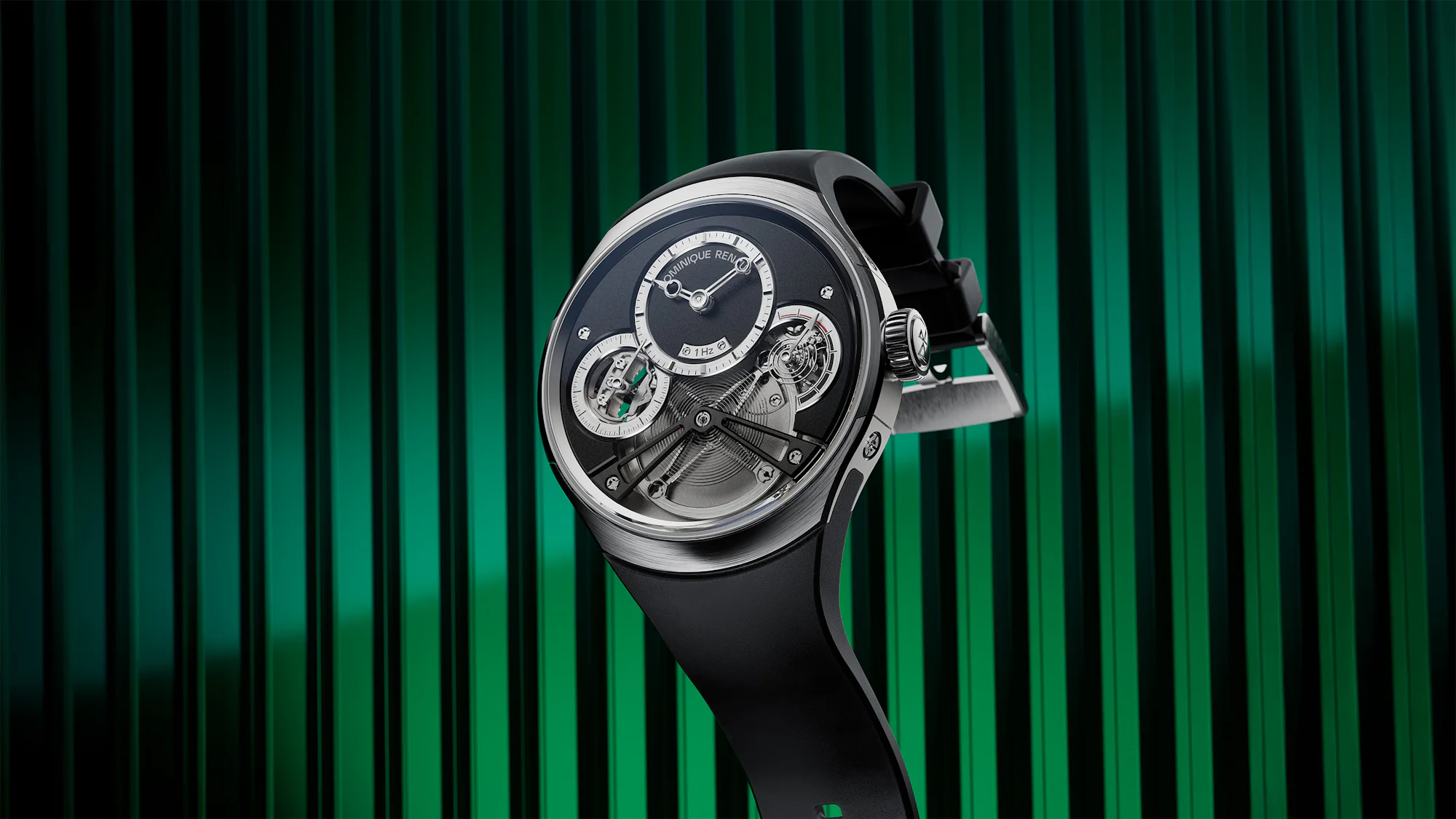
Generally, a higher beat rate comes with higher beat stability and protection against movements and shocks. Here, the large variable-inertia balance ticks at 60 beats per minute, or 7,200 vibrations (half-cycles) per hour, which Renaud says is more akin to the human heart. He’s not the first to try this in a wristwatch (Antoine Martin tried back in 2013, but was apparently stopped by a patent claim on one of his parts by a large conglomerate, among other issues). But it seems relatively unnecessary and prone to shock. Renaud claims that the larger balance diameter helps with this by buffering shocks. Also, the curb-pin regulator isn’t on the escapement, but (as in the AP caliber 7121) on its own bridge, visible in the natural dead-half-beat second subdial. Quite unusual.
On top of this, the bigger surprise is an interesting take on the escapement. On the rear of the watch, you can see a linear bridge that’s reminiscent of Lange’s second-generation Zeitwerk remontoir bridge. The watch uses an escapement that is not completely unheard of in watchmaking, but is far from common. In a normal Swiss lever escapement, the balance only rotates around 310º (there are technical reasons, but I’ll spare you until a Hands-On). Essentially, if it goes too far, it’ll hit the back of the pallet fork (not where it should hit). The design here shares many similarities with a lever escapement but uses a geared roller and other design tweaks to allow a rotation past 360º (up to a potential 700º amplitude). Renaud claims that by rotating further than the escapement itself requires, the balance is affected more by the natural physics of its own rotation and less by interactions with the rest of the escapement, and therefore is more stable.
Mark Kauzlarich
2026-03-24 13:00:00