
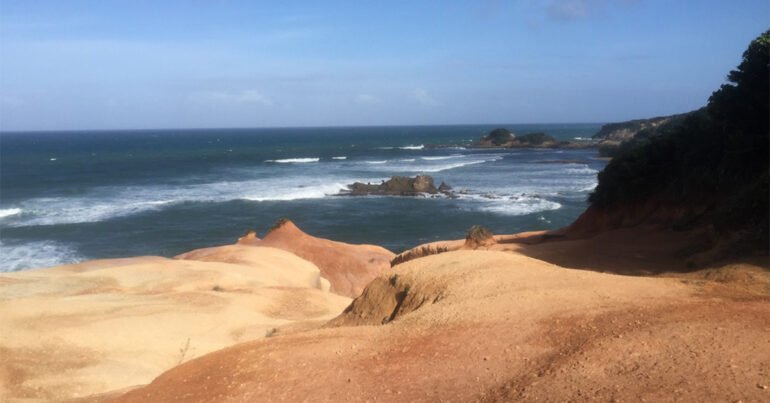
It feels like you’re on Mars. But you’re in the Caribbean.
On the north coast of Dominica, just beyond the village of Calibishie, the shoreline shifts abruptly. The green hills fall away, the palms thin out, and the ground turns a deep, rusted red. The rock here runs along the edge of the Atlantic in jagged, uneven formations, cut low and flat in some places, rising into sharp ridges in others. Waves push in from open water and break hard against the surface, sending spray across the stone.
Locals call it Red Rocks.
It’s one of the most unusual coastal landscapes in the Caribbean — not for its size or development, but for how different it looks and feels from the rest of the region. There are no wide arcs of white sand here, no rows of loungers or beach bars. What you see instead is exposed geology: iron-rich rock oxidized over time, shaped by constant wave action, set against a horizon that stays open and uninterrupted.
I came here on my honeymoon, and it remains one of my most vivid memories of the trip.
You reach it by a narrow road that runs past small houses and guest villas before giving way to a rougher track. The sound of the water arrives before the view does — a steady, heavy break that carries across the open ground.
Then the color comes into view.
A Natural Formation That Feels Out of Place — in a Good Way
The red isn’t subtle. It ranges from burnt orange to deep crimson, depending on the light and the moisture on the rock. After rain, the surface darkens and takes on a heavier tone. In full sun, it brightens, almost glowing against the blue of the water.
The formations themselves are uneven and layered, with flat sections that look almost carved and others that drop off sharply toward the sea. There are small channels where water collects, pockets where waves surge in and retreat, and narrow ledges that extend out toward the break.
This isn’t a place to settle in for a swim. The Atlantic side of Dominica carries a stronger, more consistent force, and the entry here is rocky and exposed. What draws people is the terrain itself — the contrast, the texture, the way the land meets the water without transition.
You walk along it carefully, watching your footing, stepping over cracks and ridges. In some spots, the surface is smooth enough to stand and look out across the water. In others, it’s fractured and uneven, forcing you to slow down.
There’s no signage, no structured path. Just the rock, the wind, and the sound of the ocean.
Why It Stands Apart in the Caribbean
Across much of the Caribbean, coastal identity is tied to sand — long, soft stretches that define the experience of a place. Dominica has those beaches, particularly on its west coast, but the island has always leaned more toward its terrain: rivers, cliffs, volcanic formations, and dense interior rainforest.
Red Rocks fits into that pattern.
It reflects Dominica’s volcanic origins in a direct, visible way. The iron content in the rock oxidizes over time, producing the color that sets this stretch apart. The constant exposure to Atlantic waves shapes the surface, smoothing some areas while breaking others apart.
The result is a shoreline that feels closer to raw formation than finished landscape.
There’s very little development around it. No infrastructure has been built to soften or frame the experience. You arrive, you walk, you look. That’s the interaction.
For travelers used to more structured beach environments, it can feel stripped down. For others, that’s the point.
The Setting Around It
Calibishie, the nearest village, sits just to the west, with a mix of small guesthouses, local homes, and a handful of restaurants. The pace here is slow, even by Caribbean standards. Fishing boats line parts of the coast, and the roads wind through dense vegetation before opening out toward the sea.
From Red Rocks, you can see stretches of the northern coastline, including nearby coves and the outline of other rocky formations further along. On clear days, the water shifts in color from deep blue to lighter tones closer to shore, depending on depth and light.
There’s very little interruption to the view. No cruise traffic passes directly in front. No large-scale resorts sit nearby. The coastline remains largely intact.
That sense of openness is part of what defines the experience.
How to Visit
Getting to Red Rocks requires a bit of planning, but it’s straightforward once you’re in the north of the island.
From Douglas-Charles Airport, it’s about a 20-minute drive. The road runs through small communities and coastal stretches before reaching Calibishie. From there, local directions or a guide can help you find the access point, which isn’t heavily marked.
A rental car gives you the most flexibility, though taxis from nearby areas can also arrange drop-offs and pickups.
Footwear matters here. The rock surface is uneven and can be slippery, especially after rain or when waves send spray across the ledges. Closed shoes or sturdy sandals make the walk easier.
There’s no shade directly on the rocks, so sun protection is important. Water, too — there are no facilities once you’re there.
Most visits are short, anywhere from 30 minutes to an hour, depending on how much time you spend walking the area.
When to Go
The look of Red Rocks shifts with the light.
Early morning brings softer tones, with the sun lower and the color more muted. Midday brightens everything — the red intensifies, the contrast with the water sharpens. Late afternoon can add depth, especially if clouds move through and break up the light across the surface.
Sea conditions also change the experience. On calmer days, the water rolls in more steadily, with less spray. When the Atlantic picks up, waves hit harder, sending water across the rock and creating more movement along the edge.
There’s no single “best” time, but the variation adds to the appeal.
Pairing It With the Rest of the North
Red Rocks is often part of a broader day in northern Dominica.
Batibou Beach, one of the island’s more recognizable stretches of sand, is a short drive away. It offers a different setting — softer, more traditional, with a wide shoreline and swimmable water when conditions allow.
Further along, you can explore the villages that line the coast, stop for local food, or continue inland toward the island’s river systems and hiking trails.
The contrast is what stands out. Within a relatively short distance, the terrain shifts from red rock to sand to dense green interior.
Karen Udler
2026-03-22 21:44:00