

What We Know
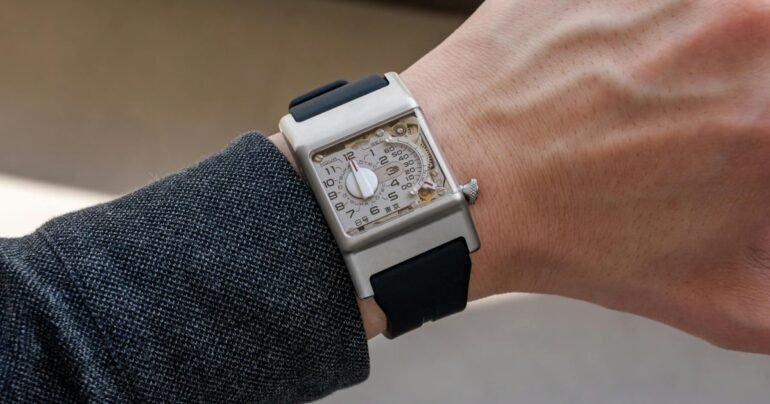
Following the release of the No. 9, Otsuka Lotec now introduces the No. 8, a new model also featuring a square case. Like other watches from the brand, the No. 8 does not rely on conventional hands to display the time. Instead, it employs an inventive display system that combines both a jumping hour and a retrograde minute indication.
Time is displayed through three distinct elements, with the minutes and hours marked by red accents. First is the jumping hour, referred to in this model as the “Hour Channel,” which instantly jumps to the next hour. The minutes are shown via the Minute Fader, a retrograde display linked to a flywheel mechanism that slowly returns from 60 minutes back to zero at a visible pace. At the top/center of the dial sits a seconds disk, which is partially visible behind the main displays.

Otsuka Lotec watches often draw their design inspiration from vintage analog machines and measuring instruments. Founder Jiro Katayama has previously cited mechanical meters—such as old electrical power meters—as sources of inspiration for his designs. For the No. 8, however, the starting point was something quite different: the mixing consoles from recording studios.
More specifically, the model takes cues from the REDD.37 tube mixing console, once used at London’s Abbey Road Studios. Known for its role in recording sessions by The Beatles, the console is celebrated for its industrial aesthetic and functional design—qualities that Katayama has long admired.

Photo Courtesy: Vintage King Audio

Photo Courtesy: Vintage King Audio

Photo Courtesy: Vintage King Audio

Photo Courtesy: Vintage King Audio
Looking at the dial, it becomes clear that many of its elements echo the controls of audio equipment. The jumping hour display—referred to by Katayama as the “Hour Channel”—takes its form from the channel select switchon mixing consoles. The result is a design that almost invites interaction, with a shape that makes you want to pinch it between your fingers and give it a turn.
The minute display is designed to resemble a mixer fader viewed from the side. This “Minute Fader” is a retrograde indication that slowly returns from 60 minutes back to zero, its motion controlled by a flywheel. The movement evokes the rotation of tape reels on vintage recording equipment, adding a tactile, mechanical quality to the display.
The dial itself is constructed in two layers, with the fader passing between them. This architecture gives the watch a distinctly three-dimensional structure, further emphasizing the mechanical character of the design.


The case design is equally distinctive. The lugs are angled both at the top and bottom, giving the watch a trapezoidal profile when viewed from the side. Finished entirely in satin brushing, the case conveys a strongly industrial character reminiscent of precision instruments. The buckle has also been newly designed specifically for this model, and notably, the No. 8 is the first Otsuka Lotec watch to be fitted with a rubber strap.
The crystal extends down along the sides of the case, allowing the internal mechanism to be viewed from an angle. From the side, it is even possible to observe the motion of the minute fader as it passes between the two layers of the dial. Together, these elements reinforce the concept behind the watch, translating the world of recording studio equipment into both the design and the motion of its time display.

Turning to the specifications, the case measures 31 mm across, 47.8 mm from lug to lug, and 10.8 mm in thickness. It is the thinnest case currently offered in the brand’s lineup and provides everyday water resistance. Inside, the watch is powered by a MIYOTA 90S5 base movement fitted with an in-house module. This module comprises 62 components—roughly twice as many as in previous models—and incorporates micro ball bearings manufactured by MinebeaMitsumi.
The retrograde minute display, one of the defining features of the watch, also required some unusual engineering. To achieve the slow, controlled return of the minute fader, a hairspring-like component is used to regulate the tension of the mechanism. Interestingly, this spring is not designed for watchmaking but is adapted from springs typically used in devices such as speedometers. According to Katayama, the solution was made possible by experience gained during the development of earlier models, including the No. 6 and No. 9.
The watch is priced at ¥990,000 / $6,300 (tax included). While it is not a limited edition and will remain in production, the model is expected to begin with very small production numbers.
What We Think
Handling the No. 8 in person, the first thing that stood out was the fascinating three-dimensional character of its mechanism. It is already a unique watch in photographs, but in the metal, the movement of the display becomes even more compelling.
The most striking element is undoubtedly the minute fader. When the display returns from 60 minutes back to zero, the flywheel-controlled retrograde moves slowly and deliberately. The motion, accompanied by a subtle vibration, is surprisingly captivating—something you could easily find yourself watching for much longer than expected.

What makes the display even more engaging is what happens at the same moment. As the fader slowly resets, the Hour Channel clicks over to the next hour. The contrast between the slow movement of the minutes and the instantaneous jump of the hour creates a dynamic that feels uniquely characteristic of this watch.
I personally own two Otsuka Lotec watches—the No. 7.5 and the No. 5 Kai. The No. 7.5 features a jumping hour that switches instantly, while the No. 5 Kai uses a wandering hours mechanism, with rotating discs that slowly move to indicate the time. Both displays are fascinating in their own way, but compared with the instantaneous jump of the No. 7.5 or the gradual rotation of the No. 5 Kai, the combination of the moving fader and the jumping Hour Channel on the No. 8 feels particularly unique.
On the wrist, the watch measures 31 mm across, which sounds quite compact, but with a 47.8 mm lug-to-lug length, it has more presence than the numbers might suggest. At the same time, the case thickness is kept to 10.8 mm, making the watch surprisingly comfortable to wear.

So, would I want one? Absolutely. To be honest, there hasn’t been an Otsuka Lotec watch so far that I didn’t find appealing, and the No. 8 is no exception. Much of the brand’s charm lies in its distinctive designs—watches that pack in the elements that Katayama himself finds “cool.” With the No. 8, however, that originality is paired with something more: the simple pleasure of watching its mechanism in motion.
The Basics
Brand: Otsuka Lotec
Model: No.8
Diameter: 31 mm
Lug-to-Lug: 47.8 mm
Thickness: 10.8 mm
Lug Width: 24 mm
Case Material: 316L stainless steel
Indexes: Hour Channel, Minute Fader, and second disk
Lume: None
Water Resistance: 3 ATM
Strap/Bracelet: Rubber strap with a newly designed buckle created specifically for the No. 8 case design

The Movement
Caliber: MIYOTA 90S5 with in-house module
Functions: Jumping hours (“Hour Channel”), retrograde minutes (“Minute Fader”), seconds disk
Power Reserve: Approximately 32 hours
Winding: Automatic
Frequency: 28,800 vph
Jewels: 33 jewels + 3 ball bearings (MinebeaMitsumi)
Chronometer Certified: No
Additional Notes: When setting the time, the crown should always be turned forward (advancing the time)
Pricing & Availability
Price: ¥990,000 (incl. tax) / ~$6,300 USD
Availability: Lottery-based sales at launch
Limited Edition: No
For more information on the Otsuka Lotec No. 8, visit the brand’s official website.
Masaharu Wada
2026-03-10 15:01:00