
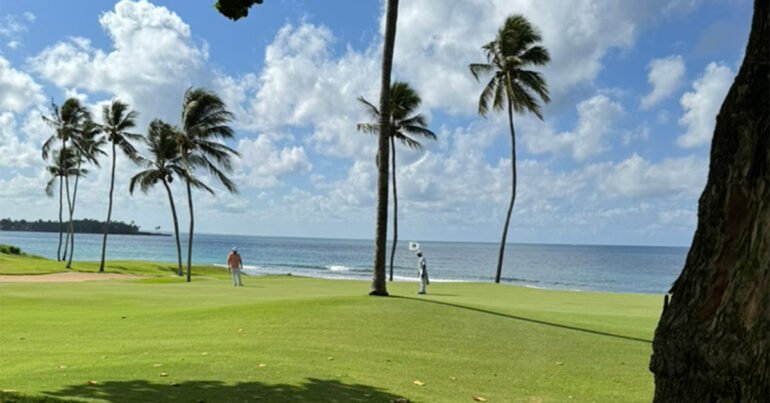
The Caribbean’s most iconic stretch of oceanfront fairways is back.
Teeth of the Dog, the Pete Dye masterpiece at Casa de Campo Resort & Villas in the Dominican Republic, has officially reopened following a meticulous restoration that returns the course to the sharpness and intent of its original design.
For more than five decades, Teeth of the Dog has defined championship golf in the Caribbean. Seven holes run directly along the rocky coastline. Coral outcroppings frame greens. Trade winds shift club selection without warning. It is the course players measure others against.
Now, after a comprehensive renovation guided by Dye’s original architectural philosophy, the layout has reopened with refined surfaces, renewed bunkering and upgraded practice facilities — while preserving the character that made it legendary.
The benchmark is back.
A Course Carved From Coral
When Pete Dye first walked the rugged shoreline at Casa de Campo in the late 1960s, there was no template for Caribbean golf at this level. He carved the course from coral rock and jagged coastline, shaping fairways and greens that felt native to the land rather than imposed upon it.
Teeth of the Dog debuted in 1971 and quickly earned international recognition. Its ocean holes — particularly the closing stretch — became some of the most photographed in the sport. Generations of touring professionals, low handicappers and bucket-list travelers made the trip to La Romana to test themselves against Dye’s angles and coastal wind.
The restoration respects that DNA.
Rather than reinventing the course, the work focused on refinement — bringing surfaces, lines and conditioning back in alignment with Dye’s original intent.
Sharper Greens, Truer Contours
The most noticeable changes are underfoot.
The greens have been rebuilt and refined to restore their shape and edge definition. Contours now sit cleaner and more precise. Approach shots demand the same disciplined positioning that Dye intended. Miss in the wrong place and recovery remains exacting.
Fairways have been tightened and reconditioned to improve both turf quality and strategic clarity. Sightlines are cleaner. Landing areas feel deliberate.
The bunkers have been renewed in the spirit of the original design, with shapes and placement reflecting Dye’s preference for bold framing and visual intimidation without gimmickry. The sand flashes bright against the green turf and blue water, particularly on the oceanfront holes.
The Ocean Holes Still Define It
Seven holes play directly alongside the Caribbean Sea, and they remain the course’s signature.
The par-3 fifth, playing toward a green perched above crashing surf, demands a committed swing. The par-4 seventh hugs the shoreline, with wind as constant companion. The closing stretch along the water continues to test distance control and nerve.
The renovation has enhanced conditioning along these coastal corridors, sharpening edges and restoring the visual contrast between fairway, bunker and sea. The backdrop remains dramatic. The margin for error remains narrow.
For returning players, the sight will feel familiar — but crisper.
For first-time visitors, the experience remains singular in the region.
Playability Without Compromise
One focus of the restoration was enhancing overall playability through improved course conditioning.
Teeth of the Dog has always rewarded precision over power. Strategic angles define scoring opportunities. The refinements ensure that shots react as intended, with truer roll on greens and consistent lies in fairways and rough.
The course retains its championship pedigree. It has hosted professional events and international tournaments over the years, and it continues to sit near the top of global rankings for resort courses.
But it also remains accessible to visiting golfers who come for the experience as much as the scorecard. Multiple tee options allow players to choose their challenge, while the architecture still demands thoughtful play.
Upgraded Practice Facilities
Alongside the course work, Casa de Campo has upgraded the practice facilities to match the standard of the layout itself.
The driving range has been refreshed, with improved turf and target alignment. Short-game areas allow players to rehearse the types of shots the course requires — tight lies, firm approaches and controlled pitches into sloping greens.
For many visitors, a round at Teeth of the Dog anchors a multi-day golf trip that may also include Dye Fore (another one of my favorites that actually includes 27 holes) and The Links at Casa de Campo. The upgraded practice areas create a stronger arrival experience before players step onto the first tee.
A Legacy That Endures
Pete Dye’s influence on modern golf course design runs deep. His work reshaped how architects approached visual intimidation, risk-reward options and integration with natural landscapes.
Teeth of the Dog stands as his Caribbean signature.
The restoration does not attempt to modernize the course beyond recognition. It restores clarity. It reinforces intention. It ensures that the strategic demands remain intact for another generation of golfers.
That approach carries weight. Courses of this stature are preserved, not reinvented.
Why It Still Leads the Caribbean
There are other strong layouts across the region — clifftop courses in Mexico, oceanfront designs in the Bahamas, championship tracks in Puerto Rico and Jamaica. But Teeth of the Dog has long held the top position in Caribbean golf conversations.
Its combination of coastal exposure, architectural integrity and resort infrastructure keeps it ahead.
You stay at Casa de Campo’s villas or rooms (or even the fantastic new Premier Club). You dine at waterfront restaurants in the Marina. You move between golf, beach and spa without leaving the property.
And at the center of it all sits Teeth of the Dog.
With the reopening complete, the course returns not as a reimagined concept but as a restored original — sharper, truer and prepared for the next wave of players who want to test themselves along its coral-lined fairways.
The ocean is still there. The wind still shifts. The greens still demand precision.
The Caribbean’s greatest course is open again.
Jose Antonio
2026-02-20 20:49:00