
One of the most useful watch complications in horological history is also one of its most forgotten.
The ring of a mechanical alarm may seem like a lost artifact, like a rotary phone dial or a manual transmission, all once the necessities of 20th century civilization. And yet, functionality of a settable and mechanical-winding alarm into the tiny confines of a wristwatch is an impressive mechanical feat, one underrated among dive bezels, world timers, pulsations scales, and tachymeters.
The alarm watch was meant for the everyman, whether they’re travelers, titans of industry, or merely early risers. Just like there is appreciation for a watch’s ability to do more than just tell time, there is the aural sensation for a watch to produce something more for the senses than just sight.

Eterna was the first to patent an alarm caliber as early as 1908, eventually introducing an alarm wristwatch in 1914 at the Swiss National Exhibition in Berne. It was an impressive achievement, but it wouldn’t last: there was the problem that the alarm could only sound for less than 10 seconds, barely enough to rouse a moderate sleeper, as well as the fact that when the alarm was set, accuracy suffered.
However, the Eterna did achieve something significant: it spurred Vulcain, in nearby La Chaux-de-Fonds, to begin developing its own alarm mechanism in 1942. The resulting Vulcain Cricket, debuting in 1947, fixed its predecessor’s shortcomings: namely, separate barrels for the alarm system and the movement ensured that the alarm had plenty of power to ring out, long and loudly. For 25 seconds, one could hear its reverberations from across a room, even from within a desk drawer—exactly the audible strength as its namesake.
“The engineers of the Vulcain Factory have overcome obstacles apparently unconquerable,” sang the praises of a 1950s instruction manual. It labeled the Cricket “probably the greatest achievement ever recorded in horology since the advent of wristwatches.”

It quickly became Vulcain’s signature model. That same year the Cricket was introduced, it won the Chronometry Prize at the Neuchâtel Observatory. Nautical and diver models followed, with up to 300 meters of water resistance: the Cricket Nautical even featured a decompression scale on its dial. Upon leaving office in 1953, Harry S. Truman was the first U.S. president to be presented with a Cricket, beginning a tradition that lasted, on and off, into the Obama administration; Lyndon B. Johnson was so enamored with the Cricket that he ordered 200 to present as gifts, reportedly using the alarm as an excuse to get out of meetings.
Vulcain relied on the alarm watch as its calling card. But other Swiss brands quickly followed: Jaeger-LeCoultre’s Memovox was introduced in 1950 and eventually added an automatic movement to the complication; so significant was it in JLC’s lineup that remains in production today, the second-oldest watch model behind the Omega Seamaster. The Tudor Advisor became the only model under the Rolex umbrella with an alarm, an embodiment of midcentury elegance. Girard-Perregaux launched its Reference 7742 with a separate alarm window at 6 o’clock, and away from Switzerland, Seiko’s Bell-Matic paired features like quickset day-dates and automatic movements with an internal rotating bezel.

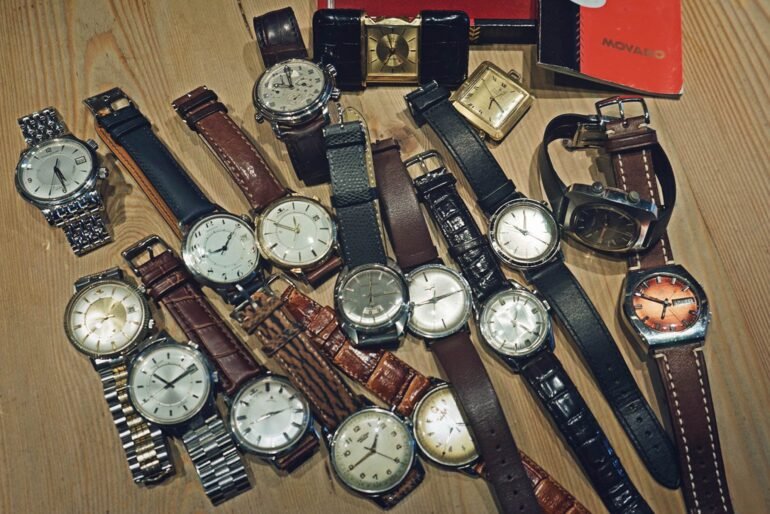
That’s only the most well-known ones. Peruse the annals of eBay listings and funky models from Hamilton, Croton, and Fortis will all appear with their own period-correct variations and styles. You might even come across some of the oddballs pictured in the above collection, such as the Hamilton which features an unusual faceted crystal, the Croton Wanderer with a diving bezel, and that Fortis with a vivid red-orange sunburst dial and an oddball and delightfully chunky 1970s case.

These are just some of the many alarm watches amassed by my friend Augustin Simat, a fixture among vintage watch collectors in New York, who appreciate the esoteric and the often-overlooked. To them, he’s the alarm watch guy: at one point he owned 60 examples, and he subsequently whittled it down to 40. “In the past four months, I bought seven alarms,” he says. “I think that whenever I see one, I just can’t not buy it. And that’s a problem, my friend.”

Simat, a classically-trained pianist, began playing at the age of five in his native Croatia. He studied at prestigious conservatories in Moscow before coming to the United States, and teaches to this day across New York and New Jersey. It comes as no surprise, then, that he tells me about the connection he senses between music to the auditory stimulus from a wristwatch, especially one that goes beyond mere mechanical ticking. Never mind that a Vulcain Cricket only produces one tone—a harsh, almost guttural note that he describes as “mostly noise.” In the realm of haute horlogerie there are Grand Sonneries, quarter repeaters, and striking mechanisms—complications that can be as elevated as Rachmaninoff’s Prelude in B-Flat Major, Simat’s favorite piece from his favorite composer. But as he shows me a series of compact travel clocks, each nearly the size of wristwatches, including a new-old-stock Movado that is wound by pushing both sides of its leather-wrapped case in and out, it’s worth remembering that these are travel tools.

“You get more than just the time, so you get to enjoy it on a different level,” he says, before describing how he sets two alarm watches in his room, every morning, using them as intended. “You get a diver watch, and you play with the bezel, fantastic. But here, you can also have a diving alarm, and it’s going to produce sound. I found it fascinating that something so small can have something so meaningful.”
Alarm watches might just be the most underrated complication in all the watch world. A stunning example can go for around $2,000, but many alarm watches that one can find listed hover around half that price or less. Sure, the modern, white-gold Blancpain Léman Réveil GMT in the group of watches pictured hovers around $15,000. But compared to GMTs, chronographs, and divers from around the same timeframe, they go for much more than that: “Dealers are staying away from them because they have this feeling, oh I’m going to buy one and I’m going to sit with it forever. And it’s a shame. I think they deserve more attention.”

If rediscovering midcentury technology is the appeal of vintage collecting, then the alarm watch has this in spades. For the uninitiated, there’s a joy in discovery from playing with the two-stage pushers and crowns and learning how to set the alarm hand to its 10-minute increments. And if one doesn’t fully trust the mechanical winding of two mainspring barrels nestled in the micromechanics of an 80-year old design, there’s always an iPhone alarm as a backup.
Blake Z. Rong
2026-02-20 21:00:00