
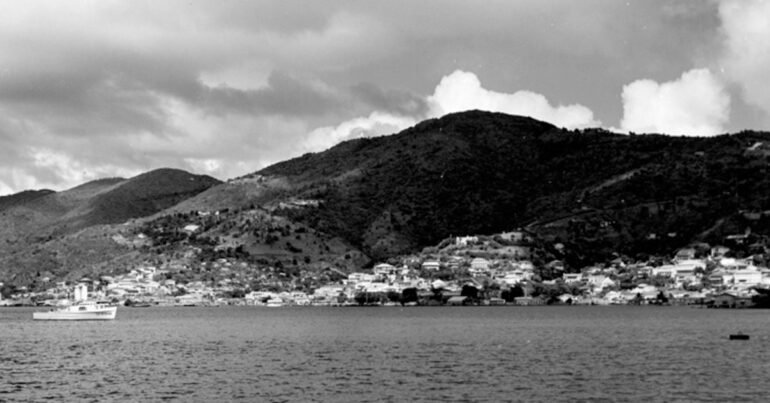
In February 1948, Harry S. Truman stepped onto the dock in Charlotte Amalie beneath a bright Caribbean sun, the presidential yacht USS Williamsburg anchored in the harbor behind him. The trip was framed as rest — a winter break from Washington — but it carried something more deliberate.
Truman spent time on St. Thomas and St. Croix, fishing, cruising, appearing in Christiansted, and speaking from Government House. The U.S. Virgin Islands had been American territory for just over 30 years. Tourism was modest. Truman saw potential. His visit placed the islands inside the national imagination at a moment when air travel was beginning to shrink distances and the postwar American middle class was starting to look outward.
He understood that a presidential presence, even briefly, functioned as endorsement. If the President of the United States could vacation here, so could Americans.
It was, in modern terms, the first clear non-state-business trip to the Caribbean by a sitting president — at least since George Washington’s 1751 journey to Barbados, long before he ever held office.
Truman’s visit did not create an immediate wave of presidential travel south. In fact, the list that followed would remain surprisingly short. But it established something important: the Caribbean as a place not just for diplomacy or strategy, but for presidential retreat. Just to note: these are places where presidents actually vacationed — not places where they came on state business.
The Virgin Islands: Familiar and Far Away
There is a practical logic to the U.S. Virgin Islands as a presidential refuge. They offer the Caribbean without the passport line. American governance alongside Danish-era architecture. Reef-lined beaches within U.S. territory — and airports that can handle Air Force One.
Bill Clinton found that balance in the late 1990s, when he spent part of the holiday season on St. Thomas at a private villa overlooking Magens Bay. The north side’s winding roads and elevated views have long drawn travelers seeking privacy without isolation. For a president, it offered both.
Two decades later, the Virgin Islands re-emerged as a presidential holiday address.
Beginning in December 2022, President Joe Biden and his family chose St. Croix for their year-end break. They returned in 2023. They returned again in 2024. Each visit followed the same quiet rhythm: arrival after Christmas, departure shortly after New Year’s Day.
St. Croix carries a different energy than its sister islands. Christiansted and Frederiksted function as working towns as much as visitor hubs. The beaches stretch wide and often uncrowded. The dining scene has sharpened into something confident and distinctly Crucian. You can walk the boardwalk in the evening. You can sit on a north shore beach and feel removed without being unreachable.
By returning three winters in a row, Biden did something unusual in the presidential travel record. He turned a Caribbean vacation into a pattern.
In doing so, he made St. Croix the most consistent presidential Caribbean retreat.
Jimmy Carter’s Caribbean Chapters
Jimmy Carter’s relationship with the Virgin Islands unfolded in two acts.
In January 1981, days after leaving office, Carter traveled to the U.S. Virgin Islands for a vacation, spending time in St. Thomas and St. John. It was the kind of trip that follows the end of public office — decompression in warm air, distance from headlines.
Nearly three decades later, he returned.
At the end of 2009, Carter and more than 30 members of his extended family spent the holidays on St. Croix, staying at the Comanche Hotel in Christiansted. They attended Crucian Christmas Festival events. They moved through town on foot. They visited Buck Island. It was not a private-island tableau. It was multigenerational, public, and distinctly local.
That image — a former president watching a holiday parade in a small Caribbean town, grandchildren beside him — feels closer to the spirit of the region than any motorcade ever could.
Jamaica and the Wider Caribbean
The Virgin Islands may anchor the presidential Caribbean story, but they are not alone.
In late 1960, before his inauguration, President-elect John F. Kennedy traveled to Round Hill in Jamaica. The resort, west of Montego Bay, had already established itself as a retreat for artists and political figures. Kennedy’s stay added a new layer to its lore. White villas against the green hills, the north coast light sharp against the sea — Jamaica offered distance without exile.
Ronald Reagan later visited Caribbean settings during his presidency, blending official travel with island stops that provided at least brief respite from Washington’s pace.
The Bahamas, too, have long drawn American political figures, especially after they leave office. Close to Florida and discreet by nature, the islands offer privacy without isolation.
A Short List, By Design
What stands out across the past century is not how often presidents vacationed in the Caribbean, but how rarely.
Maine, Texas ranches, Cape Cod compounds, Hawaii, Delaware — domestic retreats dominate the presidential record. Security logistics and political optics favor familiar ground.
And yet, when a president does head south, the moment tends to endure.
Truman’s 1948 visit still forms part of Virgin Islands lore. Carter’s holiday at the Comanche Hotel remains a story told in Christiansted. Biden’s repeated St. Croix vacations have woven the island into the recent narrative of the presidency.
The Caribbean has always represented something specific in the American imagination: warmth when the mainland is cold, horizon instead of hallway, sea instead of schedule.
For a few days at least, the office can feel very far away.
Caribbean Journal Staff
2026-02-16 20:33:00