
So why should a camera company make a watch?
Wearing any watch is a bit of an exercise in fantasy. To wear a mechanical watch is an anachronistic choice of the highest order. We don’t wear a mechanical watch because they make the most sense, or because they’re the most practical choice. We wear them because of how they make us feel, because we like how they look, and because of how we see ourselves when we wear them. The same is true for carrying a camera — doubly so for a Leica.
Walking around with a Leica around your neck lets you play the part of the rakish photojournalist, the daring adventurer, or the dashing international street photographer. A Leica camera is the perfect balance of rugged and delicate, utilitarian and elegant. More than being simply tools meant to accomplish a task, Leica has focused on creating objects you want to engage with, objects that feel great to hold, to carry, or to use. And the Leica ZM 2 is the perfect complement.
It’s a bold move for a brand like Leica to branch out. They arguably have a lot more to lose launching a watch line than most brands do. Leica is a brand with an identity, a reputation, and a devoted following — all of which are put on the line in making a brand expansion play like this one. Put another way, launching a watch on the back of a century-old (actually, century-and-a-half) camera maker’s reputation would not be a move recommended by corporate consultants (at least not corporate consultants looking to maintain their billable hours).

Still, here it’s worked, and that in no small part thanks to two things: First, Leica is a brand with a very clear design vocabulary, one which blends traditional and modern in a way few other product brands can manage effectively. Second, Leica is very good at making small, intricate mechanical things that work incredibly well. Leica isn’t a fashion house that decided it needed a watch to round out the F/W collection; Leica has been a leader in precision engineering for a very long time, and a watch is a natural extension of that skill set.
The Leica ZM 2
I think the most surprising thing about the Leica ZM 2 is that, despite having been around for a few years now, it remains a remarkably rare sight, even for those of us who get to see a lot of watches. At the same time, it feels familiar as soon as you get your hands on it. The ZM 2 is refined and precise, with a conspicuous identity that feels totally at home in a Leica boutique alongside M and Q cameras. Like a Leica camera, the watch feels special, but not precious, and robust.
On the wrist, the ZM 2 isn’t a shrinking violet. At 41mm wide, with a 48mm lug-to-lug and measuring 14.5mm thick (with a fairly pronounced — and reflective — domed sapphire crystal), the ZM 2 is a watch that lives at the outer edge of its own dimensions. The slim, but tall, polished bezel; flat caseback; and wide lug stance all contribute to this effect, but still, thanks to a compact lug to lug, and an unexpectedly sloping lug shape, the watch stays wearable and comfortable and unobtrusive. I’d be unlikely to pick the ZM 2 out of my watch box for a black tie dinner, but at the same time, if I got caught by a surprise invitation, I’d not be too hesitant to show up for that dinner wearing this watch.

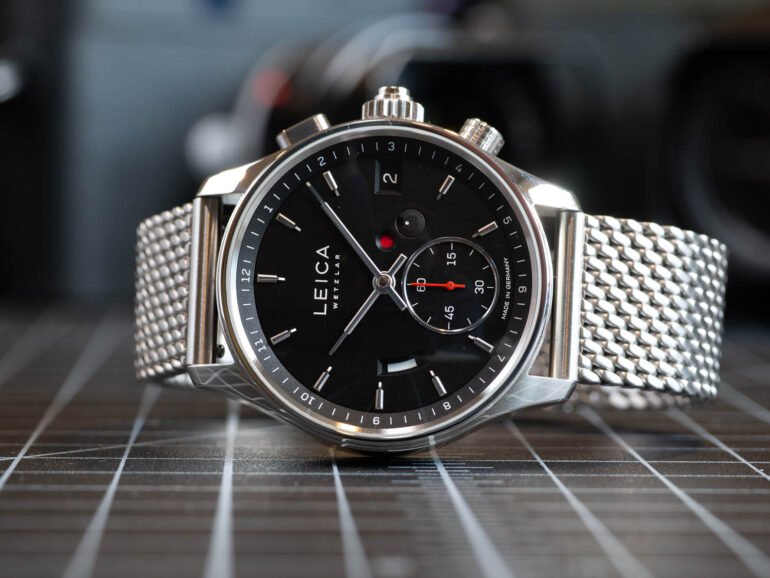
The matte black aluminum dial, with its slightly grained texture, is remarkably handsome. The spacious dial, which is finished with polished and brushed rhodium-plated and diamond-cut hands and markers, is incredibly legible, especially for a watch with as much going on as the ZM 2. Any watch with a small seconds display, date, rotating passive second time zone, day/night indicator, power reserve indicator, and mode display (more on that in a bit) runs a real risk of indecipherability, but the ZM 2 manages to side-step the hazard beautifully.
The power display indicator, which arcs between the eight and nine o’clock indices, is an elegant implementation of a complication I’m not usually a huge fan of, but which makes a tremendous amount of sense on this watch (admittedly, power reserve indicators always make more sense to me on hand-wound watches). The color-matched date wheel is subtle and unobtrusive, but legible, as are the day/night indicator (which corresponds to the second time zone displayed around the outside edge of the watch) and the mode display, which communicates whether the crown is in winding or setting mode. It’s an unusual complication necessitated by the watch’s novel, and excellent, push-crown setting system, housed in the red-capped combination crown and pusher at the three o’clock position.
The whole system is a joy. Actually, it’s the best feature of the watch. I’m not sure I’ve ever enjoyed setting a watch more than I did the ZM 2. It’s an ingenious system that does its job really well, while also highlighting just how little the process of setting a watch has changed over the last century or so. In short, the ZM 2 has two “modes,” one for winding the watch, the other for setting.

While in winding mode, the watch runs normally, and the crown can be rotated to wind the watch’s movement – opening the power reserve aperture in the process. Click the pusher in the crown, which actuates with a satisfying and audible click, and the seconds hand snaps back to 0 like a chronograph resetting; the watch stops, and the crown can be rotated to set the time. Another click restarts the timekeeping of the watch, all without having to fiddle with crown positions or phantom dates. It’s ingenious, intuitive, and the one feature I miss most, having long since returned the ZM 2.
Surrounding the crown of the ZM 2 are a pusher at two o’clock, which advances the date — again, with a satisfying and audible click — and a crown at four o’clock, which adjusts the passive second time zone function of the watch and, with it, the day/night indicator close to the center of the dial. All in all, it’s a slightly odd hodgepodge of crowns and pushers, and I found the aesthetic of the various greeblies to be the most divisive part of the watch, and also the most intriguing and confounding for several longtime collectors to whom I showed the watch (at least one friend asked me if Leica had introduced a chronograph when he saw the watch on my wrist).
Inside the watch, and backing up all this functionality, you’ll find the exclusive Leica Caliber ZM 2, which was designed and manufactured in partnership with the German mechanical engineering firm Lehmann Präzision GmbH. The hand-wound movement, which beats at 4 Hz and boasts a 60-hr power reserve, is great looking and feels thoroughly modern – more reminiscent of what you’d find looking through the caseback of a Grönefeld than that of a more traditional German watchmaker like Lange. A clearly laid out and open architecture, a blend of finishing techniques including raised edges on the plates and bridges, frosted surfaces, and polished components, all serve to make this movement something special to see.

Of course, I don’t want to leave you with the impression that the ZM 2 is without any room for improvement. The Milanese bracelet that was sent to me with the watch is really not up to par for what is, when all is said and done, a $15,000 watch. I’d probably have noticed it less five years ago, but as we’ve seen brands like Omega and Jaeger-LeCoultre really push the limits of the Milanese bracelet over the last few years, this one lags behind, and I found myself defaulting to a black sailcloth strap I had lying around in lieu of the factory bracelet. That said, Leica’s leather straps are very nice in my experience, so I’d opt in that direction, were I to pick up a ZM 2. And if you really want a Leica watch on a bracelet, you’re probably better off going for the integrated bracelet ZM 11 or ZM 12.
Also, and this is truly a very small complaint, but I just don’t care for the specific iteration of the Leica wordmark used on the dial. I’d really have loved to see the cursive script wordmark used on the top plate of Leica film cameras here. It’s a small thing, but a thought I couldn’t get past in my time with the watch. Not enough to stop me from loving the watch by any stretch of the imagination, just something for Leica to maybe consider.

So where do we go from here?
Like the M11-D, the ZM 2 isn’t going to be for everyone. In the end, it’s a highly specific experience, one predicated on a clear vision from a brand known for its specificity to begin with. It’s not a watch that’s going to make sense to people who want something straight down the middle, and it’s not quite out there enough for the collector looking for something genuinely different.
It also faces a genuine price challenge. This is not an inexpensive watch, the time-only variant of the ZM 2, the aptly named ZM 1 — which shares almost all the same feature set as the ZM 2, but drops the second time zone, and with it the 4 o’clock crown and day/night indicator — starts at just over $10,000 at the time of writing. The ZM 2 is another $4,000 on top of that, with a starting price of $14,425. It’s hard to get around the fact that there’s a lot of competition at that price, or that the primary market has been in a tough place recently.

Still, this is a watch that tugged at my heartstrings, and I have no trouble recommending it at its retail price. As someone who has been begging for more specificity from watch brands, as someone who has been begging brands to make the watches only they can, the ZM 2 is a home run. In a weird way, it feels a little bit like a 21st-century answer to the Porsche Design Chronograph, another German watch that came kind of out of nowhere, drew design inspiration from a world entirely apart from watches, and became a staple of enthusiast taste for decades. Only time will tell if the ZM 2 can achieve the same sort of status.
With all that said, I do want to leave you with this thought: This watch commands attention in a way few others I’ve worn recently do. I happened to have this watch on my wrist in December when I went to check out some new watches in Boston, and at each boutique I stopped, when I put the ZM 2 on the tray, I was immediately swarmed by salespeople eager to experience something genuinely special. It’s not an imagined impact, and I have to imagine that the ZM 2’s allure, like the M11-D and so many other Leica cameras over the years, comes down to its ability to deliver on the fantasy of a watch in a way I didn’t quite expect. Strapping on the ZM 2 is almost like having an entire imagined future projected directly into your head. One where this watch would become a travel companion and a treasured object, just like my Q2 has for me, and I know so many other Leicas have for others. Leica
Griffin Bartsch
2026-02-13 14:00:00