
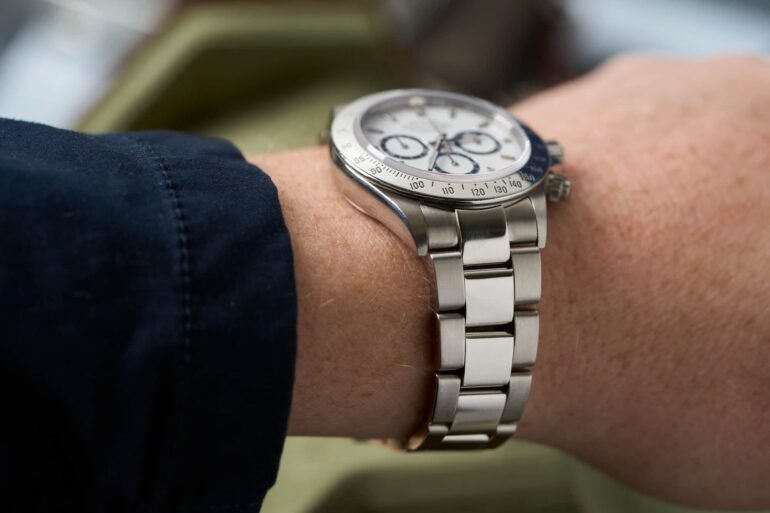

Another Rolex classic, the Jubilee is a dressier five-link bracelet design that often sports bi-metal construction to create an inner three rows of small links, bordered by two rows of larger links. When Rolex introduced this bracelet on the Rolex Datejust in 1945, it only came in solid gold, though, cementing its status as a more luxurious alternative to simpler bracelet styles.
Today, the Jubilee isn’t just seen on dress watches, though, and its influence can be felt in other five-link bracelet designs across the horological world. Two-tone bracelets lend a vintage-inspired look that exudes elegance, even if the watch they are paired with is brawny or sporty. Today, Jubilee bracelets are known for their comfort on the wrist and their durability, both thanks to that five-link design.
Milanese (Mesh)

Perhaps the most versatile of all bracelet types in terms of comfort and range of application, the mesh style allows for a lot of the same flexibility of a leather or textile strap, with the durability of a bracelet. The most recognizable type of mesh bracelet has been dubbed “Milanese” for its similarity to a technique used in the city of Milan to make bracelets in the 19th century. Often compared to chainmail, Milanese bracelets conform to the wrist and are typically micro-adjustable via a clasp that can run up and down the length of the bracelet, making them extremely versatile for many wrist sizes.
Omega is often credited for popularizing the mesh style in the 1970s, with their “shark mesh” bracelet offered on the Omega Seamaster Ploproof 600m. It was named as such to advertise its “shark proof” design. Though this was largely an exaggeration, the mesh was more durable and flexible than other bracelets’ designs, and made the large dive watch much more comfortable on the wrist. Milanese and other mesh bracelets work well with all styles of watches and can be dressed up and down, making them ideal for enthusiasts who value micro-adjustability and comfort.
Beads of Rice

Similar to Milanese options, beads of rice bracelets offer extra comfort, but lie a little closer to three-and five-link designs on the bracelet spectrum. They feature a chainmail-esque pattern much like mesh designs, but are differentiated by size of the “woven” links and the presence of larger outer links. Most beads of rice bracelets feature an inner section of seven to ten rows of small links, with two flanking outer rows of large links.
Popularized by Doxa in the 1980s, the beads of rice design is named for the appearance of the smaller inner links, and often feature on luxury timepieces. The design does, however, date back even further, with Patek Philippe and others employing it as early as the 1940s. It combines the practical comfort of the mesh style with the classic elegance of five and three-link designs, making it a good choice for those who struggle to pick which look they want to go for.
Integrated

Our last category here is a little different from the rest, in part because it usually requires the watch to be designed with this type of bracelet in mind. The integrated bracelet is just what it says on the tin, resting in between the lugs with little to no gap, creating a tapered and seamless look with the case. It’s experiencing a surge of popularity today, with brands like Tissot and their PRX line, reflecting the current desire for retro design. Perhaps the most famous use of the integrated bracelet came in 1972, with Audemars Piguet’s Royal Oak, though Patek Philippe would introduce a version just four years later on their Nautilus which sported unique H-shaped links, large central links, and a contrasting brushed and polished finish. The connection? Both watches were designed by designer Gérald Genta, hence his status as the de-facto godfather of the integrated bracelet.
Though the least versatile of the bracelet types listed here, the integrated bracelet is enjoying a burst of popularity and its sporty image pairs well with both budget-oriented brands and horological heavy hitters. Integrated bracelets are crowd-pleasers at heart, and uniquely cohesive manners of expression for whichever watch they link up with.
While this list is not exhaustive, it covers some of the most popular and historically significant bracelet designs that can still be found on watches being made today. The most important thing to remember, though, is that there is no wrong choice when picking a bracelet for your favorite timepiece; it’s a customizable hobby, and that’s what makes watches so enjoyable to wear, collect, and share.
Windup Watch Shop
2026-02-09 17:00:00