
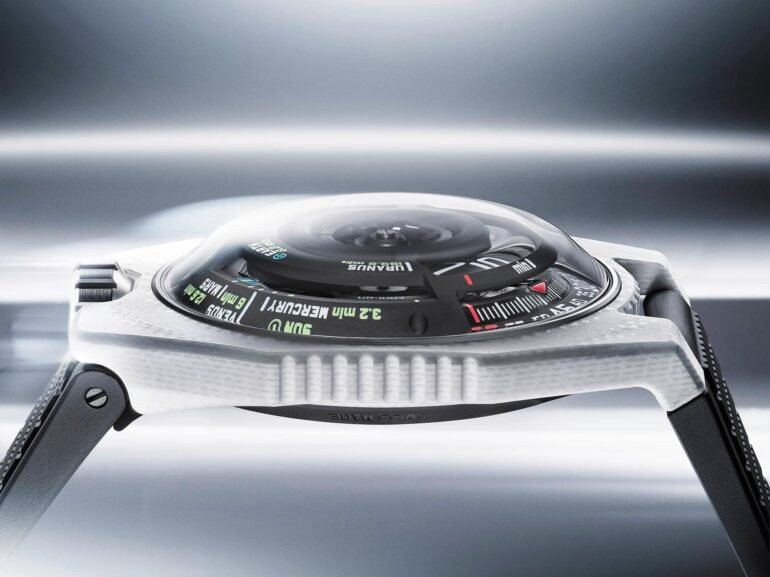
The Urwerk UR-100 has become one of my favorite designs in high end independent watchmaking. Whenever I encounter one (a rare event given the brand’s annual production of just around 200 watches total) I’m blown away by the way it distills the essence of the brand into a completely wearable, compact, package. I’ve always been a fan of the Urwerk philosophy, but until I tried on a UR-100 I always felt the watches themselves might be too ungainly or oddly shaped for me personally. There’s something about this case though, mostly its impressive thinness, that makes it feel like a “normal” watch on the wrist but still something otherworldly when you look down to check the time. That, to me, feels like a sweet spot.
The latest from Urwerk brings a new watch into the UR-100 lineage with the UR-100V LS Ceramic. This is effectively a new variant of the original UR-100V LS (short for “light speed,” which we’ll get to momentarily) that appeared in 2024. The new watch features a white ceramic case, a first for the brand and more complex than it first appears, and the same whimsical ideology of its predecessor, and many other Urwerk watches, which are all in one way or another a commentary on timekeeping itself.

All Urwerks (well, almost all) share a common wandering hour satellite time telling mechanism that has become their calling card. It’s actually a rather mechanically elegant way to tell the time, basically with a wandering hour “pointer” to a fixed minute track. The real pleasure of these displays is in observing the way each hour indicator on the three separate satellites rotates with a perfect snap at the top and bottom of each hour. It’s an incredibly complicated mechanical maneuver that ultimately displays something quite rudimentary, which is a contrast and irony that I’ve always loved.
The UR-100V LS adds an additional layer of time telling philosophy the satellite display itself. The conceit here is that once the wandering hour indicator rotates off the minute track, it begins to trace the journey of a photon leaving the sun and traveling toward each of the planets in our solar system. This, for Urwerk, represents the most elemental type of time telling possible. So as the expired hour markers move across the top half of the dial, apertures indicate the distance our hypothetical photon has traveled in a given amount of time. We’re seeing a visual representation of the measurement of the time required for sunlight to travel to each planet.

This, of course, is kind of the definition of a complication that is “useless” on a practical level. But it remains, I think, a rather profound idea, and it’s certainly part of a long tradition of watchmakers attempting to reconcile the scale of the universe with mechanical time telling. Every watch with a moonphase or a calendar complication is reaching for something similar. The way Urwerk goes about it is certainly more abstract, but there are parallels.

As cool as I think the mechanics and idea behind this watch are, it really is the case that keeps me excited for the UR-100V, and for this edition Urwerk has crafted one in white ceramic for the very first time. The material used here attempts to solve the inherent problem with ceramic cases in watchmaking: their brittleness. This weakness makes traditional ceramic tough to work with, as when it gets heated at very high temperatures during the sintering process, there is a tendency for them to shatter. Urwerk has developed their own ceramic composite material that is a combination of ceramic fibre with layers of glass and carbon fibre. According to the brand, the technologies behind this material are borrowed from the worlds of aeronautics and medicine, disciplines that have increasingly been staging grounds of a sort for new watchmaking technologies spearheaded by the more creative independent brands, Urwerk among them. The end result, on the wrist, is a white material with silver tones that after being machined has a depth that the brand asserts is uncommon in traditional ceramics in watchmaking. Like other cases in this family, it measures 43mm wide and 14.55mm tall, but those numbers are kind of meaningless considering the unique shape. On the wrist, these cases wear much thinner and more compact than you could imagine based on the published dimensions.

I like these watches a lot, but I have to admit that their nature poses some challenges when it comes to actually writing about them. It’s hard not to slip into a tone that is overly philosophical and a bit heady, and that’s not really the type of writing or commentary I tend to like, either to read or create. I think I’m just more practical, in general, about these things, and less inclined to sentiment. But it obviously says something about these watches that they get me there, to a place where you kind of have to address the vision of the piece and be comfortable with the scope. One of my favorite movies of the last twenty years or so is Moneyball, and there’s an often quoted line in the film that I think about a lot: “How can you not be romantic about baseball?” I think the same is true for these Urwerks. How can you not lean into the storytelling, the drama of it all, and yes, the romance of the very idea of tracking a light particle across the universe with a device strapped to your wrist?
More information about the Urwerk UR-100V LS Ceramic can be found on the brand’s website here. The retail price is CHF 67,000.
Zach Kazan
2026-02-06 14:00:00