
Longines is a storied and well-respected Swiss watch manufacture that formed in 1832 and has continued uninterrupted to this day. From the first wrist chronometer in 1911, to groundbreaking flyback chronographs in the 1930s, to the world’s first hi-beat wrist chronometer in 1959, Longines holds their own in the watchmaking world. My favorite period for watches is the 1950s through the 1970s and Longines was one of the top accessible brands during that time. In 1954 Longines began a marketing strategy of product families, launching the Conquest line of watches. In 1957 they introduced the Flagship line, adding to what would become a large group of watch families, many of which are still made today. Other lines that came later include the Admiral, the Ultra-Chron and the Grand Prize.

The Grand Prize line was named in honor of the multitude of watchmaking awards and honors that Longines had accumulated over the decades. It was a relatively short-lived family, produced from about 1958 to 1964 according to my research. I have found that the majority of Longines watches produced during these decades were all fairly equal in quality and craftsmanship, with most of the differences in the families being design related. The Conquests were rugged and sporty, on par with the early non-diver Omega Seamaster watches. The Flagship series were dress watches, while the Admiral line was a mixture of both. The Grand Prize family were pretty much all thin, elegant everyday type dressier watches in steel and gold plate. Despite these differences, they all shared something in common, the Longines tradition of attractive designs, high quality craftsmanship and robust, beautiful watch movements made in-house.

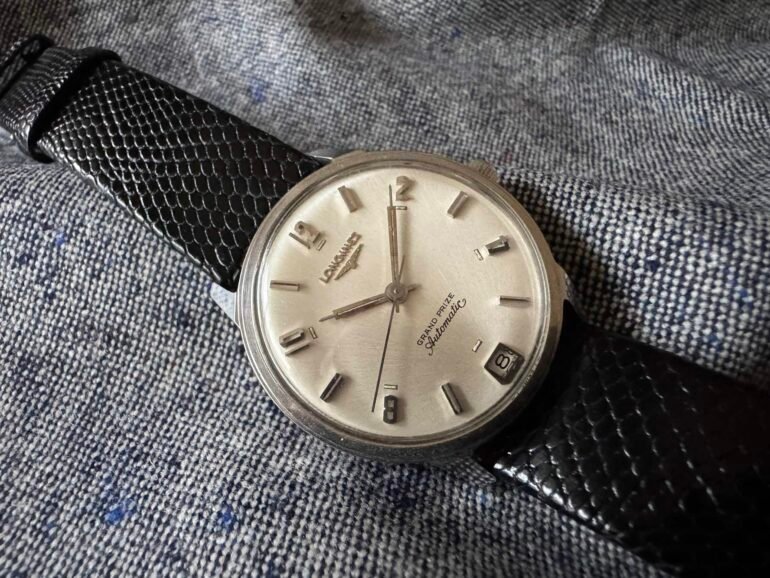
The watch I’m featuring today is a Grand Prize that dates to roughly 1963. There were an astonishing number of different designs used for the Grand Prize line, and I think this example is one of the most stunning, with multiple design elements that make it stand out in the crowd. The stainless-steel case is just the right size at 35mm wide, with a thickness of only 11mm (including the domed acrylic crystal). The case is a traditional round shape, with slimmer, slightly angled lugs that are simple yet stylish. The bezel is thin and narrow, giving it a tiny stepped look that is easily missed at first glance. This case is the front-loading type, where you have to remove the bezel and crystal first, then the watch movement can be lifted from the case. While this does help with water resistance, I don’t like this style as it’s difficult for amateurs like me to be able to see that beautiful movement. Many of the Longines families of watches feature a super cool engraved and enameled caseback medallion, but the Grand Prize line has a plain back with little to no writing. The small crown is located at three o’clock, and is ever so slightly recessed into the side of the case. It is correctly signed with the Longines winged hourglass logo. To my knowledge, all Longines crowns from this era were signed.

All this is fine and well but as is often the case, the dial is the star here, and it really steals the show. It is the classic 1960’s silver color, but instead of the common radial brushed finish it features a sunburst brushed finish that radiates up and out from the date window at six o’clock. This is really subtle, and you have to get the light and the angle just right to see it, but man is it sweet. The markers are applied, faceted steel. The 12, 2, 4, 8 and 10 are all stylized Arabic numerals, while the others are baton style. There are small dashes of lume at each of the even number markers as well, another subtle but elegant touch. As mentioned above, the date window is at six o’clock, my location of choice if there must be a date window (I’m partial to no date, but you can’t always get what you want!). The date window is surrounded by a matching faceted steel frame. Below the twelve you have an applied steel Longines name and the winged hourglass logo, with printed script of “Grand Prize” and “Automatic” above the date at six. The hands are what I like to call “skyscraper” style, long thin batons with little pointed tips that extend from the ends. These are another under-rated style touch that really ties the whole incredible look together. Longines truly did a fantastic job of adding together a number of minimalistic design elements that shine when seen as a whole. I have my example fitted with a lizard grain strap and a vintage 1960s steel Longines signed buckle, adding the final touch.

Sorry to say that I don’t have any pictures of the movement, nor do I know the exact caliber powering this beauty. However, my research indicates it should be in the 340 base family of movements, most likely a 342 if I had to guess. The Longines caliber 342 is a 17 jewel rotor automatic movement with a power reserve of 43 hours that was first released in 1963. This was from an era when Longines manufactured their own movements, which were beautiful, robust and reliable.

Vintage Longines Grand Prize watches can be readily found on eBay and other online sellers, at a wide range of price points. Longines even has a page on their site where they sell vintage watches, and they currently have a Grand Prize for sale, albeit priced at a whopping $3,600 at today’s exchange rate. This is preposterously high though. You can find a number of solid Grand Prize watches on eBay in the $500 to $1,000 range on any given day. Mind you, as with all finds on eBay you should do your due diligence before buying. That said, these watches have never been faked to my knowledge, nor are they likely to be Franken-watches as is commonly seen with vintage Seiko and Omega on eBay. So if you’re in the market for a solid, well made and well designed vintage dress watch that can be worn daily, have a look at the Longines Grand Prize.
Christoph McNeill
2026-02-04 17:00:00