
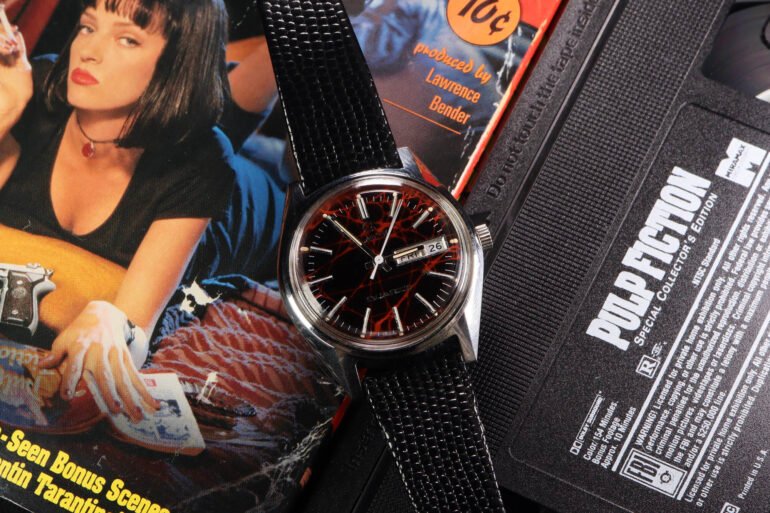
Turning on Quentin Tarantino’s 1994 masterpiece Pulp Fiction for the first time is a moment I’m sure many of us would like to relive. Among the many unexpected moments the film has to offer is a four-minute-long scene where Christopher Walken details the history of a Lancet trench watch and its unfortunate journeys through the human anatomy. The familial heirloom timepiece that Captain Koons passes down to his son, Butch, is often considered by watch buffs and film aficionados to be the true “Pulp Fiction watch” because of its inclusion in the iconic scene. I personally feel there’s another timepiece featured in the movie that should be in the running for that title as well (and no, I’m not talking about Harvey Keitel’s Gucci 3300M). The Timex Q Red Nebula never gets any clear-cut screen time, but for those keen-eyed viewers, it can be spotted on John Travolta’s wrist numerous times throughout the film. Several stories and blogs have been written about the history of the Lancet featured in the movie, but very little exists about this Timex Q in the watch space. Let’s change that, shall we?


History of the Red Nebula
This model was advertised as the ref. 989502 in Timex catalogues, but quickly gained the far catchier Red Nebula moniker because of its dial from consumers upon release. When it initially launched in 1977, it featured a faceted mineral crystal, similar to those seen on Seiko pieces from that era. The 1978 release of this same model features a domed acrylic crystal instead. The reasoning behind this change isn’t documented in any databases or sources I was able to find, but I would assume it could have been to lower production costs or streamline the production process for all Q models with the same case shape. There are two additional minor differences not documented anywhere else online about the ‘77 and ‘78 models that can be hard to spot to the untrained eye. The first can actually be found within the crystal. The ‘77 variant has a stainless ring within the crystal itself, which helps to make the bezel of the watch appear larger than it actually is. The ‘78 model has no inner steel ring and, as a result, offers more viewing angles to the dial. The last difference can be found with the day and date windows. The earlier iteration sports a white outline and red nebula inner ring, and the later model has a stainless steel border around and between both windows. Though these are incredibly infinitesimal variations in reality, these details are what help to define what a “True Vega” model is, similar to a “True Pogue” or “True Cevert” in the Seiko space.

How the Red Nebula Became the “Timex Vega”
I’ll admit it, alright? I came up with the Timex Vega nickname. While I would love for it to stick in the watch community, only time and exposure will tell (so make sure to tell all your watch-collecting buddies for me). Anyway, back to the movie. There aren’t many scenes where the watch is completely visible, but if you keep your eyes peeled and pause button handy, there are a few instances where the audience can sneak a peek. The scene I typically see referenced is when Vincent and Jules are driving in Jules’ ‘64 Chevy Malibu with Marvin in the backseat. When Vincent turns around to speak with Marvin, the Red Nebula can be seen on his wrist. I always find myself pausing the movie just to catch a glimpse of the watch in that scene (and delay Marvin’s fate by at least a few seconds).

The Vega’s Design
Before I go in-depth on any other part of this model’s aesthetics, let’s take some time to give the dial its due. Coming out the same year as the iconic Falcon Eye model, you can tell intricate and abstract dials were becoming a trend in the watch market. With more complicated dials typically comes more expensive manufacturing costs, and this can be seen through the cost of the Red Nebula upon its release. With an MSRP of $59.95 (the equivalent of roughly $298 in 2026), this was one of the most expensive models Timex offered in their catalog. Taking one look at that dial in person, though, you can see why they charged a premium. It’s truly unlike any dial I’ve seen from its period. Made even better with the applied indices and logos, the red nebula dial manages to pop in some lighting and become subdued in others. Timex would later go on to make two other watches with a red nebula dial, but both utilize printed logos and are housed within gold cases that, in my opinion, don’t work as well as the original silver pairing.

Moving to the case, the 37mm diameter is an excellent size for a vintage watch, and while the 19mm lug width may be a bit unorthodox, the proportions fit together quite nicely. Even though it’s only a 1mm difference, I think if the Vega had 18mm lugs, the case would look a bit too large for the band/bracelet. This model originally came fitted with a stainless steel bracelet, but in honor of how Travolta wore it in the movie, I decided to opt for a black leather band. The example he wore for the film actually went to auction several years back and sold for only $6,400, an incredibly low price to pay for a piece of film history. The original listing can be found on the Julien’s Auctions website, though the page only includes two relatively blurry pictures of the piece. It can be determined, using the list of variations discussed previously, that the original Vega is clearly a ‘79 model and not a ‘78. Another aspect to note is the manufacturer of the leather band. While I’m unsure how this came about, the leather band is actually Fossil-branded, as can be seen in picture two of the auction. I bet you didn’t expect there to be a Timex x Fossil crossover in Pulp Fiction, did you?
Buyer’s Guide and Pricing
The Vega can be a relatively troublesome beast to conquer. Finding one in good shape can typically set you back between $200-400, depending on cosmetic and mechanical condition. I would recommend setting up a saved search with notifications if you’re interested in adding one to your collection, being that they can be a pretty elusive watch to get a hold of. As has been discussed throughout, if getting the “True Vega” is really important to you, I recommend keeping an eye out for the correct crystal and date window variant. The most important piece of advice I can offer is to make sure the movement has been tested and is fully working, unless you have experience with working on these Timex Q movements. These can be difficult mechanisms to fully disassemble and service correctly. While many non-working examples exist on the market to cannibalize for parts, the majority of these movements have turned brittle with age, especially their plastic components and motherboard. Lastly, if the bracelet featured in the catalog is of interest, be on the lookout for large watch bracelet lots on auction websites, as many of these listings contain an assortment of Timex-branded bracelets. You never know when you might get lucky and find the original bracelet for less than the cost of two Royales with cheese.

The Timex Q Red Nebula model itself, outside of its relation to Tarantino’s film, is a wonderful exercise in watch design. Great proportions, a dial that easily trumps a majority of other watches in its field at the time of its release, and a wrist presence that is a perfect sweet spot between attention-grabbing and elegant. If you’ve never owned a Q from this era, they’re a lot of fun to have if the movement is in great shape. Timex managed to find a solid middle ground between a cheap, disposable watch and an expensive, high-quality timepiece with these models. They feel substantial on the wrist yet don’t require a careful hand when wearing them out and about every day. While its movement may not stand the test of time, its aesthetics certainly will.

Watches in film have always been a fascination of mine ever since I began collecting years ago. It’s easy to slip into a mindset of believing every watch worn by an actor or actress is a timepiece that is unattainable to the everyday collector because of what they wear to award shows or to a film’s premiere. Spotting watches in movies is made fun and accessible because of the prop specialists and creative direction of the production team. If Vincent Vega were wearing a Rolex Submariner on his wrist for the duration of the film, not only would it be unbelievable to the background of the character, but collectors would spot the watch and merely pass it off as, “yup, there’s yet another Rolex Submariner worn by an actor in a movie.” Being able to spot the unexpected and downright weird watches featured in film is an incredibly rewarding and fun experience that makes the audience wonder how or why the production team landed on that specific watch for that specific character. It truly never gets old to watch a movie with family or friends, pause it on a certain frame, point at the screen, and say, “I own that watch, that’s a *insert watch here*” to the people around you. They probably won’t care nearly as much as you do overall, but hey, that’s what Worn & Wound and the watch-collecting community are here for.
Tommy Demauro
2026-01-29 19:00:00