
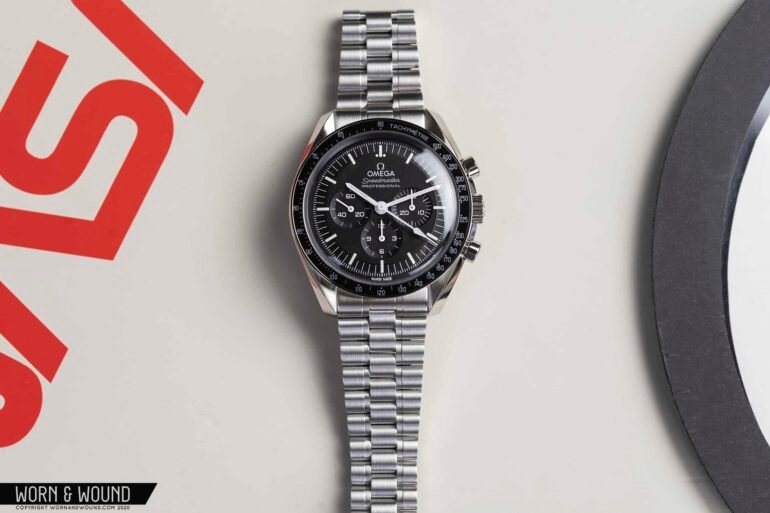
A series of features identifying the most extraordinary mechanical masterpieces in history, blending precision, innovation, and craftsmanship. We all have our favourite timepieces either in our collection or those incredible horological masterpieces that have been invented or created through the ages. This series will showcase examples from the previous centuries up to the present day and look at the importance and impact on modern day timekeeping.
In the early 1960s, NASA realised astronauts needed reliable, tough wristwatches for space missions, especially for tasks outside the spacecraft like on the Moon. So, NASA secretly bought several chronograph-type watches off the shelf. They tested watches from Omega, Rolex, Longines-Wittnauer, and perhaps a few others under extreme conditions.
“Space: the final frontier. These are the voyages of the starship Enterprise. Its 5-year mission: to explore strange new worlds, to seek out new life and new civilizations, to boldly go where no man has gone before.”
These were the immortal words of Captain James T. Kirk, of the Star Ship Enterprise, played by William Shatner, in the hugely popular series, Star Trek, first broadcast in 1966. Today we are still fascinated with space travel and the extraordinary developments that have impacted on all of our lives since Mankind first set foot on the Moon on the 21st July 1969.
It is often stated that the technology that took Apollo 11 astronauts, Neil Armstrong, Buzz Aldrin and Michael Collins was vastly different and much less advanced than what we have today. For example, the Apollo Guidance Computer (AGC), a key component of the mission, had significantly less memory and processing power compared to a modern smartphone. Additionally, the Apollo 11 astronauts relied on manual calculations and navigation using sextants, while today’s technology relies on GPS and sophisticated computer systems.
However, the ‘Space Race’ spurred the invention of several materials, including memory foam, scratch-resistant lenses, and advanced composites, all of which have found their way into everyday applications. These materials were developed to address the unique challenges of space travel, such as the need for lightweight, durable, and heat-resistant components.
It also gave us the legendary timepiece, the Speedmaster made by Omega.
Extended Rigorous Testing Program
NASA was preparing to send humans beyond the embrace of Earth’s atmosphere in the 1960s. It became clear that every piece of equipment needed to be rigorously tested. Precision and durability were paramount, and even a simple wristwatch could mean the difference between mission success and failure. NASA required a chronograph capable of withstanding the unrelenting extremes of space travel. What followed was the ultimate challenge that few timepieces could survive.

Alongside Omega, several other watchmakers, including Rolex (Cosmograph Daytona), Longines-Wittnauer (235T), and Hamilton (it was actually a pocket watch so failed very early on in the process) submitted their watches for the ultimate endurance test. The rigorous testing program was a brutal series of examinations designed to push these mechanical marvels to their breaking points.
The tests were conducted by NASA’s engineer James Ragan who ran the tests in 1964–1965. The watches were subjected to a brutal 11-test procedure including: high/low temperature (+93°C to -18°C); high/low pressure; humidity; shock; vibration; acoustic noise; G-forces (up to 40 Gs); acceleration (beyond 16 Gs); oxygen-rich environment; thermal vacuum
It was clear that NASA didn’t much care about brand names as they named the process ‘Flight-Qualified for all Manned Space Missions’ and Omega didn’t even know they won until astronauts started wearing them publicly.

According to the records the Rolex failed during the high temperature tests with the crystal popping off. The Longines-Wittnauer 235T failed as it fogged up during the humidity and pressure tests. Hamilton was disqualified early in the process because it wasn’t even a wristwatch. Only the Omega Speedmaster passed all the tests, but barely – it lost 5 minutes during one test and the luminous markers burned off – but NASA officially certified it for space missions in March 1965. It was extensively tested during Project Gemini (1964-66) which tested the technologies and procedures in space for the Apollo missions.
A Cultural Icon That Keeps on Giving

When Buzz Aldrin (above) landed second on the Moon in 1969, he wore his Omega Speedmaster. Neil Armstrong didn’t wear his outside — he left his inside the Lunar Module because the ship’s onboard clock had broken. After returning to Earth, astronauts were supposed to send most of their gear, including their watches, to the Smithsonian Museum for historical preservation.
Buzz Aldrin did exactly that — but his Speedmaster got lost and has never been found. Apparently, it disappeared somewhere between NASA and the Smithsonian. Today it would be priceless if it turned up — easily worth millions at auction. There are various theories as to what happened, including that it was deliberately stolen during transport, or that it was misplaced inside NASA or the Smithsonian’s archives, or tantalisingly, it’s sitting in some government storage room somewhere.

Watches with provenance always sell well and Neil Armstrong’s personally owned and worn 18K solid yellow gold Omega Speedmaster Professional chronograph wristwatch is no exception. It recently sold for $2,125,000 at auction and was presented to him at a special gala dinner on the 25th of November 1969, at the Hotel Warwick in Houston.

Omega initially created 26 of these gold commemorative watches—known as the ‘Tribute to Astronauts’ watch—to present to NASA astronauts alive and deceased, with the case-back of each watch specially engraved with a quote, the name and missions of the astronaut, and a unique number relative to when the astronaut flew into space. Armstrong’s watch was issued as No. 17, and engraved on the case-back, ‘Astronaut Neil A. Armstrong, Gemini 8 – Apollo 11’. The special central quote reads: “To mark man’s conquest of space with time, through time, on time.”
It’s What’s Inside That Counts
Inside the original Omega Speedmaster was Calibre 321 which is legendary among collectors. Omega have even re-created it recently, but regular Speedmasters now have the updated 3861. The Cal.321 is a column-wheel chronograph (smooth start/stop of stopwatch), hand-wound, and super robust.
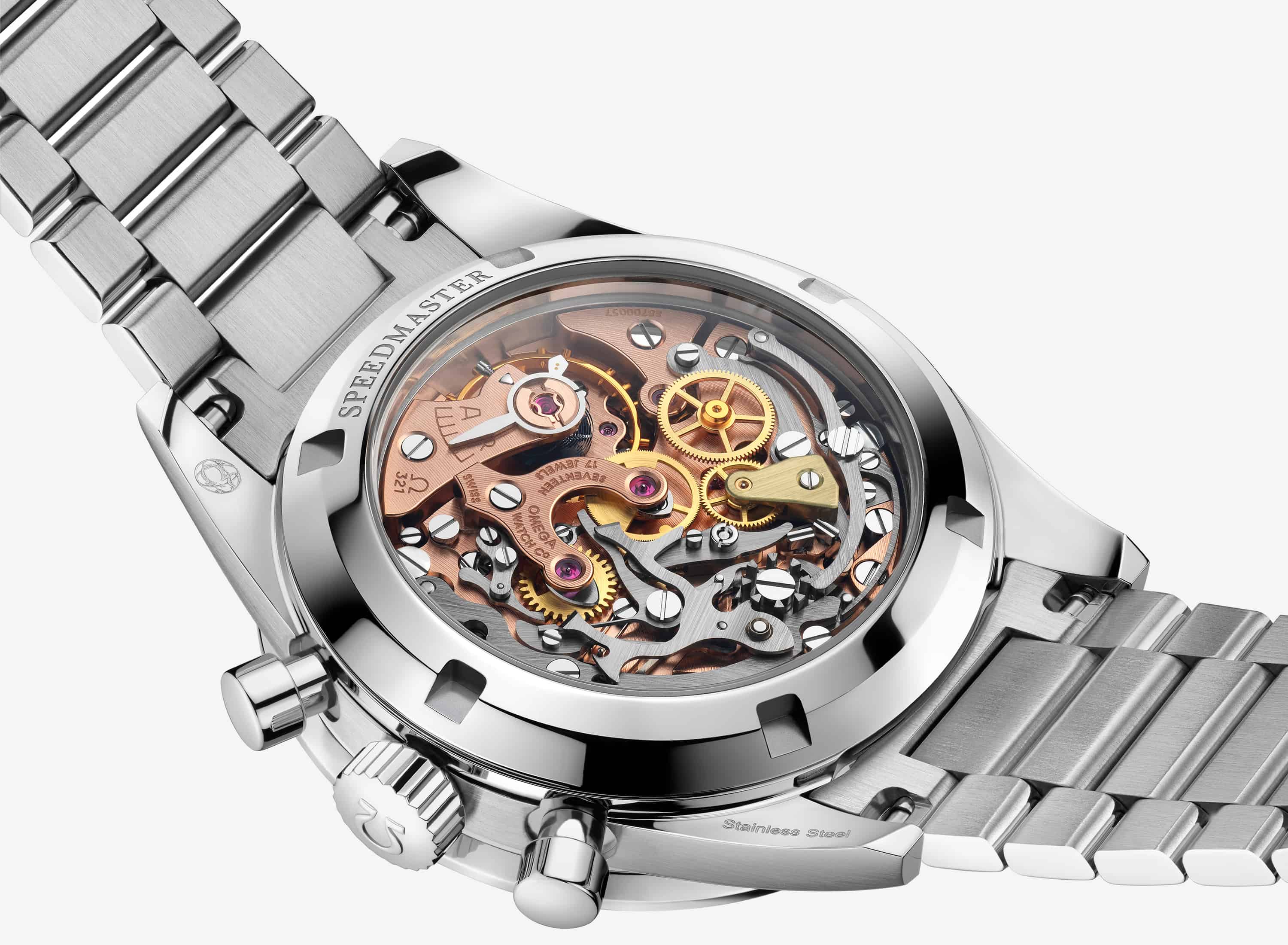
The Calibre 321 (above) powered the early Omega Speedmaster models — notably the Speedmaster ST105.003, worn by astronaut Ed White during the first American spacewalk in 1965. It uses a horizontal (lateral) clutch system for engaging the chronograph second’s wheel. It has a high-end feature for the time, contributing to excellent isochronism (consistent timekeeping over the power reserve) and has a frequency of 18,000 vibrations per hour.
Omega phased out the Calibre 321 in 1968 in favour of the more production-friendly Calibre 861, which used a cam-switching mechanism and higher beat rate (21,600 vph). The transition was part of Omega’s strategy to streamline production and improve durability and cost-efficiency.

In 2019, Omega reintroduced the Calibre 321 (above) — hand-assembled in a special workshop in Bienne, Switzerland — as part of the Speedmaster Moonwatch 321 Platinum and later stainless-steel versions. The new version is a faithful reconstruction of the original, down to the last screw, using digital scanning of an original 105.003 model worn by astronaut Gene Cernan.
Back To the Moon and Beyond
Since the Apollo era, Omega has remained deeply involved with NASA and space exploration, but as technology evolved, so have their watches. The Speedmaster X-33 is one of the most important watches astronauts wear today.

The Omega Speedmaster Skywalker X-33 has space-grade durability and is made from titanium to withstand space conditions and physical stress. There are multiple functions, including analogue and digital readouts — perfect for astronauts on extended space missions, where they need things like mission timers and chrono functions.
Because astronauts have limited space on the ISS, the X-33’s titanium case is much lighter than the classic Speedmaster’s steel case. Unlike the hand-wound Omega Speedmaster chronographs of the past, this watch is quartz, providing more precise timekeeping in the extreme conditions of space.

We still obsess about Omega watches in space, with astronauts Chris Hadfield (Canadian astronaut, commander of the ISS), Jean-François Clervoy (French astronaut) and Samantha Cristoforetti (Italian astronaut) all wearing the Speedmaster X-33 during their missions, sometimes alongside their Omega Speedmaster Professional watches.
Taking the Speedmaster to the Limit
It looks like the next frontier for space travel will be a mission to Mars. That may be some way off, but the Omega connection with space continues at pace. They entered into a collaboration with Swatch to attract a new younger (Gen-Z) audience to the brand. If this was the objective, then the huge hype, long queues, extensive media coverage and social media buzz, got younger people excited about watches who might not have considered Omega otherwise. It made Omega more visible and relevant to a wider audience.

However, some purists thought that it damaged Omega’s prestige. Associating a luxury watch like the Speedmaster with a £250 plastic watch made certain collectors feel it ‘cheapened’ the brand. Omega historically sits just below Rolex in terms of luxury image, and some worry the MoonSwatch blurred that a little.
Let’s not take anything away from this type of collaboration which was deemed a great success, but there is a word of warning that any brand considering this would be aware of unintended consequences.

When I was a child and asked what I’d like to be when I grow up, I always said I’d like to be an astronaut. Of course, this was a childhood dream which sadly never came to fruition. However, I was fortunate to have the opportunity to meet a real-life astronaut, Mike Foale (above), a veteran of six space missions and is the only NASA astronaut to have flown extended missions aboard both Mir and the International Space Station. He was the second Briton in space and the first to perform a spacewalk. It was wonderful to hear about his exploits in space. When we got on to the subject of watches and discussions about the Omega Speedmaster, and although he was a fan, he said that he favoured the quartz variety of watch when he was on his missions.
As the journey continues beyond the bounds of earth, the Omega Speedmaster is still out of this world.
Andrew Canter
2026-01-27 20:00:00