

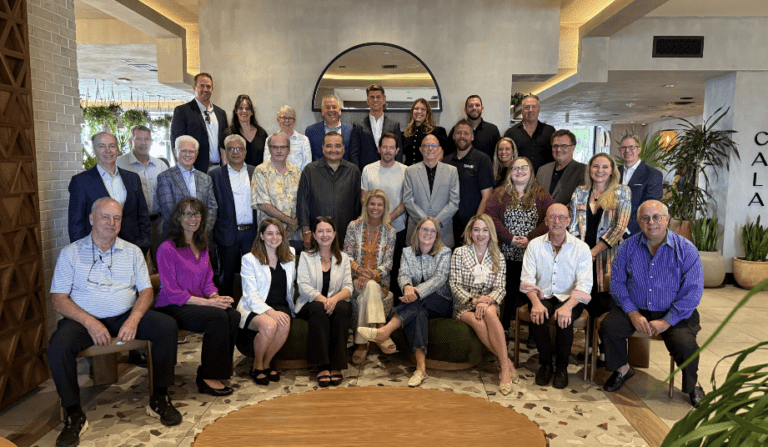
At Cayuga Hospitality Consultants’ Annual Conference 2025, industry leaders examined where hospitality is headed and how to prepare for the next era of change. From AI integration and workforce evolution to shifting insurance markets and event space innovation, the conversation revealed a mix of challenges and opportunities.
1. AI Will Become the Industry’s Backbone, Not a Buzzword
Artificial intelligence is no longer futuristic—it’s functional. Hotels are already utilizing AI to integrate siloed systems, such as PMS, accounting, CRM, and forecasting platforms, to drive faster and smarter decisions. Tools like Placer.ai and PredictHQ help identify ideal customers through demographic, behavioral, and geolocation data.
As automation expands, the next opportunity lies in strategic human oversight: consultants and managers will interpret AI outputs, guiding capital investments and operational priorities rather than being replaced by algorithms.
2. Refinancing Pressure Will Reshape Ownership
With interest rates still elevated, the wave of refinancing is forcing owners to face hard choices: refinance at higher costs, sell, or seek new investment partners. Expect to see consolidation, creative deal structures, and a greater need for consultants who can help operators navigate financial and operational restructuring.
Advertisements

3. Insurance Costs Will Climb, and Coverage Will Shrink
Across the board, insurance is becoming more expensive and less comprehensive. Rates will rise regardless of claim history, coverage limits will contract, and government intervention may eventually be required to stabilize the market.
The industry will also pay more attention to smaller-scale risks, ranging from weather disruptions to cyber incidents, making proactive risk management and data-driven prevention essential.
4. Labor Shortages Will Force a Rebrand of Hospitality Careers
The industry’s talent pipeline is under strain. From frontline staff to engineers and tradespeople, shortages are driving up costs and extending project timelines.
The next evolution of workforce strategy will involve changing the narrative and positioning hospitality as a viable, long-term career. Employers who offer mentorship, clear advancement paths, and recognition of transferable skills will have a decisive advantage.
5. Hotel Schools Must Evolve or Risk Irrelevance
Hospitality education is at an inflection point. Traditional hotel schools must shift from operational training to career-building programs with placement support, mentorship, and exposure to technology. Future graduates will need to navigate AI tools, asset management, and financial strategy, in addition to service execution.
6. Outsourced Expertise Will Redefine Operations
Third-party food and beverage (F&B) and procurement partnerships are gaining traction as hotels seek to improve their margins and enhance the guest experience. Expect more specialized restaurant management, outsourced catering, and design-procurement hybrids that streamline development and bring creative expertise in-house.
At the same time, the event space battle is heating up: restaurants and standalone venues are drawing business away from hotels. To compete, hotels will need to transform ballrooms into authentic, experience-driven gathering places.
7. FF&E and Supply Chains Will Feel the Squeeze
Vendors are struggling with tariffs, bankruptcies, and a lack of skilled partners in the market. The resulting bottlenecks will prompt hotels to adopt longer lead times, diversified sourcing, and closer vendor relationships. Operators who build redundancy and transparency into procurement will weather the storm best.
8. Conversions Will Outpace New Development
Rising construction costs and capital constraints are accelerating a pivot toward conversions. Expect to see more professional, brand-aligned conversion projects that emphasize adaptive reuse and sustainability rather than ground-up builds. This trend will also fuel growth among agile regional management companies that can operate flexibly within diverse ownership structures.
9. Guests Will Redefine Wellness, Design, and Community
Modern travelers are changing faster than most operators can keep up. Millennials and Gen Z guests are increasingly focused on wellness, sustainability, and transparency, opting for low- or no-alcohol experiences and food with ethical sourcing.
A countertrend is also emerging: the desire for in-person connection after years of digital-first interactions. Hotels have a unique opportunity to serve as social anchors with spaces that blend health, community, and creativity.
10. Human Judgment Will Remain the Ultimate Differentiator
Across all conversations—AI, finance, design, and education—one theme resonated: hospitality is about people empowered by better data.
Technology will enhance, rather than replace, the industry’s human element. Whether it’s interpreting AI outputs, developing talent, or creating spaces that inspire connection, the next era of hospitality will reward those who combine analytical precision with emotional intelligence.
Discussion participants:
Charis Atwood, Susan Barry, Rick Blackburn, Tom Cleary, Joe Cozza, Jennifer Dohrmann-Alpert, Don Farrell, Juliette Gust, Gary Isenberg, Chuck Kelley, Prakash Khemlani, Haydn Kramer, James Kuester, Jay Landfair, Jim Miles, Debbie Miller, Stacy Moore, Katie Moulton, Mandy Murry, Jon Peck, Brian Schoettes, Stephanie Smith, Rick Tomljenović
Guest Contributor
2026-01-15 00:51:00