
Every few years, a new independent hits the scene with something that hits just the right notes to get all the factions of the watch world vibrating at the same frequency. However, no recent newcomer has managed to unite the watch echo chamber the way Swiss independent Berneron has.
When Berneron unveiled their debut offering, the Mirage, in 2023, it was universally lauded as the most intriguing and refreshing new watch seen in ages. The Mirage was a legitimately unique take on upscale watchmaking, with a striking aesthetic and design narrative as unexpected as its asymmetrical shape and wildly ambitious bespoke movement. The Mirage’s styling was initially met with comparisons to the Cartier Crash, but the reality is its melted case shape was an elegant solution for housing the watch’s impressive mechanics–a case shrink-wrapped around a new caliber that was designed from scratch, free from the rules of traditional movement design.
The Mirage was a helluva of a breakout hit; it had mystique, it was technically impressive, and it was different without resorting to arbitrary design choices. The Mirage’s success would be difficult to replicate, but with the Quantième, Berneron has both side-steped the sophomore slump and cemented the reputation of its founder and Creative Director Sylvain Berneron as a true visionary and a generational talent.
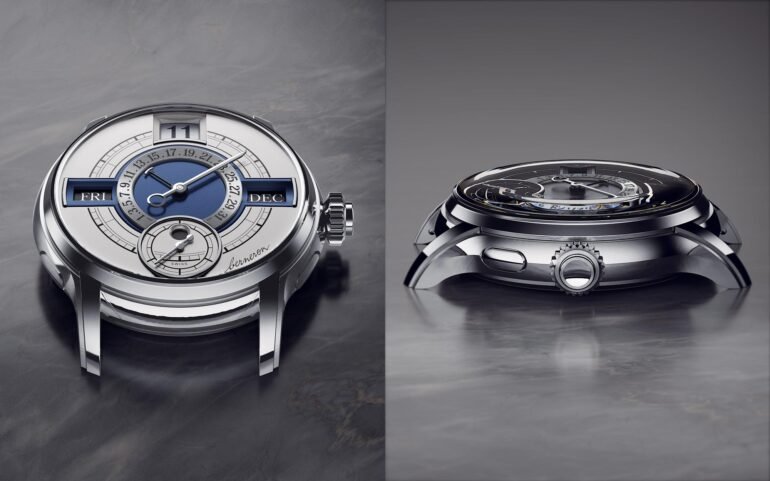
The Quantième applies Berneron’s virtuosic technicality to a watch that embraces a more traditional look than the Mirage, but is just as exciting. It’s an elegant, timelessly handsome annual calendar that in Berneron’s own words “elevates the standard for complicated calendars and future complications.” It does just that, with a dizzyingly impressive spec sheet.

Berneron’s watches are more than just a breath of fresh air in an industry that’s unabashedly rehashed its greatest hits ad nauseam for decades. These watches are a direct response to the industry’s inability to move the needle forward from a man that’s been to the top of the watchmaking establishment’s ivory tower and found himself so creatively frustrated that he chose to risk it all to chase the muse.
A design prodigy with an incredibly illustrious CV for someone his age, Sylvain Berneron started his career at 19 with a multi-year stint in BMW’s design studio. He then spent 5 years at Richemont as a design manager before putting in another 5 years as the Chief Product Officer at Breitling, where he became the youngest person to ever become a member of the board. After several failed attempts to push more creative watch designs through the traditional pipeline, Berneron found himself creatively unfulfilled and frustrated, at which point he decided to set out on his own. That risk has obviously paid off at this point, but Berneron is far from satisfied.
In the following interview, Berneron goes into detail on saying goodbye to the establishment, his approach to creating something that’s as progressive as it is timeless, why he hates composite materials in watchmaking, and what’s next for the brand.
David Von Bader: You mentioned that the brand has already exceeded your expectations. What exactly were you expecting when you left your position in the corporate world to start Berneron?
Sylvain Berneron: The brand is turning into a much nicer journey than I could have ever imagined. I worked for five years at Richemont as a product designer before I joined Breitling for five years, where I became a member of the board as a Chief Product Officer. When I left, I was looking for more creative freedom and the sentiment was creative frustration. I didn’t want to comply with what I heard too often in the industry, which is that it was better 50 years ago, that all the good things have been invented already, and that all this generation can do is perpetuate the good reputation of a brand and its heritage. I found that idea terribly depressing as a young designer, but also as a younger person in the industry. When I left, I just wanted to be creative again.

It’s obviously a huge risk to leave a top position at an establishment brand like Breitling to work independently on something radically different.
Sylvain Berneron: Yes, indeed. The level of risk was the highest it could have been for me. I risked my professional reputation, a good job, and at 34 years old, I was the youngest board member at Breitling. I also risked a million Swiss francs of pure cash from my own pocket to launch Berneron. It was all of my money and I had started saving when I got my first job at BMW at 19.
The early days of building the brand must have been absolutely terrifying.
Sylvain Berneron: Yes, but looking back on that period, I was motivated by a deep trust that there are still creative things to be done in the watchmaking industry. I find it terribly depressing to hear that the best is behind us and that all this generation can do is admire what has been done. I refuse to believe that.
Your watches are extremely progressive mechanically and have an incredibly unique aesthetic, but they’re also somehow timeless. One of the most difficult things to do as a designer is to say something new while retaining that sense of familiarity and timelessness. How did you approach that as a designer and how deliberate was that balancing act?
Sylvain Berneron: Watches need to be designed to be timeless because a good luxury watch should outlive you. In that regard, I always try to make sure that the watches we design embody some traditional codes, whether it is in the materials used, in the characteristics of the architecture, or in the way we place the finishing. These are the core elements in my opinion. If those elements are right, I guarantee value retention of the object in the long run because they’re what makes something timeless.
Now when it comes to progress, there are two different paths that have been taken. One is what I would call the techno-solutionist path, which is the extensive use of tungsten and different composites, which I am absolutely not a fan of. For one reason, they have an absolute lack of durability and composites degrade with UV light. It turns into ash eventually, which is simply the laws of physics. They also cannot be repaired when they break. Same goes for nickel-phosphorus, by the way. These new materials that you find in this new cutting edge age–whether it is in a movement or a case material– are used by brands that push a techno-solutionist narrative to have the tone of progress. I completely refuse that path because I think it cuts out the timelessness of jewelry altogether. It turns it into a trashable good or brings it closer to a computer in that when it breaks, you have no choice but to replace the component altogether. To me, that’s the opposite of what a good piece of jewelry is. To me, a good piece of jewelry has to tick certain boxes, and one of these boxes is that’s endlessly repairable. This is why jewelry holds its value and can be passed down through generations. I doubt anybody is going to inherit an iPhone, for example.

How do you think people are going to view watches like a Richard Mille in thirty years?
Sylvain Berneron: I should take my corporate hat off and speak as a collector for this, so this is not the answer of the company, but it’s the answer of the individual. There has still not been any carbon composite watch that retains good value at auction–whether it is a Richard Mille or another brand. I think there is a good reason behind that. It’s the same with the hypercars of the modern age, starting with the McLaren P1 in the early 2000s; they have all these carbon structures that are a gamble because if you break carbon fiber, you have to replace the whole cell. You can’t fix it most of the time. And again UV light will degrade it in the long term. The same thing cannot be said of a century old Bugatti that has been crafted out of steel and aluminum which you can replace, repaint, renew and keep running.
And every time someone tosses an old Bugatti into the hay bales at Goodwood, it gets repaired.
Sylvain Berneron: Yes, exactly. It may be a bit backwards thinking, but I believe in the timeless vision of watchmaking in the sense that I have refused “new and fancy materials” altogether–even if they could make my movements more efficient. The path of progress that I chose is bringing more substance to our product. For example, with the Mirage the creative thinking behind it was that instead of designing a movement that was locked into the form of a circle and could be cased in many different watches, I drew and constructed the train of gears from scratch on a blank piece of paper. That allowed me to tick all of the performance boxes that I needed. I wanted my movement to have a three day power reserve, 7.5 milligram per square centimeter inertia for the balance wheel, and a direct small seconds and inverted end stack. Those were the criteria of my dream movement.
I placed them on a piece of paper and the size of each component was defined by physics and not compromised by any given diameter needed to fit the movement in a circular form. The Mirage’s shape came from me trying to balance the downside of having such a big barrel, which would require a 45mm case if I made it circular. That gave me the idea to basically bring the case in tight around each wheel, and that gave the watch its heavily asymmetrical case shape. So the Mirage is effectively a case wrapped around the train of gears, rather than a free shape with a round movement inside it. To my knowledge, that hasn’t been done before.
We’ve had a lot of comparisons with the Cartier Crash, which is effectively the Mirage’s strict opposite. The Crash is a freeform case drawn by Rupert Emmerson in the ‘60s, and then the poor watchmaker had whatever tiny spaces were left inside to put a small Jaeger movement. In that sense, the Crash is form dictating function, where the Mirage is literally form following function–which is the ethos of the design I’ve always been taught.

I think most people have a tendency to see things in relativity, especially with watches and cars. Does it bother you that people often lead with the Crash comparison when discussing the Mirage?
Sylvain Berneron: As you said, I think people like to anchor a new thing close to the nearest one that they know and it is true that the Mirage and the Crash have a heavily asymmetrical nature. I’m not bothered by it at all because I think it is not a problem when you have the two watches side-by-side and realize how different they are. The Mirage is much slimmer than the Crash. The Crash has no lugs where the Mirage does, there’s Roman numerals versus Arabic numerals. They actually do not share much in common except the extensive use of asymmetry.
Can you define who the typical Berneron client is at this point? Obviously your brand is quite new, but it’s made a real splash with people that really know what they’re looking at in the horology world.
Sylvain Berneron: I think our customers are what I would call seasoned collectors. I don’t think any of our clients have less than 10 watches to begin with because we are a very small brand, so you must scratch beneath the surface of the usual suspects to find us. I also think the Mirage is something that needs to be understood before it can be really appreciated. We have been extremely fortunate to count collectors that have seen it all as clients, people like Laurent Picciotto who are pioneers in the industry. Laurent was the founder of Chronopassion, helped start Richard Mille, is a supporter of MB&F, and was the one and only Gerald Genta retailer back in the ‘80s, and he was our first client and acquired the Mirage in Prussian Blue with white gold. Roni Madhvani was one of our first clients, and there were a few other major players that were early Berneron clients. Massive collectors that I couldn’t even dream of grasping the attention of because they receive so many solicitations and have seen it all. Somebody like that is almost impossible to impress, but they went for it. I think it’s because the Mirage showed off some untapped territories in terms of how you can create a watch. Particularly the reverse way I designed the case. So I would say the typical client, for the Mirage at least, has tasted multiple flavors within the watch industry and is someone looking for a new expression, which the Mirage seems to deliver.
We also have collectors who came from the very technical side–people interested in how we achieved the inverted end stack and how we made such a thin caliber entirely of gold. Those collectors were not always necessarily willing to cope with the visual consequences of those technical achievements and the asymmetrical nature of the Mirage wasn’t for everyone. We’ve recovered a lot of those collectors with the Quantième collection, which is a heavy hitter in terms of technique and complication. So we now have a whole other group of collectors that come to the brand from a completely different place with our second collection. When I told you earlier that this is turning into a much bigger thing than I could have ever imagined, part of that is that the Quantième collection has attracted such different clients from the Mirage.

I think a lot of people might miss the technical virtuosity of the Mirage because the aesthetic is so striking. I also think a lot of people were expecting something even wilder looking from your next watch. Were you worried about the Quantième losing Berneron fans with its more conventional aesthetic after the success of the Mirage?
Sylvain Berneron: From a big picture point of view, the big risk with the Mirage–especially because we consolidated in the second year with a smaller 34mm case– is to get boxed in. To have to wear the Mirage hat forever and be locked into the jail of its success, so to speak. I quickly wanted to escape from that because I think if I would’ve done five years of consecutive launches with asymmetrical shaped watches, I would have become boxed in. The same way you could argue that AP is now a prisoner of the Royal Oak.
Stuck looking out of the porthole for an eternity.
Sylvain Berneron: Yeah! In that sense, Patek has been brave and smart to discontinue the Nautilus, even if it’s a temporary move. Otherwise the model would’ve hidden the brand. In my case, I had multiple risks that I needed to consider. Beyond not wanting to be boxed into the asymmetrical jail, I wanted to avoid what I call the young independent syndrome; I think that the most common big mistake young independents make is packing all of their ideas into one watch, release it, make a huge buzz, and then get caught in the speed of the buzz and not have the clarity to think about what’s coming next. They end up being forced to dilute their first creation with color variation for their next release because they don’t have another idea and then basically disappear.
I have a very precise launch sequence that I’ve thought out through until 2035. That would be the first chapter of the brand, and we will release one product every year that includes a new caliber every year–which is quite a busy schedule, especially for a company of 10 people. The goal is to build a product portfolio which I’d call a complete painting: four different collections and a total production of 600 pieces per year by 2035, split across 25 references. Each watch that we make will be made at a rate of 24 pieces per year and per reference for a span of 10 years.
I want to guarantee exclusivity in a sense and I do not want to dilute it into more dial executions or more volume. I also think bigger brands have made the mistake of trying to grow too much. There is a finite amount of Royal Oaks and Nautiluses that the market can swallow and if a large number of people acquire those watches, they become a common good and no longer a luxury item.
I come from the music world and there’s a saying about big debut albums, which is you have your entire life to write your first record. Sophomore records are usually weaker because they carry the pressure to follow up that success and they have to be done quickly. Were you daydreaming about the Mirage when you were working your corporate jobs? Was it something you were sketching on your lunch?
Sylvain Berneron: I was dreaming about the first three collections, so the Mirage, the Quantième, and the third one, the Fiasco. Those ideas were built in my mind over the course of 10 or 15 years and they came through all of the little refusals and budget constraints, and the lack of courage to try new things that I had to deal with in the establishment watch industry.
It all snowballed into my uncompressible desire to just give it a try, frankly. Even the sequence in which we launch our collections is very deliberate and is actually forced because I was only able to afford the research and development cycle for the Quantième when I acquired deposits for the first Mirage. The Quantième is three times more expensive to make and to develop than the Mirage, and the same goes for the Fiasco that will come after.

I think people will be surprised to find that you have it planned out that far. Do you have the references already in mind and the specifics of the models?
Sylvain Berneron: Yes. When we launched the Mirage, we already had the Quantième in the pipeline. On a daily basis I’m developing three calibers at the same time. As we speak I’m following the production of the Quantième–so I’m going to the different suppliers to check the finishing and the quality, and making sure every component comes together correctly so that we can assemble these later next year. I am also currently taking the technical construction and converting it into technical plans for the caliber we’re going to launch in September of next year. And we are currently brainstorming and constructing the calibers that we’re going to launch in 2027.
That’s surprising. Each watch has been so remarkably thought through, I can’t imagine crafting something like the Mirage and multitasking the development of a watch like the Quantième.
Sylvain Berneron: It is. Don’t get me wrong, each of these watches requires hundreds of hours of R&D and iterations and failures that require us to start over. But if we want to keep the narrative alive and achieve this ambitious brand building sequence that we’ve dreamt of for the next decade, we have to have multiple calibers in the pipeline.
Did you ever bring a design as radical as the Mirage to a board of peers when you were working at a brand like Breitling? I would love to have been a fly on the wall at that meeting if so.
Sylvain Berneron: Yes, of course. First I’d knock on my boss’s door with a stack of exotic drawings and say “We could do this and we could do that. And what if we could challenge that?” Most of the time you’re met with executives who do not have the imagination, so you can show them an amazing sketch, but they do not see the potential. I think designers and creatives vastly underestimate the lack of imagination of normal or non-creative people. I’ve faced this very often. When I launched the Quantième this year, I showed a plastic dummy to quite a lot of people at Watches & Wonders. 80% of these people did not pull the trigger then. After we launched the watch, they were sadly met with my refusal to allocate a piece because it was too late and we already allocated all of the parts.They were “But I did not realize that it would be this good.” I said “Look, you had the watch in your hands six months ago.” I don’t know what I could have done differently. It was not a metal watch, but it was a one-for-one 3D print. So it’s even worse when you present sketches because people lack imagination.
After I presented sketches, I took the liberty to spend money from the black box of the company, so to speak, to make a prototype. I showed up to my CEO’s office with a prototype since they couldn’t understand it on paper. I’ve done that two times in my career and both times I’ve been met with misunderstanding and even threats–people saying “How dare you spend the time and the resources of the company to do work that you haven’t been commissioned to do!”
Eventually I was like “Okay, screw that” and bit my tongue and waited until I became a board member. I was very impatient to get there because I thought then I would have the resources and the latitude to operate and create these things. The truth of the matter is that it took me 15 years to realize that unless you write the check to make these things yourself, you are not the decision maker.
It was a very tough lesson for me to realize that being a board member at Breitling still wouldn’t give me the creative freedom to try these ideas. You would think I would be sitting in the right chair as Chief Product Officer, but if I couldn’t decide how the product looked in that role, I had to ask where I needed to go to make those decisions. The answer is you need to make your own business.

I think a lot of watch fans are frustrated right now because we all love those stalwart heritage brands, but I think many of us want to see something new from them that really embraces their spirit, but progresses the idiom.
Sylvain Berneron: I face the same frustration from within. I won’t name names because that would not be elegant of me, but the biggest argument that I had was with a CFO where I was like “I’m asking 0.02% of the turnover to potentially venture into an R&D project that could shift the whole perception of the brand for decades to come.” I don’t think that is much to ask and the potential returns would be far greater than the risk taken. I received a clear “no.” It’s not even about the money anymore, they just see the risk more than the opportunity. It’s really a mindset problem, and you cannot change that. When a company makes so much money every year, they develop a defensive mindset where they no longer go for the opportunity. They just want to preserve the current golden goose.
They are afraid that any creative endeavor could damage the reputation of their current icons. I think people have started to forget that Rolex perfected the automatic movement, the waterproof case, and the god damned date-wheel for God’s sake. These are three of the major structural innovations of modern watchmaking. Three of them from one brand! When you see something like the Land Dweller or the Cubitis, I’m not impressed to be honest. Is all you can achieve creatively after 25 years of silence?
With my brand, I have nothing to lose, other than all of my money. I had no brand reputation or heritage to look after, no icons to defend.
Your line has made a splash in the culture in a really impressive way. Are you validated in your decision to leave the corporate side of watchmaking at this point, or is it more a feeling of pressure to do more?
Sylvain Berneron: I think I am not fully aware of how people perceive my work. I keep hearing positive feedback and I try not to let it sink in too much because I was raised by a painter mother who always told me it is about the work, not about the outcome. So I really try to stay true to that philosophy.
What I can say is that I am falling in love more and more with this project and this company every day. We grow the team and we get to grow a set of values and a company culture as well, which is even harder to communicate to the end consumer. What was a creative project is truly turning into a life project and it’s not only about the product, but about the company itself. The entire thing is really shaping into something that I do not regret for one second. The risk was well worth it.

You are obviously a student of designers. Who are your heroes when it comes to the rock stars of design? Who are the people that you still look to for inspiration when it comes to your approach to creating an object?
Sylvain Berneron: It’s not only designers, but also artists. Painters like Magritte. I really vastly admire the work of Rene Magritte. I admire the work of the Dada movement and very unconventional ways of working. The Bauhaus movement is also a huge source of inspiration in its clarity and its vision. When it comes to the modern age of design, the work of people like Chris Bangle, the work of Gerald Genta, Andrew Grima. I think all these guys have one thing in common, which is a clear vision and the sort of relentless commitment to execute it. This is probably the most unspoken challenge of the young independent in the watchmaking industry.
The shockwaves that we receive on a daily basis–whether it is from the supply chain or from the market or from the community–you get knocked down every single week. The question is how resilient are you? Can you cope with those challenges? I keep saying to my team because every week one of my guys comes into my office with a very sad face and tells me they’re in a huge quagmire. I keep telling them, we do not lose: we either win or we learn, but there is no losing.
To be honest with you, I’ve learned that mindset through absolute pain. When I launched my company, I spent so much money and so much time working that I sometimes ended up in very dark places. I remember this feeling very vividly, wondering how is it that I spend so much fucking time and so much fucking money and I ended up in so much trouble? The only way to pass through that feeling is to say “Look, there must be something to unlock or something to learn so that you can go around it because that problem cannot be the end.”
Now I’ve been doing this for almost five years and that mentality of you do not lose, you either win or you learn, has served me greatly.
David Von Bader
2025-12-19 15:00:00