
:max_bytes(150000):strip_icc():format(jpeg)/faw-ceramic-cookware-sets-june-24-test-caraway-nsimpson-1077-2c85744435514e49ad5bd30cacfd37f8.jpeg)
Nonstick pans are present in nearly every kitchen, but how exactly to care for them can be somewhat of a mystery. Conversations around Teflon and non-toxic cookware have spiked in recent years, but so have complaints about alternative coatings, such as ceramic, that chip or scratch. While there is no one magic model that will last a lifetime, there are some things you can do to get the most out of any nonstick pan.
Care, cleaning, and how you use them all determine whether you’re ruining your nonstick pans. “Even the best nonstick pan won’t stay nonstick forever if it’s mistreated,” says Chef Robert C. Hale, Corporate Executive Chef & Brand Ambassador for Cangshan Cutlery and New Star Foodservice. “Most people don’t purposely destroy their pans — they just don’t realize how sensitive nonstick surfaces really are.” We spoke to several chefs who broke down the major mistakes home cooks make with these finicky pans and which products can help address them.
Expert Recommendations for Preserving Your Nonstick Cookware
Don’t: Buy low-quality pans
Do: Invest in better nonstick cookware
Made In Cookware ProCoat 12-Inch Nonstick Frying Pan
Amazon
The nonstick pan you’re using matters. It might be tempting to go for the under-$20 pan, but with these coatings, you get what you pay for. All the chefs we talked to urged against buying low-quality options. We extensively tested nonstick pans, and this Made In skillet came out on top and was still our top pick after six months of regular use; no scratched coating here!
Caraway Nonstick Ceramic Cookware Set
Amazon
If you’re specifically looking for nonstick ceramic cookware, this Caraway 12-piece set is the way to go. It’s one of our most tested cookware sets and is at the top of our ceramic, nonstick, non-toxic, and induction cookware lists. The ceramic coating can handle higher heat than most nonstick cookware — up to 550°F — and, in testing, it looked brand new after we seared a steak.
Don’t: Scratch your pans using the wrong utensils
Do: Use wood or silicone on nonstick cookware
GIR 3-Piece Silicone Essentials Kitchen Utensils Set
Amazon
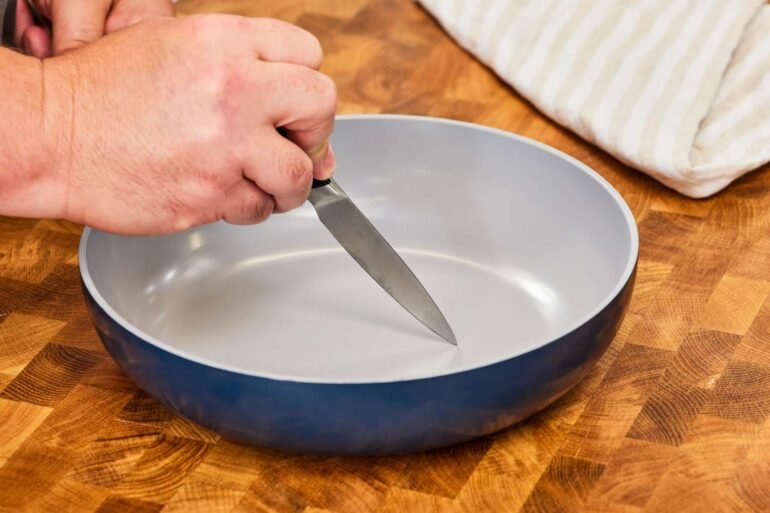
The No.1 thing you can do to preserve your nonstick cookware is to swap out metal utensils for soft silicone.“You might not see the damage at first, but micro-scratches from metal tools add up quickly, “ says Hale. He recommends avoiding all metal tongs, spatulas, and forks in favor of silicone tools, such as this handy 3-piece set from GIR. “If it can scratch stainless steel, it will absolutely destroy nonstick.”
Faay 13.5-Inch Teak Cooking Spoon
Amazon
Like silicone, wood is a standard material for nonstick-safe cooking tools. Amir Alon, CEO of Swiss Diamond, a manufacturer of nonstick cookware, praises wooden utensils.“They’re firm enough to give you control when stirring, flipping, or scraping, yet soft enough not to create micro-abrasions,” he says. This teak spoon was one of our favorites when we tested wooden spoons and offers a smooth finish that won’t mar the coating.
Don’t: Ruin the coating with improper care and cleaning
Do: Use gentle cleaning, storage, and cooking materials
Mr. Siga Microfiber Cleaning Cloths
Amazon
Soft microfiber cloths like these are gentle enough to avoid damaging the nonstick coating but still absorbent to clean and dry easily. Chef Patrick Czerniak, Executive Chef at Square 1682 in Philadelphia, has strict nonstick cleaning rules for his cooks: “Soap, water, and towel, that’s it.”
These microfiber cloths also come in handy once the cleaning is done. “We dry the pans and store them with soft kitchen towels to prevent scratching,” says Chef Armond Joseph, executive chef at Léon 1909 on Shelter Island, New York.
Flairosol Olivia Oil Sprayer
Amazon
Since nonstick cookware doesn’t need much oil, home cooks sometimes reach for aerosol spray oils, but Alon says this could secretly be ruining your cookware.”Many contain additives that leave residue on nonstick surfaces.” Over time, this can build up and leave a sticky film that Alon says is “nearly impossible to remove.” He recommends a reusable oil sprayer like this one, which you can use with your favorite oil and forgo the additives.
Alon also told us that the type of oil matters; he strongly recommends avocado oil, as it can withstand higher temperatures and is less likely to burn and stain.
Boyan Pot and Pan Protectors, Set of 12
Amazon
Chef Sonny Ingui, Executive Chef at Urban Farmer and Assembly Rooftop Lounge in Philadelphia, told us that the most common mistake he sees is in storage. “You don’t want to stack metal pans directly on the surface of the nonstick,” he says. He recommends preventing the bottom of other pans from scratching the nonstick surface by placing a soft barrier, like these protectors, between each pot, pan, and lid.
Geloo Silicone Sponge
Amazon
Even nonstick pans need thorough cleaning. Alon warns that carbon from burnt food can build up inside the coating over time and “take over the surface and the pan,” making it no longer nonstick. But traditional dish scrubbers or the dishwasher can spell disaster for the delicate coating. Hale recommends a gentler sponge like this Geloo Silicone Sponge. He says, “Warm water, mild soap, and a soft sponge — that’s it. Skip the abrasive scrubbers and the dishwasher.”
Nick DeSimone
2025-11-24 13:00:00