
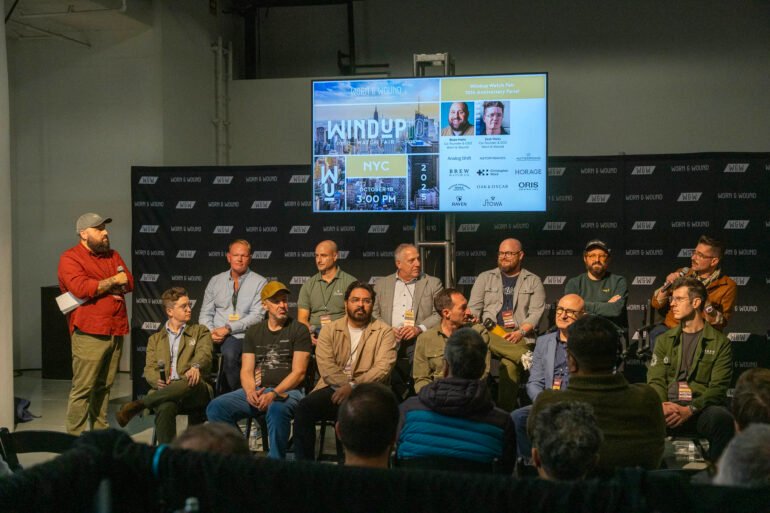
The following conversations have been lightly edited for brevity and clarity.
On looking back 10 years:
Blake:
Hello and welcome to the Wind-Up Watch Fair. I’m Blake, one of the co-founders of Worn & Wound. I’ve been working on this Wind-Up thing for the past 10 years, and it’s incredibly humbling to have all of you here. Thank you for making Wind-Up what it is today.
This is going to be a special conversation. The folks on stage represent many of the brands that were at the very first Wind-Up 10 years ago. They took a chance on an unproven event and helped shape what it’s become. So before we begin, let’s give them a round of applause.
We’re going to talk about what Wind-Up was like 10 years ago, how things have changed, and maybe what the next 10 years will look like. We’ll also take questions from the audience.
Let me introduce everyone on stage. Andy Felsey, CEO of Haraj. Andrew Perez, founder of Astern Banks. Bradley Price, president and creative director of Autodromo. Chase Fancher, founder of Oak & Oscar. Daniel Roy, CEO of Tempest Art and now operator of Stowa. Jonathan Ferrer of Brew. James Lamdin, VP of vintage and pre-owned timepieces at Analog Shift. Mike Pearson, North American brand director of Christopher Ward. Steve Laughlin, founder of Raven Watches. V.J. Geronimo, CEO of Oris Americas. Damir Armstrong, SVP of Dubertime, representing Milagros Suta. And Zach Weiss, co-founder of Worn & Wound.
Zach, let’s start with you. What do you remember from the first Wind-Up?
Zach Weiss:
It was very anxiety-inducing. We were risking it all on this little project. The company was much smaller—just Blake, James, me, and a couple of employees. Not a lot of money. We’d do one big project a year, and this was it. Either it worked or it sank us.
I remember Blake saying if we’d seen the Fyre Festival documentary beforehand, we probably wouldn’t have done it. But it went really well. It was a whirlwind—I barely remember it because it was so crazy. But it was exciting and encouraging. The moment it ended, we started planning the next one.
Blake:
V.J., you were with Oris, easily the most established brand at the first Wind-Up. Why did you decide to participate?
V.J. Geronimo:
We liked what you guys were doing. As one of the few truly independent mainstream brands, we saw ourselves as part of that independent spirit. Your team clearly loved watches, and we wanted to be there and support the community. That’s always been our approach.
Blake:
Was there ever a moment where you thought, “What did we get ourselves into?”
V.J. Geronimo:
Not at all. You guys were always good. You’re a lot less stressed now, but back then it was just excitement—watch excitement. Social media was just starting to take off, and that made a big difference too.
Blake:
Chase, Oak & Oscar is celebrating its 10-year anniversary. Let’s get a round of applause for that. Wind-Up was a risk for you too. What was your experience like?
Chase Fancher:
Honestly, I don’t remember much from way back then. You guys talked to us about it, and it seemed like a fun way to get in front of people and be part of a community. We had just launched our first watch, and it was a great chance to come to New York and connect with people.
Blake:
Was there a moment that weekend where you got feedback that made you feel like you were on the right track?
Chase Fancher:
Definitely. Sitting across from someone at a table, showing them something you’ve poured your heart into, and hearing them say, “I really like this”—that’s special. That first weekend gave us the feeling that we had a chance. It was a great way to connect.
Blake:
James, anything you remember from the first show?
James Lamdin:
I wasn’t an exhibiting brand at the first Wind-Up, but we did sponsor the opening cocktail night, which was very on-brand for us. Going back even further, I hosted the launch of Analog Shift at a hotel bar nearby. Maybe 12 people showed up, and you two and Bradley were among them. We kind of came up together.
My memory of the first Wind-Up was that it was small. How many brands were there?
Blake:
Eighteen.
James Lamdin:
And how many are here today?
Blake:
Between 140 and 150.
James Lamdin:
Let’s give a round of applause to the Worn & Wound and Wind-Up staff. That’s 10X growth in 10 years. Step it up, guys.
Blake:
Thanks. It’s crazy to think about. Zach and I don’t really do anything anymore—it’s all our team. Credit to them.
Let’s talk about turning points. Jonathan, Brew has had a meteoric rise. Was your brand brand-new at the first Wind-Up?
Jonathan Ferrer:
Yes. That same year I was making 3D models and kickstarting the brand, I also did Wind-Up. So this is technically my 10-year anniversary too.
Blake:
Congratulations. Is there a moment that stands out as a turning point?
Jonathan Ferrer:
Years three to five were tough. We weren’t selling much—one watch a week was a win. Things didn’t really kick off until year five or six. It was through meeting other enthusiasts, going to Wind-Up, RedBar, and being around great people. That gave me credibility and validity.
If I’d stayed isolated and hired internally, I wouldn’t have had the same momentum. The watch community is self-filtering—credibility is built by the people around you. We all try to take care of one another and be respectful and loyal. It’s like a family.
Blake:
I remember having coffee with you when you were deciding whether to expand. A year later, you had your second office and a big team.
Jonathan Ferrer:
I told you I was moving out of my apartment into a real office. You said I’d hire more people and double the space. I didn’t believe it—but now we have a 6,000-square-foot complex. You called it from the beginning.
Blake:
Michael Pearson, let’s talk about Christopher Ward. A big part of your success has been the in-house movement work. Can you speak to that?
Michael Pearson:
Mike France sends his regards. He was here the first day, and his absence now shows how much the brand has grown. The in-house movement is interesting—we’ve had our own complication for 11 years. Bel Canto happened around Wind-Up and Worn & Wound. Mike has a talent for launching a watch without launching it—people talk about it before it’s even out.
We sold two years’ worth of Bel Canto stock in two days without having built any. That forced us to grow up fast. People started rediscovering Christopher Ward. When we released the 12X to celebrate 10 years of our movement, nobody knew we’d had it that long. Reddit and forums lit up. But Wind-Up gave us a platform we couldn’t have built ourselves.
That’s why we’re opening a showroom in New York and have a bigger booth here. Movements and momentum matter—but only if the audience understands who you are. That’s what Worn & Wound does better than anyone.
Blake:
If you ever get the chance to meet Mike France, he’s one of the smartest people in the industry—a real visionary.
Anything else from the last 10 years that stands out?
Jonathan Ferrer:
One last thing. This is a luxury industry. We’re in magazines, podcasts, YouTube—but Wind-Up is disarming. V.J. will unpack boxes just like Mike. We all work hard to show beautiful things that aren’t necessary but are deeply loved. Wind-Up shows the best of the people in this industry.
Worn & Wound
2025-11-20 17:00:00