
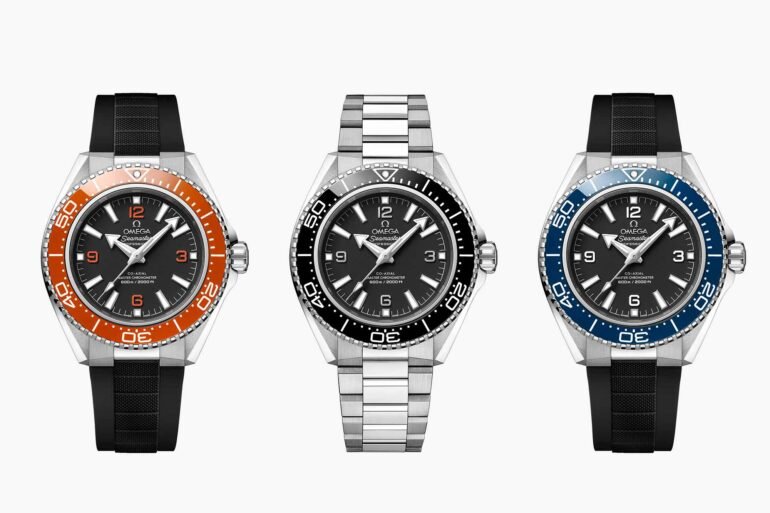
You have to give credit where it’s due: Omega teased a big update to their Seamaster Planet Ocean, and they delivered. The collector community will surely debate every aspect of the new fourth generation Planet Ocean, but this is not an iterative change or a minor tweak. It’s a fairly radical rethinking of the style and aesthetic of Omega’s premier professional diving watch, and when you put an early version of the Planet Ocean next to the new gen, it’s honestly hard to see the connection between them. Not impossible, but by “iconic dive watch” standards, which keeps stalwarts like the Submariner and Fifty Fathoms looking much like the watches that they started life as, this is a different kettle of fish entirely.

We’ll start with the case, because that’s really where the heart of the Planet Ocean’s rethinking really comes into play most clearly. The knock on the Planet Ocean, since its inception, has always been that it’s overly thick. Of course, being that this is a pro diver with double the water resistance of most other consumer oriented divers, a little heft is to be expected. Still, the general proportions of previous Planet Ocean cases were always a cause of consternation among a subset of die hards.
The new watch measures 42mm in diameter and is 13.79mm thick, a significant reduction over the previous Planet Ocean’s 16.1mm case height. The new case also benefits from a flat sapphire crystal and a new titanium caseback, both of which ought to make the watch wear significantly thinner and perhaps a bit lighter.

And then there’s the profile of the case. This is truly the crux of what people will either love or hate about the new Planet Ocean. This is a far more angular design with prominent facets, and bears little resemblance to the familiar Omega twisted lug case designs that have been present in the Speedmaster and Seamaster collections for as long as most can remember. The lug to lug is a modest 47.5mm thanks to sharp, stubby lugs. The new style more closely resembles the format of something like the modern Zenith Defy than any other watch in Omega’s collection at the moment.

The dial is matte black with three configurations available at launch differentiated by (ceramic) bezel and numeral color. There’s an orange bezel (iconic to the Planet Ocean collection) with orange numerals, a blue bezel with white numerals, and a black bezel with rhodium plated numerals.

One of the big and obvious highlights of the new design is that the much maligned helium escape valve has been completely ditched on the fourth generation Planet Ocean. The typical 600 meters of water resistance is still present, however. The bracelet has also been tweaked and resembles the classic “flat link” design of classic Omega sports watches. This is a huge improvement as the bracelets on earlier Planet Oceans were always a little lacking in refinement, in my opinion. That’s honestly true for most Omega sports watches, which makes me think they should just stick to flat links for everything. If someone wanted to run for office on a platform of flatlinks being mandatory on Omega sports watches, they’d probably get my vote. Just saying.

Pricing starts at $8,600 for the black and blue models on a rubber strap (orange is a little more expensive as it’s more difficult to produce the ceramic bezels). The collection tops out at under $10,000, though, which feels significant as watches exceeding that five figure price point from brands that were once considered fairly accessible have become the norm. It’s still an expensive watch, of course, but considering the massive changes made and apparent improvements in wearability, it also seems weirdly fair considering the rest of the market. Naturally we have an Omega movement inside with all the bells and whistles, too (the METAS certified Calibre 8912, which has been featured in previous Planet Oceans).
More on the new Seamaster Planet Ocean collection can be found at the Omega website here.
Zach Kazan
2025-11-19 21:00:00