
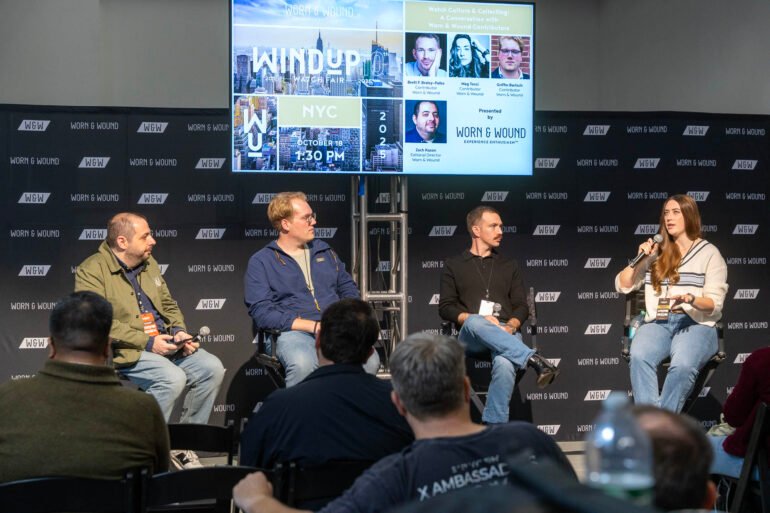
The following conversation has been lightly edited for brevity and clarity.
Zach Kazan:
Hello, everyone. Thanks for coming to the first panel of day two of the Wind-Up Watch Fair in New York City. I’m Zach Kazan, Director of Editorial at Worn & Wound, and I’m really happy to be moderating this panel.
I’ve wanted to do a panel like this for a long time—just getting contributors together to talk about their interest in watches and how working in watch media influences their collecting and view on the hobby. I’m lucky to have three great contributors here who were willing to participate and humor me a bit.
We have Griffin Bartsch, contributor for Worn & Wound. Griffin, thanks for being here.
Griffin Bartsch:
My pleasure. I try not to miss a Wind-Up.
Zach Kazan:
Your attendance has been duly noted and appreciated. We also have Brett Braley-Palko, who’s working the Estabrook booth in the EDC area of the show. Brett, great to have you.
Brett Braley-Palko:
Thank you for having me.
Zach Kazan:
And last but not least, Meg Tocci, based in Colorado and another Worn & Wound contributor. Is this your first Wind-Up?
Meg Tocci:
It is—first Wind-Up and first watch event ever.
Zach Kazan:
Welcome to New York City and thanks for joining us. Let’s start with a bit of background. How did you get into watches and what drew you to the hobby?
Meg Tocci:
I was in grad school about five years ago and had a friend who was really into watches. He kept talking about them, and I didn’t get it at first. I was studying military history, and he pointed out the overlap between watches and military history. I started researching brands like Hamilton and Omega and got hooked. I met Zach at a small event in Fort Collins with Vortic Watch Company, and that led to writing for Worn & Wound. I’ve been doing that for about two years now. Being in Colorado makes it harder to get to Wind-Up, though.
Zach Kazan:
Brett, your path is a little different. Can you talk about how you got into the space?
Brett Braley-Palko:
My background is in menswear. I’ve been writing for magazines in that space for about a decade. I also work full-time at Estabrook, a luxury pen company. I noticed a lot of parallels between the watch and pen industries and wanted to blend that into what Estabrook was doing. That brought us to Wind-Up two years ago—first in San Francisco, then New York. I got to know Kyle over Instagram, which led to writing for Worn & Wound and bridging my freelance and professional worlds.
Zach Kazan:
Griffin, you’ve been involved in the watch hobby for quite some time. What’s your origin story?
Griffin Bartsch:
I’ve been wearing a watch every day since I was about three years old. I got my first digital watch when my younger brother was born, and it became a habit. I was always stealing watches from my parents and grandparents—just obsessed with them as design objects. On my 13th birthday, my godfather gave me a 1940s Hamilton, one of those small gold-capped dress watches that used military movements in civilian cases. That got me into mechanical watches. I started collecting in earnest at 13, not with much budget, but it spiraled from there. I’ve been working in the watch industry since 2022 and writing for Worn & Wound for about two years.
Zach Kazan:
Let’s talk about how writing about watches and thinking about them professionally impacts your personal collecting and enthusiasm. Griffin, since you’ve been in the industry a bit longer, can you speak to that?
Griffin Bartsch:
It really slowed me down. Working in the industry put the brakes on my collecting. You can satisfy your urge for novelty without putting a credit card down, so you become more deliberate. During the pandemic, I had just finished college and had some money, so I was buying watches constantly—every other week. I was buying whiskey and watches and sitting at home with both. But last year, I didn’t spend more than $110 on a watch, and only did that three times. It’s made me much more deliberate, and that’s a gift I hope to carry forward even if I leave the industry.
Zach Kazan:
That tracks with my experience too. Seeing watches for work scratches the itch in unexpected ways. I don’t feel the need to own as much because I’m constantly seeing new things. Meg, how has writing about watches changed your collecting?
Meg Tocci:
I totally relate. Right after grad school, I dove into the hobby—joined RedBar Denver and bought a ton of watches. But once I started writing for Worn & Wound and got hands-on with more watches, it slowed me down. I didn’t feel the need to own everything. It also made me a more critical collector. Now I ask a lot of questions before buying, and I need to try things on first. That wasn’t my pattern before—I used to buy without trying.
Zach Kazan:
Brett, how has writing about watches changed your thinking around collecting?
Brett Braley-Palko:
Coming from a different background, I used to feel self-conscious about gaps in my knowledge. But over time, I’ve become more confident in what I know and what I bring to the table. That’s made me a more discerning writer and critic. Early on, I thought I had to own a Rolex, an Omega, a Hamilton—one of each to fill the gaps. But exposure therapy helped me realize I can appreciate and write about watches without owning them. That’s changed my taste too.
Zach Kazan:
Has that exposure sparked genuine interest in new things?
Brett Braley-Palko:
Absolutely. In fashion and pens, luxury is often seen as the top mark. I used to think owning a Cartier Tank meant I’d made it as a collector. But Worn & Wound exposed me to small makers, microbrands, and brands having a renaissance. I’ve learned to appreciate individual watches and brands for what they are, not just as status symbols. I’m not chasing a $5,000 watch to show off—I value the storytelling and want that reflected in my collection.
Worn & Wound
2025-11-17 17:00:00