
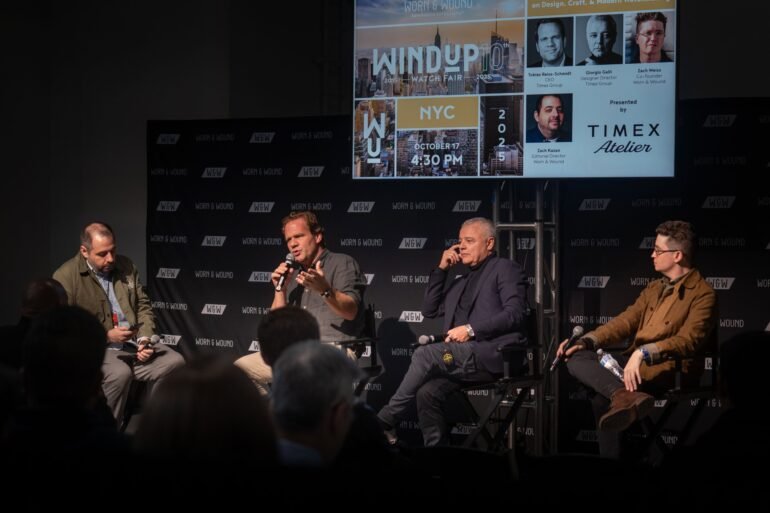
The following conversation has been lightly edited for brevity and clarity.
Zach Kazan:
Hello, everybody. I’m Zach Kazan, Director of Editorial at Worn & Wound. Welcome to our second panel of the day, all about Timex Atelier. I’m thrilled to be joined by Tobias Reiss-Schmidt, CEO of Timex Group; Giorgio Galli, designer at Timex; and Zach Weiss, co-founder of Worn & Wound and a watch designer himself.
Tobias, first question for you. Timex Atelier feels like a defining new chapter for the brand. Can you tell us how this idea took shape and what inspired its creation?
Tobias Reiss-Schmidt:
Thanks for having us. It’s a pleasure to be here and see so much interest in watches—and in Timex. Today, you’ll hear an Italian and a German talk about a Swiss-made watch from the oldest American watch company. That’s pretty exciting.
Seeing a Swiss-made Timex priced at $1,000 or more might be surprising, but for us, it was a natural evolution. Timex is an iconic brand with a storied history. About ten years ago, we began a journey to elevate Timex to its rightful place and honor its heritage.
We started working with Giorgio and leveraged our in-house watchmaking expertise. We began using premium materials, refined finishing, and introduced products at higher price points. Even launching a $150 Timex back then was unexpected. Initial consumer feedback was lukewarm—Reddit and Instagram comments told us to “stay in our lane.” But we doubled down, launched reissues, and did some great collaborations. Enthusiasts started to take note.
Today, we’re well established in the $200–$300 range. Launching a $500 titanium automatic diver doesn’t raise eyebrows anymore. The success of the Giorgio Galli series was a catalyst—it made Atelier a logical next step. It’s also a project Giorgio and I personally want to own, which makes it even more special.
Zach Kazan:
Giorgio, how does designing for Timex Atelier differ from designing a standard Timex?
Giorgio Galli:
Timex has always been one of my favorite brands. I’ve worked across many brands and price points, but Timex was the one I really wanted to work with because I saw its potential.
The philosophy behind Timex Atelier and the standard Timex collection is the same—passion, method, and purpose. Of course, with Timex we’ve had price constraints, though our price range has expanded significantly over the last decade. We’ve done an incredible job creating desirable products within those limits.
With Atelier, we’re working at a different level. We’re trying to contain costs within what we call “luxury the Timex way.” At that price point, the value of the product is much higher. We engineer as much as possible and it took time to reach a point where we were satisfied. Atelier proves that Timex can elevate its philosophy. The challenge is to make a product that’s honest, emotionally resonant, and surprising in terms of what you get for the price.
Zach Kazan:
Zach, you’re deeply plugged into the enthusiast community. What has Timex meant to that community and to Worn & Wound over the years?
Zach Weiss:
Timex is one of those brands you know without knowing where you know it from—it’s part of the cultural lexicon. If you liked watches as a kid, you probably had a Timex. I had Timex Ironman watches and still have some in boxes.
There’s a nostalgic reverence for Timex. I remember when the Marlin 34 hand-wound came out—it was a big moment. At the time, Timex was mostly doing quartz watches, so a small, mechanical, historically accurate piece was a huge deal. It was affordable and hit all the right notes. That moment shifted the lens back onto Timex.
Instead of chasing trends, Timex leaned into its catalog and found pieces people cared about. Now it’s not strange for collectors to have Timexes alongside high-end watches. The Marlin 34mm hand-wound is still one of the five best-selling watches every week when it’s in stock.
Zach Kazan:
Giorgio, what did you learn from designing the S series that you’ve applied to Timex Atelier?
Giorgio Galli:
It’s more than a process—it’s a method of thinking. Designers need a vision and a way to connect the dots to make a product happen. The S2 and Atelier evolved in parallel. The S2 was my project; Atelier was Tobias’s. When he saw what I was doing with the S3, he said, “This is it.”
We tried different routes before landing on what you see now. You need identity when launching a product—something recognizable. The skeleton case and dial ring from the S2 were perfect for Atelier. I designed that case back in 1996, and it’s part of my heritage. We’ve already designed four lines based on these elements, each with its own evolution.
Zach Kazan:
Tobias, I noticed the word “luxury” appears multiple times in the press release. That’s unusual for Timex. Are you concerned about how core Timex customers might react to that positioning?
Tobias Reiss-Schmidt:
It’s a fair question. In a way, we’ve been in the luxury business for 20 years. Nobody needs a watch to tell time anymore—every watch purchase is a luxury, regardless of price.
Internally, we debated using the word “luxury.” We decided to use it, but always qualified it as “luxury the Timex way.” That means design that’s understated and timeless—not loud or flashy. We’re not trying to be exclusive. Accessibility and attainability are core to Timex’s DNA.
Even with Atelier, we’re still trying to create amazing watches that are attainable for as many people as possible. We didn’t expect Atelier to be an overnight commercial success. We’re focused on earning the trust of the watch community by making great watches. The more people see, wear, and handle them, the more the word will spread. We’re in it for the long run—and we love it.
Zach Kazan:
Zach, can you think of other brands that have made a similar move upmarket? Is there a playbook for this kind of transition?
Zach Weiss:
Funny enough, I had trouble thinking of examples in the contemporary space. Seiko and Grand Seiko come to mind, but that goes back to the ’60s. More often, we see luxury brands trying to move downmarket.
Moving up is harder. The key is authenticity. That’s what Timex has done with Atelier. It doesn’t feel like a cash grab—it feels like a watch that costs what it does because of its design. It’s not chasing trends. It has vintage elements but is also contemporary and distinct.
That authenticity makes it more challenging—you have to win people over. But sticking with the theme and pushing it forward shows dedication to the DNA. That’s what works. Attempts by larger Swiss groups to create affordable sub-brands haven’t always succeeded. You can’t just capture a market—you have to create the product first and let people come to you.
Zach Kazan:
Giorgio, in the press release you said these watches are “not nostalgic or futuristic—they are modern.” What does modern mean to you in the context of Timex Atelier?
Giorgio Galli:
For me, modern means timeless and comfortable—not ornamental or futuristic. It’s something solid and simple. The way we design Timex Atelier is to fit into Timex’s DNA and provide a product that’s solid and contemporary. We use design elements that create identity and modernity.
Worn & Wound
2025-11-14 17:00:00